
Summary of ATMEGA3208 POWERED DEVELOPMENT BOARD FOR EMBEDDED APPLICATIONS
Microchip has introduced a compact development board for embedded and IoT projects, centered on the ATmega3208 microcontroller. This 8-bit AVR processor operates at up to 20MHz with 32 KB Flash, 4 KB SRAM, and 256 bytes of EEPROM. The board features an onboard decoupling capacitor, a Unified Program and Debug Interface (UPDI) with USART signals, an LED connected via a 2k2 resistor, a reset button linked to the PF6 pin, and an extra 2-pin header for VCC and GND. It supports digital peripherals like UART, SPI, I2C, and includes a 10-bit ADC with 12 channels.
Parts used in the ATmega3208 Development Board:
- ATmega3208 microcontroller
- Onboard decoupling capacitor
- Unified Program and Debug Interface (UPDI)
- LED connected to PF5 pin
- 2k2 current-limiting resistor
- Onboard button connected to PF6 RESET pin
- Extra 2-pin header for VCC and GND
- Digital communication peripherals (UART, SPI, I2C)
- 10-bit 12-channel analog to digital converter
Microchip has recently launched a simple yet powerful development board aimed at embedded and IoT applications. As the name suggests, the development board is powered by the ATemga3208 from Microchip. The microcontroller features an 8-bit AVR processor clocked at up to 20MHz and comes with up to 32 KB Flash, 4 KB SRAM and 256 bytes of EEPROM. The AVR family of processors is famous for their performance, power efficiency, and design flexibility and are widely used in embedded systems applications.
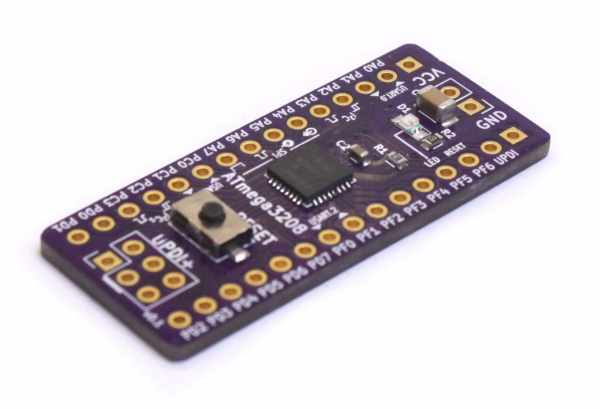
The development board has an onboard decoupling capacitor, which suppresses high-frequency noise in the power supply signals, and Unified Program and Debug Interface, which is an interface for external programming and on-chip debugging of a device. This programming header includes the USART.0 TX and RX signals in “UPDI+” that is in a 2×3 o.1″ layout matrix at the lower end of the board.
The LED is attached to the PF5 pin that can be seen from the figure and is connected through a 2k2 current-limiting resistor to ensure that the amount of current does not exceed the limit that the circuit can handle. Similarly, the onboard button is connected to the PF6 RESET pin via a resistor, while the PF6 pin is the default pin for the GPIO mode.
Additionally, you can see an extra 2-pin header that has a VCC and GND pin for additional connections that are placed above the onboard LED. Coming back to the heart of this development board that is ATmega3208 chip has a CPU Speed of 20 MIPS/DMIPS. The chips also have digital communication peripherals, including 3x-UART, 1x-SPI, and 1x-I2C, along with a 10-bit 12 channel analog to digital converter input.
Read more: ATMEGA3208 POWERED DEVELOPMENT BOARD FOR EMBEDDED APPLICATIONS
- What is the clock speed of the ATmega3208 microcontroller?
The microcontroller features an 8-bit AVR processor clocked at up to 20MHz. - How much Flash memory does the ATmega3208 have?
The chip comes with up to 32 KB of Flash memory. - What interface is used for external programming and debugging on this board?
The board uses the Unified Program and Debug Interface (UPDI). - Which pin is the LED attached to on the development board?
The LED is attached to the PF5 pin. - What is the purpose of the 2k2 resistor connected to the LED?
The resistor ensures that the amount of current does not exceed the limit the circuit can handle. - Which pin serves as the default GPIO mode for the reset button?
The PF6 pin is the default pin for the GPIO mode and is connected to the reset button. - What digital communication peripherals are included with the ATmega3208?
The chip includes 3x-UART, 1x-SPI, and 1x-I2C peripherals. - Does the board support analog-to-digital conversion?
Yes, it includes a 10-bit 12 channel analog to digital converter input.
