
Summary of CLOCK OSCILLATOR IN MINI PACKAGE – CLOCK IN A CAN
The ClockInACan project by Schlae addresses clock signal noise in microcontroller prototyping caused by parasitic capacitance in breadboards. It offers a breadboard-friendly PCB alternative to legacy full/half-can oscillators, which are becoming obsolete. This compact circuit accepts user-provided crystals and uses solder jumpers for frequency division, ensuring stable clock signals without requiring complex oscillator components.
Parts used in the ClockInACan:
- Oscillator IC (NJU6311RB2-TE1)
- 0.1uF capacitor
- Optional load capacitors
- Divider jumpers
- 40 ohm solder jumper
- Crystal
- PCB pins
Most microcontroller implementation these days, use the traditional capacitor + crystal approach to generate their clock, this approach sometimes, however, lead to problems, especially when used in prototyping situations with a breadboard, jumper wires, etc., all of which have an (unknown) inherent capacitance that could lead to the clean 8 or 16MHz signal we desire, becoming noisy.
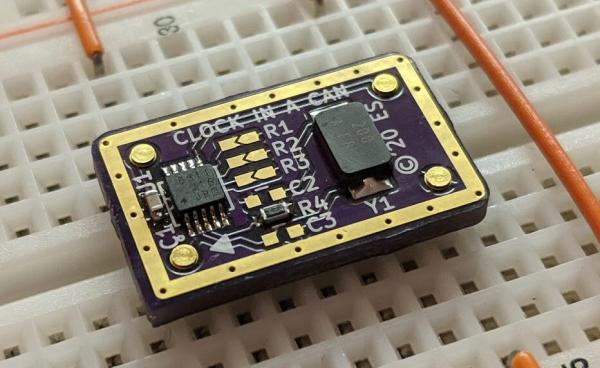
A (now regarded as old school) approach to eliminating this is to use a full-can or half-can oscillator which usually comprises the crystal and other elements of the oscillator circuits. However, with advances in microcontroller technologies relegating the need for these oscillators, manufacturers are discontinuing legacy product lines and it’s becoming harder and harder to find through-hole versions of the full/half can packages. To give the OG’s another option, Schlae recently developed a breadboard friendly PCB version of the full-can and half-can oscillator package called ClockInACan.
According to Schlae, the ClockInACan is a small circuit board that comes in the form factor of the full-can and half-can oscillators and performs the same exact function as the oscillators.
Some Features Of The Oscillators Include:
- Wide +2V to +5.5V power supply range
- Logic-level enable pin with internal pullup
- CMOS-compatible output
- Selectable divide ratio of 1, 1/2, 1/4, 1/8, 1/16, and 1/32
- Crystal footprint fits through-hole and many surface mount crystals
- Pins are breadboard compatible, and also fit in DIP socke
The oscillators are super easy to use, and all you have to do is provide your own crystal of the desired frequency or a multiple of the desired frequency, and set the three solder jumpers to select the divide ratio.
To make the oscillatorseasy to replicate, it is designed with readily available components. The basic bill of materials is provided in the table below and all components can be found on Mouser by searching with the Mouser Part Number.
| Q | Designator | Description | Mouser Part Number |
|---|---|---|---|
| 1 | U1 | Oscillator IC | 513-NJU6311RB2-TE1 |
| 1 | C1 | 0.1uF capacitor | 603-CC603KRX7R9BB104 |
| 0 | C2, C3 | Optional load caps | |
| 0 | R1, R2, R3 | Divider jumpers | |
| 1 | R4 | 0 ohm solder jumper | |
| 1 | Y1 | Crystal | |
| 4 | J1, J7, J8, J14 | PCB pins | 575-0542000150000 |
Read more: CLOCK OSCILLATOR IN MINI PACKAGE – CLOCK IN A CAN
-
What problem does the ClockInACan solve?
It eliminates clock signal noise caused by inherent capacitance in breadboards and jumper wires during microcontroller prototyping. -
Can I use surface mount crystals with this board?
Yes, the crystal footprint fits both through-hole and many surface mount crystals. -
How do I select the divide ratio on the oscillator?
You must set the three solder jumpers to select from ratios of 1, 1/2, 1/4, 1/8, 1/16, or 1/32. -
What is the power supply range for the device?
The oscillator supports a wide power supply range from +2V to +5.5V. -
Is the output compatible with standard logic levels?
Yes, it features a CMOS-compatible output and a logic-level enable pin with an internal pullup. -
Where can I purchase the required components?
All components listed in the bill of materials can be found on Mouser using their specific part numbers. -
Does the ClockInACan fit in a DIP socket?
Yes, the pins are breadboard compatible and also fit in DIP sockets. -
Who developed the ClockInACan design?
The design was recently developed by Schlae as a breadboard friendly option.
