
Summary of CSI Premier 75W and Hakko 936 Solder Station Teardowns
The CSI Premier 75W soldering station features high-quality construction and manufacturing, though it uses lower-grade JWCO electrolytic capacitors. The design includes several cost-saving mysteries, such as an unnecessary external 8 MHz crystal instead of an internal oscillator, an external EEPROM despite the microcontroller's flash memory, an unused ICSP plug header, and an optical isolator for a triac that can be controlled directly by GPIO.
Parts used in the CSI Premier 75W Soldering Station:
- Soldering stations
- JWCO electrolytic capacitors
- Microcontroller (S3F8S19)
- External crystal (8 MHz)
- External EEPROM
- ICSP plug header
- Optical isolator IC
- Triacs (600E)
Summary:
The workmanship found in both soldering stations showed quality construction, soldering and manufacturing. I did not see any sloppy messy joints or poor workmanship. Most items were quality parts with the exception of the JWCO electrolytic capacitors in the CSI 75W.
For a device that was trying to save cost at any expense I found it strange that they did not use the internal oscillator in the microcontroller. I don’t see the point of having an external crystal running at 8 MHz when you could use an internal 8 MHz oscillator in such a design. If you’re not doing data communication and other high-speed tasks then an internal oscillator is more than accurate enough timekeeper. Maybe they needed this because they knew they were going to have to program and calibrate the microcontroller after production and the accurate timekeeping was necessary for the programming communications.
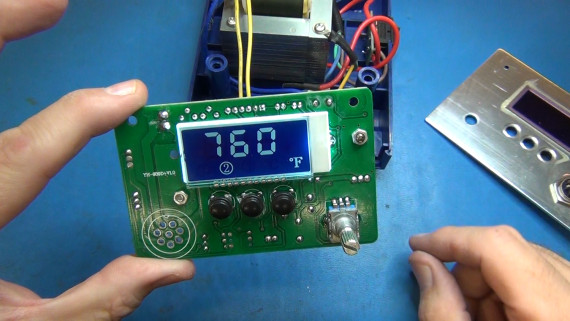
Also, the S3F8S19 microcontroller they used was able to store data in a small section of flash so why they needed or felt they needed an external EEPROM is a mystery to me. And when you’re trying to save costs why would you include an ICSP plug header or any other such unused connector when simple pogo pin pads would be just fine for after production code updates or calibrations.
One last mystery was why they used an optical isolator IC for controlling the triac when these 600E triacs are designed to be controlled directly from a GPIO of any microcontroller. I just don’t see what the opto isolator is adding to this design that is necessary.
CSI Premier 75W Soldering Station Review
ISO-TIP solder iron review
Dri-Wick Desoldering Braid with Thumb Wheel Dispenser
G Chemicals 8341 No Clean Flux Paste
Datasheet (PDF) for the microcontroller in the CSI premier 75W soldering station – S3F8S19
For more detail: CSI Premier 75W and Hakko 936 Solder Station Teardowns
- What quality issues were found in the soldering stations?
The workmanship showed quality construction with no sloppy joints, except for the use of JWCO electrolytic capacitors which were not considered quality parts. - Why was an external crystal used instead of an internal oscillator?
The article suggests this may have been necessary for programming communications requiring accurate timekeeping after production. - Did the microcontroller require an external EEPROM?
No, the S3F8S19 microcontroller could store data in its own small section of flash, making the external EEPROM unnecessary. - Why include an ICSP plug header if pogo pins would suffice?
The author finds it mysterious why an unused connector was included when simple pogo pin pads would be sufficient for updates. - Is the optical isolator necessary for controlling the triac?
No, the 600E triacs are designed to be controlled directly from a GPIO of any microcontroller without an isolator. - What specific microcontroller is used in the CSI Premier 75W?
The device uses the S3F8S19 microcontroller. - Are there other teardowns mentioned for comparison?
Yes, the article references teardowns for the Hakko 936 Solder Station alongside the CSI Premier 75W. - Does the design prioritize cost saving?
Yes, the article notes the device appears to try saving cost at any expense, leading to questionable component choices.
