
Summary of Non-Contact Body Temperature Meter
This article describes a low-cost, non-contact digital thermometer using an IR sensor to measure body temperature via thermal radiation. The system employs a microcontroller that processes data from the sensor over an I2C bus and displays results on a four-digit seven-segment display. It is powered by four coin batteries regulated to 5V DC, requiring careful software calibration for accuracy.
Parts used in the Non-Contact Body Temperature Meter:
- Microcontroller
- Four digit seven segment display
- Infrared (IR) temperature sensor
- I2C bus interface
- Five volt DC power supply
- Four 20mm coin shape batteries
- 120591-1 TE Connectivity battery holder
- Low-dropout voltage regulator
Summary
One of the most commonly used medical instruments nowadays is the thermometer. The thermometer is used to monitor or measure the body temperature of a sick person. The idea of creating a thermometer started from a device called thermoscope, a thermometer without a scale. Several inventors developed it until Sir Thomas Allbutt invented the first practical 6-inch medical thermometer able to sense a body temperature in five minutes. The development of the thermometer did not stop there and today, digital thermometer exists which is faster and very accurate.

This reference design is an example of a low cost non-contact digital thermometer. It only uses a microcontroller, a four digit seven segment display and an infrared (IR) temperature sensor. The concept of this design is to make the IR sensor measure the temperature of the thermal radiation emitted by the body being measured. The data acquired by the sensor will be sent to the microcontroller through the I2C bus. The microcontroller will analyze the data and then shows the body temperature on the four-digit seven-segment display.
The circuit of this reference design uses few components only and is very easy to understand. However, to make the circuit function accurately, software calibration must be implemented carefully. The whole circuit is powered by a 5V DC power supply regulated from the four 20mm coin shape batteries contained in a 120591-1 TE Connectivity battery holder. The batteries are connected in series-parallel connection to produce a 6V 480mAh source of power. With the help of a low-dropout voltage regulator, the 6V is regulated to a 5V DC supply.
For more detail: Non-Contact Body Temperature Meter
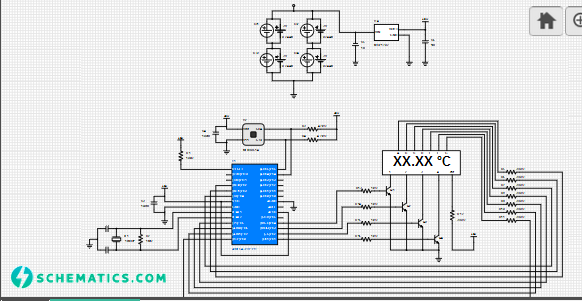
This reference design is an example of a low cost non-contact digital thermometer. It only uses a microcontroller, a four digit seven segment display and an infrared (IR) temperature sensor. The concept of this design is to make the IR sensor measure the temperature of the thermal radiation emitted by the body being measured. The data acquired by the sensor will be sent to the microcontroller through the I2C bus. The microcontroller will analyze the data and then shows the body temperature on the four-digit seven-segment display.
The circuit of this reference design uses few components only and is very easy to understand. However, to make the circuit function accurately, software calibration must be implemented carefully. The whole circuit is powered by a 5V DC power supply regulated from the four 20mm coin shape batteries contained in a 120591-1 TE Connectivity battery holder. The batteries are connected in series-parallel connection to produce a 6V 480mAh source of power. With the help of a low-dropout voltage regulator, the 6V is regulated to a 5V DC supply.
For more detail: Non-Contact Body Temperature Meter
- How does the device measure body temperature?
The IR sensor measures the thermal radiation emitted by the body being measured. - What type of display is used in this design?
A four-digit seven-segment display shows the analyzed body temperature. - How is data transmitted between the sensor and microcontroller?
Data is sent through the I2C bus. - What powers the circuit?
The circuit uses a 5V DC power supply regulated from four 20mm coin shape batteries. - How are the batteries connected to generate power?
The batteries are connected in series-parallel to produce a 6V 480mAh source. - Why is software calibration necessary?
Software calibration must be implemented carefully to make the circuit function accurately. - What component regulates the voltage from 6V to 5V?
A low-dropout voltage regulator converts the 6V source to a 5V DC supply.
