
Summary of Arduino Web Enabled RGB lighting
This article describes building a custom web-enabled RGB LED controller to replace expensive commercial drivers. The author, motivated by high component costs and the desire to test a home automation server project, created an Arduino-based solution accessible via HTTP. While specific parts are not listed in detail, the project utilizes an Arduino microcontroller, MOSFETs or transistors for driving LEDs, and requires a web interface for control.
Parts used in the Arduino Web Enabled RGB lighting:
- Arduino microcontroller
- MOSFETs or transistors
- LED strips
- Web interface components
- Home automation server
I just happened to see some large strips of LED lighting when I was picking up some parts at Maplin which were on sale (if I remember correct they were around £12 per approx. 2m strip) however the controller/driver was still around £40, so I thought I would just build a better one myself.
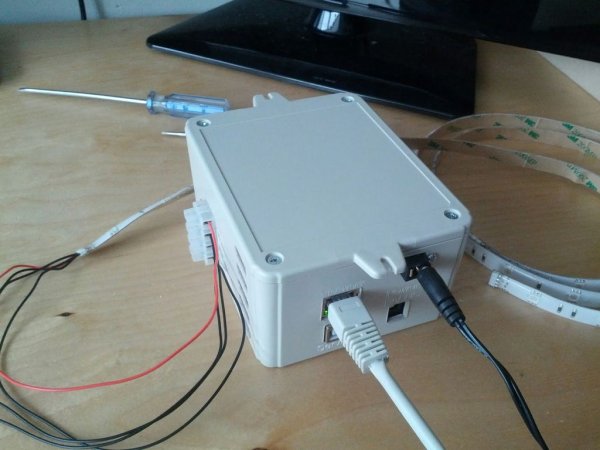
I wanted it to be a web enabled controller as there are a lot of cool things that can be done with a device once it is accessible over HTTP, and I am working on a home automation server project so it would be good to have some devices which I can test this with.
Anyway, let’s get started, here is a basic parts list, some of the components may change depending on the nature of your lighting installation (i.e. if you are driving more LEDs you may need higher power transistors, etc.
For more detail: Arduino Web Enabled RGB lighting
- Why did the author build their own controller?
The commercial driver was too expensive at around £40 compared to cheaper LED strips. - What is the main advantage of this web enabled controller?
It allows access over HTTP to perform cool things with the device. - What project is the author working on that uses this device?
The author is working on a home automation server project to test devices. - How much did the LED strips cost at Maplin?
The LED strips were around £12 per approximately 2m strip. - Can the power requirements change based on the installation?
Yes, higher power transistors may be needed if driving more LEDs. - What type of lighting does this project support?
The project supports RGB lighting controlled via an Arduino. - Is the parts list fixed for all installations?
No, some components may change depending on the nature of the lighting installation. - What protocol is used to make the controller accessible?
The controller is accessible over HTTP.
