
Summary of ATmega USB Programmer
This article provides a DIY guide for building a USBasp in-circuit programmer for Atmel AVR microcontrollers (ATmega8 or ATmega48). It includes schematics, PCB layouts, firmware hex files, Windows drivers, and a GUI for burning hex files. The programmer supports Linux, macOS, and Windows, offers up to 5 kB/s programming speed, and includes an SCK option for low-clock targets.
Parts used in the ATmega Programmer (USB):
- ATmega8 or ATmega48 microcontroller
- USB interface connector
- Crystal or resonator (as per schematic)
- Reset circuit components (reset button, resistor, capacitor)
- Voltage regulator (if required for target power)
- Decoupling capacitors
- Programming header (ISP 6-pin or 10-pin)
- LED indicator(s) and current-limiting resistors
- PCB (board for assembly)
- Miscellaneous passive components (resistors, capacitors)
USB programmer for Atmel AVR microcontrollers including ATmega series
This is USBasp in circuit Programmer for programming Atmel AVR Series using USB interface. It is a complete DIY guide to build this programmer project. Core IC used in development of this programmer is ATmega8 or you can also use ATmega48.
No special components are required to build this programmer.
Major Features
– USB programmer Works under multiple platforms. Linux, Mac OS X and Home windows are examined.
– USB programmer requires No special remotes or smd components are essential.
– USB programmer’s Programming speed can be 5kB per sec.
– SCK choice to support targets with low clock speed (< 1,5MHz).
– Planned: serial interface to target (e.g. for debugging)
AVR ATmega Programmer(USB) Schematic:
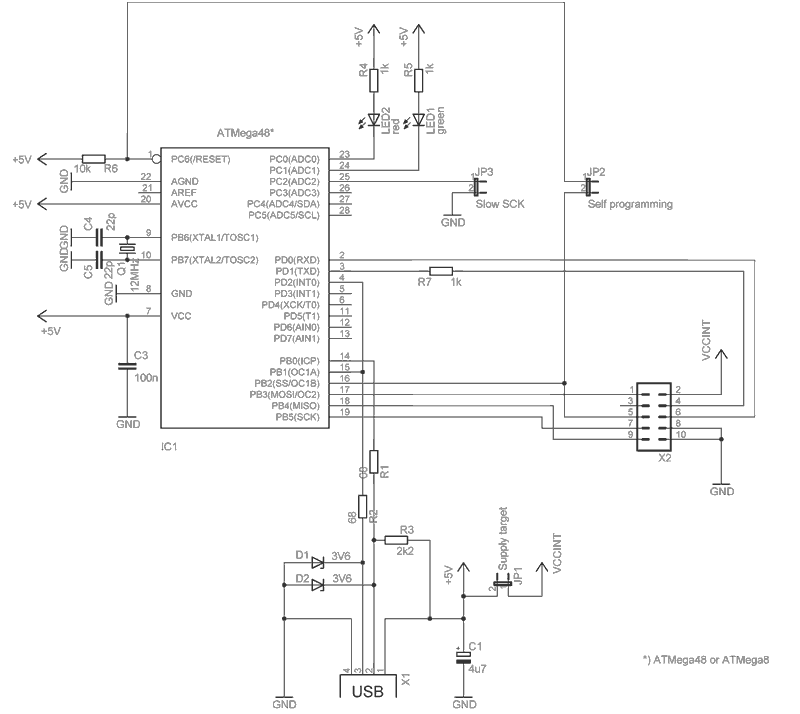
ATmega Programmer (USB) PCB:
ATmega Programmer (USB) PCB Component Side Layout:
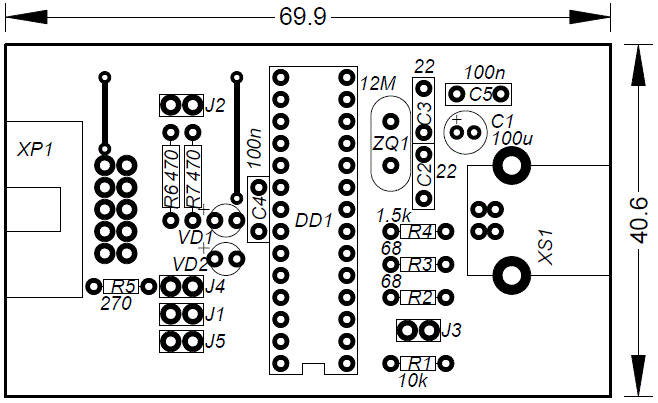
ATmega Programmer (USB) PCB Top Side:
Click to download ATmega Programmer (USB) PCB Top Side in PDF format
ATmega Programmer (USB) Schematic for PCB Assembly:
Click to download ATmega Programmer (USB) Schematic for PCB Assembly PDF format
Final Product Using above PCB will be Look Like:

AVR ATmega Programmer(USB) Firmware Hex Files:
- Download AVR ATmega Programmer(USB) Firmware Hex File for ATmega8
- Download AVR ATmega Programmer(USB) Firmware Hex File for ATmega48
ATmega Programmer (USB) Windows Drivers:
ATmega Programmer (USB) Software GUI:
Engineers also use following terms to find this article:
atmega-series-usb-programmer, atmega-usb-reader, atmega162-usb, atmega32-usb, atmega32-usb-driver, atmega48-usb, avr-usb-programmerpcb, usbasp-usb-programmer-for-atmel-avr-controllers-pcb-assembly
- Which microcontrollers can be used as the core IC for this USB programmer?
The core IC used is ATmega8 or you can also use ATmega48. - Which operating systems are supported by this USB programmer?
It works under Linux, Mac OS X and Windows as examined in the article. - Are special SMD components required to build this programmer?
No special remotes or smd components are essential. - What is the programming speed of the USB programmer?
Programming speed can be 5kB per sec. - Is there support for programming targets with low clock speeds?
Yes, there is an SCK option to support targets with low clock speed (< 1,5MHz). - Are firmware files available for download for this project?
Yes, firmware hex files are available for ATmega8 and ATmega48. - Does the article provide PCB layouts and schematics for assembly?
Yes, it provides schematics, PCB top side and component side layouts and a schematic for PCB assembly. - Are Windows drivers provided for the programmer?
Yes, ATmega Programmer (USB) Windows drivers are available for download. - Is there software to burn hex files to targets?
Yes, a software GUI to burn hex files is available for download. - Is a serial interface to the target planned for this project?
A serial interface to the target (e.g. for debugging) is planned.
