
Summary of AVR Atmega8 Microcontroller Architecture & Its Applications
### Summary This article introduces the AVR Atmega8 microcontroller, an 8-bit MCU by Atmel featuring Harvard architecture and RISC processing. It details the chip's components, including 8KB Flash memory, 1K SRAM, and a 10-bit ADC. The text explains its 28-pin configuration across three I/O ports, internal timers, SPI, USART, and TWI interfaces. Finally, it lists diverse applications such as LED matrices, fire alarms, motor control, and sensor interfacing.
Parts used in the AVR Atmega8 Microcontroller Projects:
- AVR Atmega8 Microcontroller
- LED Matrix
- Arduino Uno
- Optocoupler
- LDR (Light Dependent Resistor)
- Ammeter Circuit Components
- Anti-Theft Alarm System Sensors
- Joystick Module
- Flex Sensor
- Stepper Motor
The abbreviation of AVR Microcontroller is “Advanced Virtual RISC” and MCU is the short term of the Microcontroller. A Microcontroller is a tiny computer on a single chip and it is also termed as a control device. Similar to a computer, the Microcontroller is made with a variety of peripherals like input & output units, memory, Timers, serial data communications, programmable. The applications of Microcontroller involve embedded applications & automatically controlled devices like medical devices, remote control devices, control systems, office machines, power tools, electronic devices, etc. There are various kinds of Microcontrollers available in the market like 8051, PIC and AVR microcontroller. This article gives brief information about AVR Atmega8 microcontroller.
What is an AVR Atmega8 Microcontroller?
In 1996, AVR Microcontroller was produced by the “Atmel Corporation”. The Microcontroller includes the Harvard architecture that works rapidly with the RISC. The features of this Microcontroller include different features compared with other like sleep modes-6, inbuilt ADC (analog to digital converter), internal oscillator and serial data communication, performs the instructions in a single execution cycle. These Microcontrollers were very fast and they utilize low power to work in different power saving modes. There are different configurations of AVR microcontrollers are available to perform various operations like 8-bit, 16-bit, and 32-bit. Please refer the below link for; Types of AVR Microcontroller
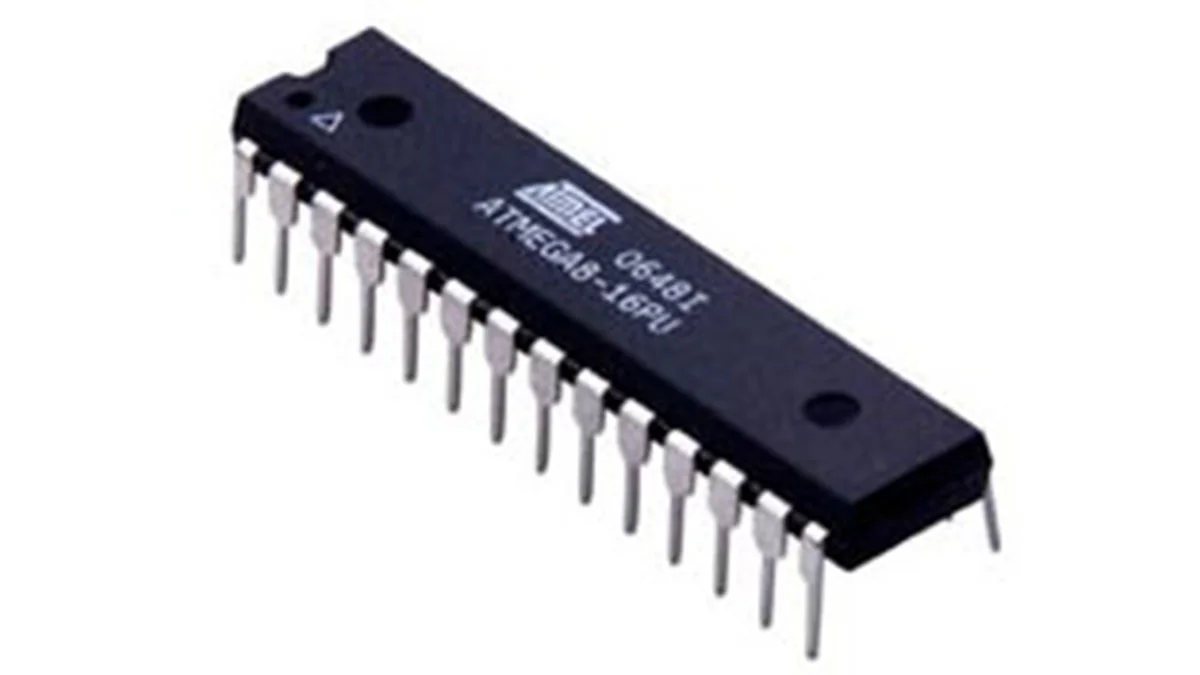
AVR microcontrollers are available in three different categories such as TinyAVR, MegaAVR, and XmegaAVR
- The Tiny AVR microcontroller is very small in size and used in many simple applications
- Mega AVR microcontroller is very famous due to a large number of integrated components, good memory, and used in modern to multiple applications
- The Xmega AVR microcontroller is applied in difficult applications, which require high speed and huge program memory.
Atmega8 Microcontroller Pin Description
The main feature of Atmega8 Microcontroller is that all the pins of the Microcontroller support two signals except 5-pins. The Atmega8 microcontroller consists of 28 pins where pins 9,10,14,15,16,17,18,19 are used for port B, Pins 23,24,25,26,27,28 and 1 are used for port C and pins 2,3,4,5,6,11,12 are used for port D.
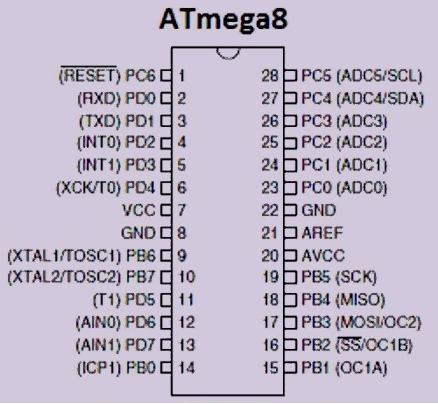
- Pin -1 is the RST (Reset) pin and applying a low-level signal for a time longer than the minimum pulse length will produce a RESET.
- Pin-2 and pin-3 are used in USART for serial communication
- Pin-4 and pin-5 are used as an external interrupt. One of them will activate when an interrupt flag bit of the status register is set and the other will activate as long as the intrude condition succeeds.
- Pin-9 & pin-10 are used as a timer counters oscillators as well as an external oscillator where the crystal is associated directly with the two pins. Pin-10 is used for low-frequency crystal oscillator or crystal oscillator. If the internal adjusted RC oscillator is used as the CLK source & the asynchronous timer is allowed, these pins can be utilized as a timer oscillator pin.
- Pin-19 is used as a Master CLK o/p, slave CLK i/p for the SPI-channel.
- Pin-18 is used as Master CLK i/p, slave CLK o/p.
- Pin-17 is used as Master data o/p, slave data i/p for the SPI-channel. It is used as an i/p when empowered by a slave & is bidirectional when allowed by the master. This pin can also be utilized as an o/p compare with match o/p, which helps as an external o/p for the timer/counter.
- Pin-16 is used as a slave choice i/p. It can also be used as a timer or counter1 comparatively by arranging the PB2-pin as an o/p.
- Pin-15 can be used as an external o/p of the timer or counter compare match A.
- Pin-23 to Pins28 have used for ADC (digital value of analog input) channels. Pin-27 can also be used as a serial interface CLK & pin-28 can be used as a serial interface data
- Pin-12 and pin-13 are used as an Analog Comparator i/ps.
- Pin-6 and pin-11 are used as timer/counter sources.
Atmega8 AVR Microcontroller Architecture
The Atmega AVR Microcontroller architecture includes the following blocks.
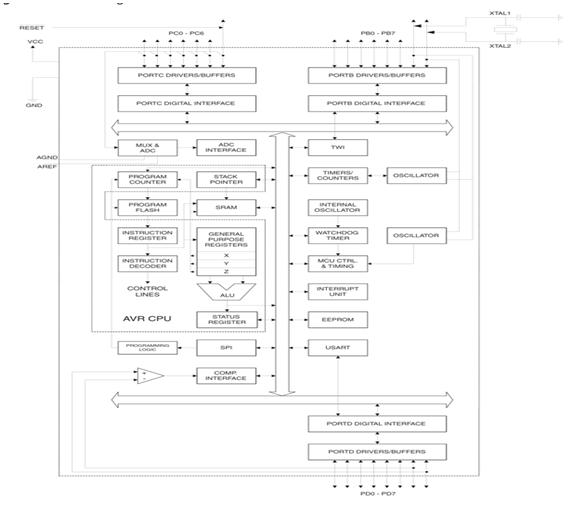
Memory: It has 1Kbyte Internal SRAM, 8 Kb of Flash program memory and 512 Bytes of EEPROM.
I/O Ports: It has three ports, namely port-B, port-C, and port-D and 23 I/O line can be attained from these ports.
Interrupts: The two Exterior Interrupt sources are located at port D. Nineteen dissimilar interrupts vectors supporting nineteen events produced by interior peripherals.
Timer/Counter: There are 3-Internal Timers are accessible, 8 bit-2, 16 bit-1, presenting numerous operating modes & supporting internal/external clocking.
Serial Peripheral Interface (SPI): ATmega8 microcontroller holds three integrated communication devices. One of them is an SPI, 4-pins are allocated to the Microcontroller to implement this system of communication.
USART: USART is one of the most powerful communication solutions. Microcontroller ATmega8 supports both synchronous & asynchronous data transmission schemes. It has three pins allocated for that. In many communication projects, the USART module is widely used for communication with PC-Microcontroller.
Two-Wire Interface (TWI): TWI is another communication device that is present in the ATmega8 microcontroller. It permits designers to set up a communication b/n two devices using two wires along with a mutual GND connection, As the o/p of the TWI is made using open collector o/ps, therefore external pull-up resistors are compulsory to make the circuit.
Analog Comparator: This module is incorporated in the integrated circuit that offers a contrast facility between two voltages linked to the two inputs of the comparator through External pins associated with the Microcontroller.
ADC: Inbuilt ADC (analog to digital converter) can alter an analog i/p signal into digital data of the 10-bit resolution. For a maximum of the low-end application, this much resolution is sufficient.
Atmega8 Microcontroller Applications
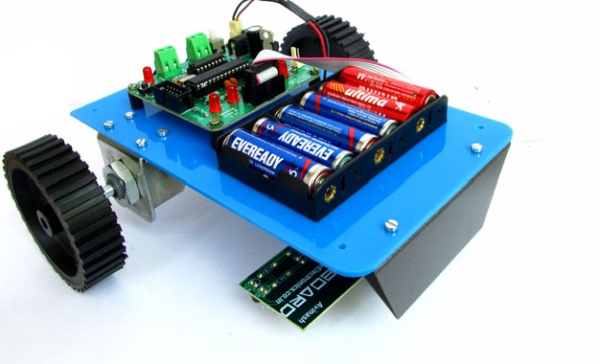
The Atmega8 microcontroller is used to build various electrical and electronic projects. Some of the AVR atmega8 Microcontroller projects are listed below.
- AVR Microcontroller based LED Matrix Interfacing
- UART communication between Arduino Uno and ATmega8
- Interfacing of Optocoupler with ATmega8 Microcontroller
- AVR Microcontroller based Fire Alarm System
- Measurement of Light Intensity using AVR Microcontroller and LDR
- AVR Microcontroller based 100mA Ammeter
- ATmega8 Microcontroller based Anti-Theft Alarm System
- AVR Microcontroller based Interfacing of Joystick
- AVR Microcontroller based Interfacing of Flex Sensor
- Stepper Motor Control using AVR Microcontroller
Therefore, this is all about the Atmega8 microcontroller tutorial which includes, what is an Atmega8 microcontroller, architecture, pin configuration, and its applications. We hope that you have got a better understanding of this concept. Furthermore, any doubts regarding this concept or to implement AVR microcontroller based projects, please give your feedback by commenting in the comment section below. What is the difference between Atmega8 and Atmega 32 microcontroller?
Source: AVR Atmega8 Microcontroller Architecture & Its Applications
- What is the full form of AVR?
The abbreviation stands for Advanced Virtual RISC. - Who produced the AVR Microcontroller in 1996?
The Atmel Corporation produced the AVR Microcontroller in 1996. - How many pins does the Atmega8 microcontroller consist of?
The Atmega8 microcontroller consists of 28 pins. - Does the Atmega8 support both synchronous and asynchronous data transmission?
Yes, the ATmega8 supports both synchronous and asynchronous data transmission schemes via its USART module. - What resolution does the built-in ADC provide?
The inbuilt ADC can alter an analog input signal into digital data with a 10-bit resolution. - Are external pull-up resistors required for the TWI interface?
Yes, external pull-up resistors are compulsory because the output of the TWI is made using open collector outputs. - Can the Atmega8 be used to control a stepper motor?
Yes, one of the listed applications is Stepper Motor Control using the AVR Microcontroller. - How many internal timers are accessible in the Atmega8?
There are 3 internal timers accessible, consisting of two 8-bit timers and one 16-bit timer.
