
Summary of Digital dimmer using Microcontroller atmega8
This project controls lamp brightness or fan speed using an ATmega8 microcontroller, a zero crossing detector, and a TRIAC load driver; it detects AC zero crossings via an optocoupler, interrupts the MCU at each crossing, and fires the TRIAC (BT136) at user-selected delays adjusted with two pushbuttons to vary output power. The TRIAC can handle up to 5 A and an optocoupler may be used for TRIAC gate isolation.
Parts used in the Digital dimmer using atmega8:
- Zero crossing detector circuit
- Optocoupler for zero crossing isolation
- Microcontroller ATmega8
- Two push buttons (increase and decrease)
- TRIAC BT136 (load driver)
- Optional optocoupler for TRIAC firing side
- AC mains supply and load (lamp or fan)
This project is used to control the brightness of the lamp or can be used to control the speed of the fan.
The system consists of 3 block they are
- Zero crossing detector
- Microcontroller (Atmega8)
- Load Driver (BT136)
 As the name implies the zero crossing detector generates pulses for every zero crossing of the input AC signal. This pulses are fed to the microcontroller interrupt pin through the opto coupler. The opto coupler is used for the isolation of the high voltage AC to the low voltage DC supply at the microcontroller side.
 - The microcontroller was interrupted for every zero crossing which switch on the TRIACas per the user need. The user can increase or decrease the output voltage with help of 2 push buttons.The TRIAC BT136 is used to drive the load. It can withstand a maximum load of 5A. You can also use an opto coupler at the TRIAC firing side.


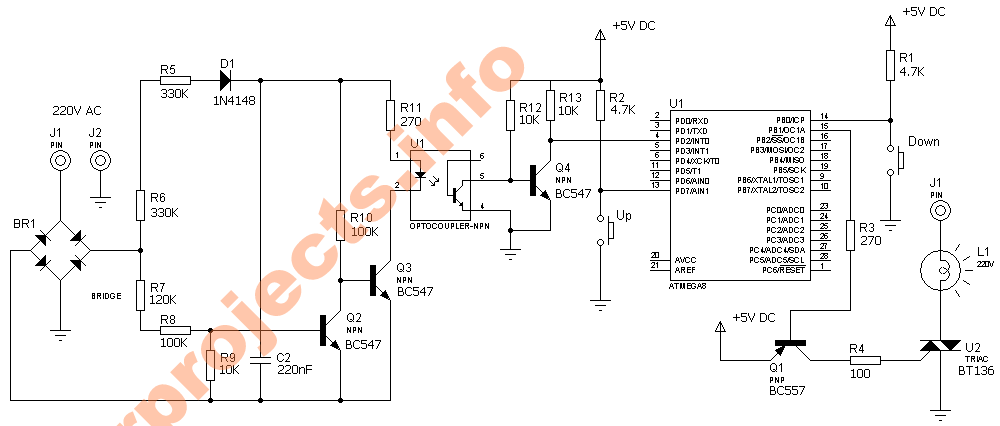
Fore more Detail: Digital dimmer using atmega8
- What is the purpose of the zero crossing detector?
The zero crossing detector generates pulses for every zero crossing of the input AC signal which are fed to the microcontroller interrupt pin. - How is the microcontroller isolated from high voltage AC?
An optocoupler is used to isolate the high voltage AC from the low voltage DC side of the microcontroller. - How does the system vary lamp brightness or fan speed?
The microcontroller interrupts at each zero crossing and switches on the TRIAC at user-selected delays using two push buttons to increase or decrease output voltage. - Which microcontroller is used in the project?
The project uses an ATmega8 microcontroller. - What TRIAC is used to drive the load?
The TRIAC used is BT136. - What is the maximum load the TRIAC BT136 can handle?
BT136 can withstand a maximum load of 5 A. - Can an optocoupler be used at the TRIAC firing side?
Yes, you can also use an optocoupler at the TRIAC firing side. - How does the user change the output voltage?
The user increases or decreases the output voltage using two push buttons connected to the microcontroller.
