
Summary of Fire-free LED Matchstick Using a Tiny13 microcontroller
This article describes a fire-free LED matchstick project that simulates a real flame using an inductive sensor and neodymium magnets. Striking the stick against a magnetized box triggers a Tiny13 microcontroller to flicker an LED powered by a supercapacitor and DC-DC converter, eventually dimming like a burning match. The author plans to encase the electronics in a perspex tube for durability and ease of handling.
Parts used in the Fire-free LED Matchstick:
- Neodymium magnets
- Inductive sensor
- LED
- 3F/2.7V supercapacitor
- DC-DC converter
- Tiny13 microcontroller
- Perspex tube (planned)
video Fire-free LED Matchstick
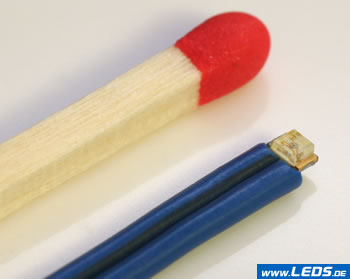
I just completed a new project: a fire-free and fire-safe LED matchstick. To light this matchstick you strike it against a normal matchbox filled with neodymium magnets. The LED matchstick has an inductive sensor that detects the magnetic field as you strike the matchstick against the matchbox and it lights up a LED in a flickering fashion. The power to the matchstick is through a 3F/2.7V supercapacitor and a DC-DC converter. As the LED lights up, the supercapacitor discharges and eventually the matchstick splutters off just like a normal matchstick.
The matchstick is controlled by a Tiny13 microcontroller. Still need to put it in a perspex tube so that its easy to handle and is not damaged.
The matchstick is controlled by a Tiny13 microcontroller. Still need to put it in a perspex tube so that its easy to handle and is not damaged.
For more details, click: Fire-free LED Matchstick a Tiny13 microcontroller
- How do you light this matchstick?
You strike it against a normal matchbox filled with neodymium magnets. - What component detects the magnetic field?
An inductive sensor detects the magnetic field as you strike the matchstick. - How does the LED behave when lit?
The LED lights up in a flickering fashion. - What powers the matchstick?
The power source is a 3F/2.7V supercapacitor and a DC-DC converter. - Why does the matchstick stop lighting up?
The supercapacitor discharges until the matchstick splutters off. - Which microcontroller controls the matchstick?
The matchstick is controlled by a Tiny13 microcontroller. - What material will be used to house the electronics?
The author plans to put the components in a perspex tube. - What is the purpose of the perspex tube?
The tube makes the device easy to handle and protects it from damage.
