
Summary of New Research Could Open Door to Megawatt Energy Storage Flywheels
LaunchPoint Technologies secured NSF ARRA funding to develop advanced adaptive control systems for high-speed flywheel energy storage, such as the 'Power Ring'. This technology aims to stabilize electric grids by providing rapid power bursts during outages or surges. The system utilizes carbon composite materials and magnetic bearings within a vacuum to minimize friction and wear, enabling operation at 20,000 rpm. The research seeks to unify disparate control techniques for reliable levitation, with potential applications extending to other high-speed machines like the PediaFlow heart pump.
Parts used in the Flywheel Energy Storage Project:
- Carbon composite material
- Magnetic bearing
- Vacuum chamber
- Flywheel rotor
- Flywheel stator
- Adaptive control system
- PediaFlow Pediatric Ventricular Assist Device (for related application)
Santa Barbara, CA (PRWEB) August 5, 2009
LaunchPoint Technologies Inc. has won National Science Foundation (NSF) American Recovery and Reinvestment Act (ARRA) funds to develop advanced control techniques for the operation of high-speed, high-efficiency, energy storage flywheels. Energy storage flywheels, such as LaunchPoint’s ‘Power Ring’, provide bursts of power over short time periods and are currently being developed as a more cost-effective method for maintaining electric power stability in the face of outages, surges, and sags that typically last up to a few seconds. These disturbances in power have an enormous economic impact (estimates exceed $ 100 billion per year), interrupting business operations and causing inconvenience and safety concerns for millions of people.
Maintaining the rated voltage and frequency of the U.S. electric power grid under changing load conditions requires a significant amount of readily controllable generating capacity or operating reserve. Today, the majority of that reserve comes from fossil fuel stations operating at partial capacity. This mode of operation is inefficient, leading to increased emissions as well as increased energy losses. Flywheel energy storage systems, on the other hand, are non-polluting in operation, more efficient under rapid load changes, and respond more quickly than conventional backup energy sources, making them well-suited for frequency regulation applications. This is particularly true for the regulation of highly variable energy sources such as wind power.
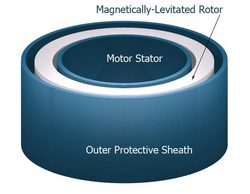
To be effective, however, energy storage flywheels must be able to generate power on the megawatt scale, which requires high rotational speeds and results in centripetal forces in excess of 100,000 G’s. To achieve these speeds, which are on the order of 600 meters per second at 20,000 rpm, the flywheel is constructed of a carbon composite material and is levitated using a magnetic bearing. By using magnetic levitation and operating the flywheel in a vacuum, friction is eliminated, permitting higher rotation speeds and lower operating costs as a result of decreased wear on the system and reduced energy consumption. These advantages, however, can only be realized by an active control system that enables a uniform levitation gap between the flywheel stator and rotor (see figure).
Led by VP of Engineering, Mike Ricci, LaunchPoint is working to develop a robust adaptive control system that will allow a reliable and energy-efficient levitation system for flywheels operating at high speeds. This research will extend the state of the art in control theory by generalizing several disparate control design techniques into one unified framework.
“While our immediate application for the control system is the flywheel, this research will also be applicable to reducing energy consumption in many of the high speed machines that LaunchPoint designs,” notes Mike Ricci, including the PediaFlow Pediatric Ventricular Assist Device (an implantable pediatric heart assist pump).
About LaunchPoint Technologies, Inc.
LaunchPoint Technologies, Inc is a venture engineering firm specializing in R&D, rapid prototyping, and product design. Our staff includes a group of creative product and system designers, engineers, and physicists, covering a wide array of disciplines. Brad E. Paden, Ph.D., IEEE Fellow, and Professor of Mechanical Engineering at UCSB, co-founded the company in 1992. Our business models include: consulting for companies that need to solve engineering challenges; grant writing for technology development; and equity-exchange for engineering work on promising technologies.
Areas of specialty include: Systems Engineering, Electrical & Electronic Engineering, Mechanical Engineering, Biomedical Engineering, Chemical Engineering, Security, MEMS/NANO, Materials Science, Intellectual Property, Fail-Safe Systems, and Circuit Design.
Contact:
Jerome Wiedmann
Business Development
LaunchPoint Technologies Inc.
1-805-683-9659 x200
###
More Electronic Circuits Press Releases
- How do flywheel energy storage systems maintain power stability?
They provide bursts of power over short time periods to handle outages, surges, and sags that typically last up to a few seconds. - What are the benefits of using flywheels compared to fossil fuel stations?
Flywheels are non-polluting, more efficient under rapid load changes, and respond faster than conventional backup sources. - Why is a vacuum necessary for these flywheels?
A vacuum eliminates friction, which permits higher rotation speeds and reduces operating costs through decreased wear. - What materials are used to construct the high-speed flywheel?
The flywheel is constructed of a carbon composite material to withstand centripetal forces exceeding 100,000 G's. - At what speed does the LaunchPoint flywheel operate?
The flywheel operates at approximately 20,000 rpm, reaching speeds on the order of 600 meters per second. - Does the developed control system apply to other devices?
Yes, the research applies to reducing energy consumption in other high-speed machines like the PediaFlow pediatric heart assist pump. - What economic impact do power disturbances have?
Estimates suggest power disturbances cost over $100 billion per year due to interrupted business operations and safety concerns. - How does the control system ensure uniform levitation?
An active control system enables a uniform levitation gap between the flywheel stator and rotor.
