
Summary of p.u.l.s.e. – fader control for Motorcycle parking Lamp
### Summary This project details a compact "heartbeat" lamp controller for a KTM Duke 200 motorcycle parking light. Designed by an enthusiast using an ATTiny45 microcontroller, the circuit replaces standard wiring to create a pulsing effect when the Neutral Detect (ND) signal is LOW, while keeping the lamp fully lit when ND is HIGH. The author utilized the Arduino environment on the ATTiny45 to avoid complex C coding and PIC microcontrollers. The board fits into the original T10 lamp socket, featuring a clean installation with three wires connecting to the lamp socket and the bike's ND signal.
Parts used in the p.u.l.s.e. Motorcycle Lamp Controller:
- ATTiny45 microcontroller
- T10 lamp socket
- p.u.l.s.e. custom PCB board
- 6-way ICSP header for programming
- Green wire for Neutral Detect signal
- Red and Black wires for lamp power connections
- KiCad software for schematic and layout design
My brother is a Mechanical Engineer who loves his KTM Duke 200 bike. He asked me to build this circuit : http://sunbizhosting.co.uk/~spiral/blog/?p=227 for a ‘heartbeat’ lamp controller for the parking light. A Neutral Detect (ND) signal controls the lamp pulsing. When ND is HIGH, the Lamp is fully lit. When ND goes LOW, the lamp starts pulsing.
I’m not familiar with PIC microcontrollers, and didn’t want to dabble in “C” code. I’d be comfortable with an Arduino, but even the smallest ATMega seemed too big (and overkill) for this simple requirement. How about an ATTiny ? A bit of Googling, and I found this excellent resource for running the Arduino environment on the ATTiny : http://hlt.media.mit.edu/?p=1695
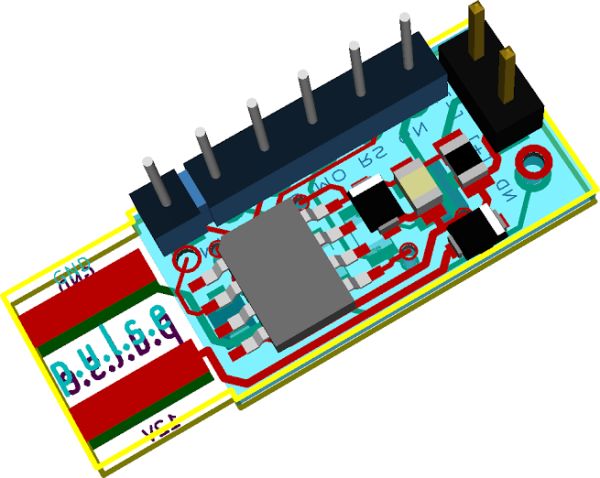
Time to churn out a circuit. I selected the ATTiny45 which has 6 I/O pins, with two of them being PWM, and three Analog. The schematic and board layout (in KiCad) can be found on the wyolum code repository at Google Code. The idea was to have a board that plugs in to the existing lamp socket. The board size is about the same as a T10 lamp. A new socket is wired to the p.u.l.s.e. board which then attaches to the lamp. A third wire from the p.u.l.s.e board goes to the Neutral Detect (ND) signal in the bike. This makes the installation clean and simple.
3D render of the p.u.l.s.e. board
The 6 way header is ICSP for programming the ATTiny.
p.u.l.s.e boards
Assembled p.u.l.s.e board
Green wire is for ND signal. Red and Black go to a Lamp socket. The p.u.l.s.e board plugs in to the original lamp socket.
Now for the Important bits – getting Arduino to run on the ATTiny. These are the steps
For more detail: p.u.l.s.e. – fader control for Motorcycle parking Lamp
- What controls the pulsing of the lamp?
The Neutral Detect (ND) signal controls the lamp pulsing. - When does the lamp stay fully lit?
The lamp is fully lit when the ND signal is HIGH. - When does the lamp start pulsing?
The lamp starts pulsing when the ND signal goes LOW. - Why was the ATTiny45 chosen over other microcontrollers?
The ATTiny45 was selected because it has enough I/O pins and is smaller than the ATMega, avoiding the need for C code. - How can the Arduino environment run on an ATTiny?
The Arduino environment can be run on the ATTiny using resources found at hlt.media.mit.edu. - How large is the p.u.l.s.e. board?
The board size is about the same as a T10 lamp. - What is the purpose of the green wire?
The green wire carries the Neutral Detect (ND) signal from the bike. - How are the red and black wires connected?
The red and black wires go to a new lamp socket attached to the p.u.l.s.e. board.
