
Summary of RC Car Controller Using Atmel 4414 chip
This project involves building custom transmitter and receiver modules for a radio-controlled car to enable variable-speed motor control and continuous steering. The team replaced the original discrete speed controls with pulse width modulation using a microprocessor and utilized commercial radio modems for communication. A PC joystick was modified to serve as an intuitive controller, converting analog signals via serial ADCs into digital commands sent over a serial link.
Parts used in the RC Car Controller:
- Tamiya RC model kit
- Rudimentary radio control unit
- Microprocessor (Atmel 4414 chip)
- National Semiconductor radio modems (AirShare label)
- PC joystick from Radio Shack
- National Semiconductor serial ADCs
- Pulse width modulation circuitry
- Servo attached to steering linkage
Overview:
We decided to build transmitter and receiver modules for a radio-controlled (RC) car, as well as implement variable-speed motor control and a continuous steering function. The simple speed controls included in most RC kits seldom offer more than three forward speeds and one reverse speed; furthermore, steering controls in most “Radio Shack” toys only offer binary steering: Either the car is turning left, right or not at all. We felt that overcoming these limitations would make any RC car more realistic to handle and ultimately more fun to drive.
The Car
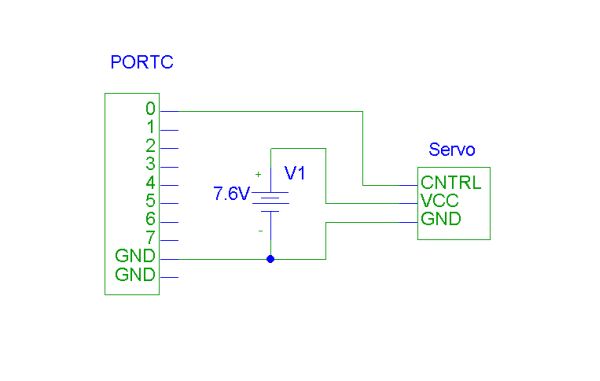
A Tamiya RC model kit was bought from a Maryland hobby store, along with a rudimentary radio control unit to verify that original unit’s operation. After making sure all parts were assembled correctly, the mechanical speed control, speed control servo, and radio receiver module were all removed. The car we selected already implements continuous steering with a servo attached to the steering linkage; however, because the radio receiver was no longer being used, we decided to leave the servo in and reverse engineer its interface.
The original implementation of speed control in the car consists of a servo which mechanically moves the arm of a simple high-power potentiometer. While the motion of the servo is continuous, the circuit only produces six discrete levels: three forward, two reverse, and neutral. Hobbyists in RC cars often replace this assembly with an electronic speed control (ESC), which uses pulse width modulation to provide a smooth speed control. We chose to simulate the function of these commercially available ESCs by using the microprocessor to modulate pulse width across the motor.
Communication
An RC car is of little value if the controls are tethered to the vehicle. However, we determined during the design process that the radio system was mostly irrelevant to the actual project, and that the time required to build the system would seriously impede on the rest of the project. We decided instead to use a pair of commercially available radio modems. The devices, made by National Semiconductor and used by Laplink under the “AirShare” label, claim to establish a 115 kbps serial connection at a distance of up to 30 feet with clear line-of-sight. While this range is inferior to that of commercially available radio control units, it is more than adequate to prove that the rest of the design works.
| Command | Opcode | Magnitude Range |
| Forward | 0000 | 0000 – 1111 |
| Reverse | 0001 | 0000 – 1111 |
| Left | 0010 | 0000 – 1111 |
| Right | 0011 | 0000 – 1111 |
| Start | 0100 | n.a. |
| Stop | 0101 | n.a. |
A simple communication protocol was established to send messages from the controller to the car. Because the connection is serial, we encode each command into a byte-long packet. The top nibble denotes the command, and the lower nibble represents the level at which the command is to be executed. For discrete operations (like headlights), the second nibble determines which functions are to be toggled. Communication travels one way from the controller to the car, which cuts down on the hardware required for either unit.
Controller
The original controller used spring centered potentiometers to produce analog signals which controlled the speed and direction of the car. The analog signals were transmitted to the car via a 75 MHz AM radio link.
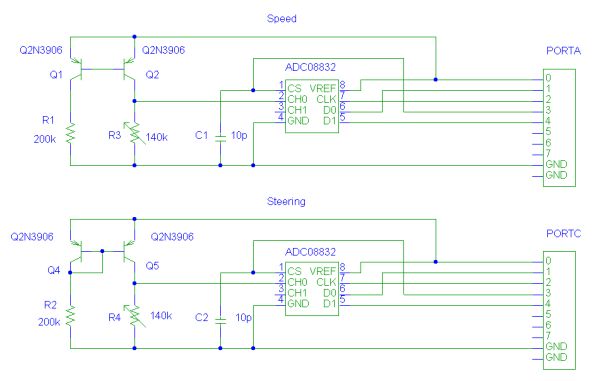
In order to emulate the true RC car experience, we decided that we needed something more visually intuitive than two potentiometers stuck into a breadboard. We purchased a simple PC joystick from Radio Shack and removed the “turbo” button circuitry. Using the existing interface cable, we were able to connect the internal potentiometers and pushbuttons to the receiver board without cosmetically altering the joystick.
Our design for the controller uses National Semiconductor serial ADCs to convert the analog waveform from the potentiometers to a digital signal. For example, the 8-bit value obtained from the forward/reverse potentiometer is compared against a known value for that potentiometer’s “centered” value; we can therefore determine whether the user intends to go forward or backward, and the rate at which she plans to do so. These data are used to generate the opcode and value to be sent to the car over the serial connection.
For more detail: EE 476 Final Project RC Car Controller
- Why did the creators build custom transmitter and receiver modules?
To overcome the limitations of standard kits that only offer three forward speeds, one reverse speed, and binary steering. - How does the system achieve smooth speed control?
The microprocessor modulates pulse width across the motor to simulate commercially available electronic speed controls. - What type of communication method was chosen instead of a traditional radio system?
The team used a pair of commercially available National Semiconductor radio modems operating at 115 kbps. - How is the command data structured in the communication protocol?
Each command is encoded into a byte-long packet where the top nibble denotes the command and the lower nibble represents the execution level. - What hardware was used to create the controller interface?
A simple PC joystick from Radio Shack was purchased and its internal potentiometers and pushbuttons were connected to the receiver board. - How are analog signals converted to digital signals in the controller?
National Semiconductor serial ADCs convert the analog waveforms from the potentiometers into digital signals. - Does the communication between the controller and the car require two-way transmission?
No, communication travels one way from the controller to the car to reduce the required hardware. - What was the intended range of the radio modems used?
The devices claim to establish a connection at a distance of up to 30 feet with clear line-of-sight.
