
Summary of Switching Diodes 101: What You Need to Know
This article introduces switching diodes, explaining their function as semiconductor components that control current flow by rapidly switching between on and off states. It details their working principles involving p-n junctions and key characteristics like forward voltage drop and reverse recovery time. The guide outlines specific applications in RF signal switching, modulation/demodulation, high-speed digital circuits, and protection against reverse current. Finally, it offers selection criteria including operating frequency, voltage ratings, temperature range, and package type to ensure optimal performance in various electronic projects.
Parts used in the Switching Diode Project:
- Switching diodes
- Silicon diodes
- Germanium diodes
- Schottky diodes
- Surface mount diodes
- Through-hole diodes
- Circuit boards
- Capacitors
- Inductors
Diodes: they’re small but have a big job to play in various circuits. Switching diodes in particular are indispensable, essential for regulating voltage and processing all the signals our digital world revolves around in work, play, and daily living. Most electronics engineers will have to use them at some point, so why not learn about them now?
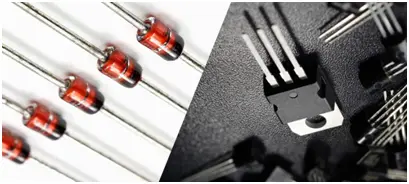
Ready to get started? Read along for our complete beginner’s guide to switching diodes. Taking you from what they are to how they’re used, you should be ready to properly utilize them for your projects in no time!
What are Switching Diodes?
Switching diodes are fundamental electronic circuit components, a kind of semiconductor diode that controls the flow of current. They - as their name would suggest - switch on and off, allowing current to pass through them in one direction while blocking it in the opposite.
Unlike many other diodes, switching diodes can quickly shift between their on and off states. This, along with their often low capacitance and forward voltage drop, makes them ideal for both low-voltage circuits and high-frequency ones. However, how well they will fare within a certain application will largely depend on the given circumstances and each diode’s specific features/performance characteristics.
How exactly these diodes work is a bit technical. Essentially, switching diodes rely on two things: the properties inherent to semiconductor materials (electrical and thermal conductivity, carrier mobility, etc.) and the formation of a p-n junction - fancy shorthand to describe the interface between a positively charged type/region of semiconductor material and a negatively charged one.
When these two regions meet, positive material connected to a positive terminal and negative material/terminal connection also established, the diode becomes forward-biased. It frees up the electrical current, electrons moving from the n-side and holes moving from the p-side to recombine at the junction. However, if the converse happens, the diode becomes reverse-biased. Most of the negative region’s electrons and positive region’s holes are then repelled by the other side, and electric charge can’t flow through the diode.
Characteristics of Switching Diodes
Okay, so you’re now a little more familiar with the basics of switching diodes and how they work, but that can still only get you so far. Ever planning to go past theory? Want to get hands-on, deep into the internals of an electronic project? Then, truly understanding the characteristics of switching diodes should be your next goal. After all, you can’t properly utilize them if you don’t even know their key attributes!
Unsurprisingly, switching diodes have a laundry list of characteristics to consider, but forward voltage drop is a solid place to start. Sounding is more complicated than it is, forward voltage drop is simply the voltage required to forward-bias (i.e., switch on) the diode and allow the current to flow sans resistance.
The exact level of voltage needed to do so can vary significantly from switching diode to switching diode, influenced by diode type and materials used. For instance, the forward voltage drop of silicon diodes usually hovers somewhere between .2 and .7 volts, but germanium ones tend to be even lower. That probably doesn’t sound all too important at face value, yet a diode’s forward voltage drop is critical for efficiency and power dissipation.
Switching speed is another characteristic that makes all the difference in efficiency. This is just the time it takes for a diode to switch from off to on and vice versa. Similarly, reverse recovery time is a term that indicates the time a diode needs to transition from conducting to blocking in the reverse direction.
Applications of Switching Diodes
Diodes are components used in various systems and circuits, used for everything from signal clipping to light emission and more. But switching diodes are a specific type of diode and thus, have some unique and specific applications that others wouldn’t well suit. Some of these include:
- RF signal switching. Due to their quick switch speed, switching diodes are often used in RF signal switching. Arranged into a matrix formation, they help route RF signals onto the appropriate path by applying the correct bias voltage. This provides great precision without significant signal distortion.
- Signal modulation/demodulation. In this kind of application, switching diodes both encode and decode information in analog/digital signals. They change carrier signal strength in AM circuits and extract the original modulating signals in demodulating circuits - something super helpful for radios, TV sets, and communications systems.
- High-speed digital circuits. If signal integrity is your primary aim, then switching diodes are going to be one of your best solutions. These little components do a great job at level shifting and signal routing, their low capacitance and speed making them ideal for microprocessors!
- Reverse current and discharge protection. Switching diodes are safeguards against reverse current and discharge when used within electronic circuits. They prevent potential damage caused by voltage surges and, within circuits that feature capacitors/inductors, divert surplus energy away from vulnerable elements when discharge happens. High-back pressure switching diodes are ideal here as they readily handle high reverse voltage spikes and frequent voltage transients.
Considerations for Selecting Switch Diodes
Switching diodes aren’t the only component that can be used for circuitry, nor are they always the best choice despite their solid versatility. Like any other electronic parts and devices, they have their strengths, weaknesses, and considerations to well… consider. Though the full list would be too long to cover, here are a few major ones to think about before settling on a switch diode:
- Operating Frequency: All circuits may be useful, but not all of them are the same. Each one will work a little differently and have a different operating frequency. Ensure you know what this is so you don’t get the wrong diode! High-frequency circuits will almost always require fast-switching diodes to minimize delays, while others might have more flexibility regarding type. High-speed switching diodes and ultra-high-speed ones are best suited.
- Voltage and Current Ratings: Obviously, you don’t want to overload the circuit you’re trying to work with. Be sure then to ensure your chosen diode can handle the maximum voltage and current levels anticipated without exceeding rated specifications. We recommend playing it pretty safe here just for peace of mind. Go with a diode with voltage/current ratings well above average operating conditions, and you’ll likely avoid any unexpected damages.
- Reverse Recovery Time: If your project has anything to do with motor control, power supply circuits, or otherwise requires fast switching, reverse recovery time suddenly becomes a big deal. Choose diodes with shorter reverse recovery times to reduce energy dissipation and switching losses. Your circuit’s performance will thank you.
- Temperature Range: Recovery time and voltage ratings aren’t the only factors when finding the right switching diode for the job. Temperature range is just as critical. If your project involves extreme temps or demanding environmental conditions, always double-check that your diodes are rated for it. When in doubt, lean more towards Schottky diodes. Their metal-semiconductor junction has higher thermal stability than ones in standard diodes.
- Package Type: Perhaps the consideration people most often forget is space. You’ll always be working with spatial constraints - don’t forget to select a package type that suits both assembly and space requirements. Have a small board on your hands? Surface mount diodes are going to be ideal. However, should you have more space available, through-hole diodes are preferable since they provide more soldering ease and mechanical support.
- What are switching diodes?
Switching diodes are fundamental electronic circuit components that control the flow of current by switching on and off. - How do switching diodes work?
They rely on semiconductor material properties and a p-n junction, becoming forward-biased to allow current or reverse-biased to block it. - What is forward voltage drop?
It is the voltage required to forward-bias the diode and allow current to flow without resistance. - Can switching diodes be used for RF signal switching?
Yes, due to their quick switch speed, they help route RF signals onto appropriate paths with great precision. - Do switching diodes protect against reverse current?
Yes, they act as safeguards to prevent damage from voltage surges and divert surplus energy away from vulnerable elements. - Which diodes are best suited for high-frequency circuits?
High-speed switching diodes and ultra-high-speed ones are best suited for high-frequency circuits to minimize delays. - What should you consider regarding voltage ratings?
You should ensure the chosen diode can handle maximum anticipated voltage levels without exceeding rated specifications. - Why is reverse recovery time important?
Shorter reverse recovery times reduce energy dissipation and switching losses in motor control or power supply circuits. - Which diode type has higher thermal stability?
Schottky diodes have higher thermal stability than standard diodes due to their metal-semiconductor junction. - What package type is ideal for small boards?
Surface mount diodes are ideal for small boards due to spatial constraints, while through-hole diodes offer more soldering ease.
