
Summary of GIGABYTE GA-PICO3350 APOLLO LAKE PICO-ITX BOARD COMES WITH SO-DIMM RAM SLOT, SATA AND MSATA STORAGE
GIGABYTE's GA-PICO3350 is a compact Pico-ITX motherboard featuring an Intel Celeron N3350 processor. It offers flexible expansion with a SO-DIMM slot for up to 8GB RAM, SATA and mSATA storage options, HDMI video output, and Gigabit Ethernet. The board supports Windows 10 and Linux, though drivers must be sourced separately for the latter. It includes essential connectivity like USB ports, M.2 for Wi-Fi, and Mini PCIe slots, making it ideal for small form-factor embedded systems or home servers.
Parts used in the GIGABYTE GA-PICO3350:
- Intel Celeron N3350 dual-core Apollo Lake processor
- 1 x DDR3L SO-DIMM socket
- 1x SATA 6Gb/s connector
- 1x mSATA connector
- HDMI 1.4 port
- LVDS header
- Flat panel display header
- Realtek ALC887 audio codec
- Gigabit Ethernet port via Realtek PHY
- 2x USB 3.0/2.0 ports on back panel
- M.2 Socket connector (M2_WIFI)
- Full-size Mini PCIe slot
- iTE I/O controller chip
GIGABYTE GA-PICO3350 may be the smallest motherboard from the company so far. The Pico-ITX board comes with an Intel Celeron N3350 dual-core Apollo Lake processor with a SO-DIMM slot, SATA port, and mSATA socket that give you more options will selecting RAM and storage.
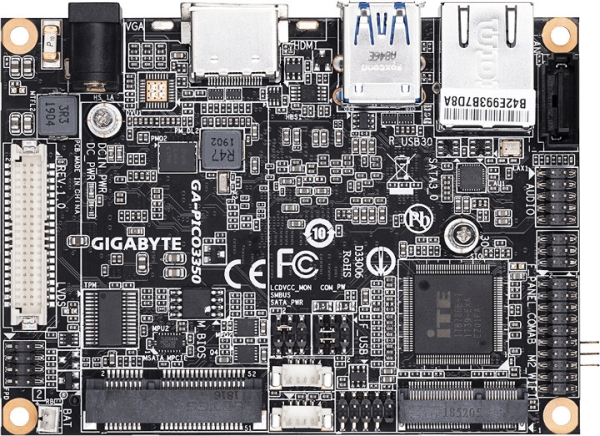
GA-PICO3350 Specifications:
- SoC – Intel Celeron N3350 dual-core Apollo Lake processor @ up to 2.4 GHz with 2 MB cache, Intel HD graphics; 6W TDP
- System Memory – 1 x DDR3L SO-DIMM socket supporting up to 8 GB DDR3L 1866/1600 MHz
- Storage- 1x SATA 6Gb/s connector, 1x mSATA connector (multiplexed with mPCIe), 128 Mbit flash for BIOS/UEFI
- Video Output
- HDMI 1.4 up to 3840×2160 @ 30 Hz
- 1x LVDS header
- 1x flat panel display header
- Audio – Realtek ALC887 codec, 1x front panel audio header
- Connectivity – Gigabit Ethernet port via Realtek PHY
- USB – 2x USB 3.0/2.0 ports on the back panel, 2x USB 2.0/1.1 ports available through the internal USB headers
- Expansion
- 1x M.2 Socket connector for the wireless communication module (M2_WIFI)
- 1x full-size Mini PCIe slot (MSATA_MPCIE)
- 1x GPIO header
- 1x SMBUS
- 1x serial port header
- Misc – Front panel header, serial port power select jumper (COM_PW), LCDVCC/MON header (LCDVCC_MON), battery cable header, iTE I/O controller chip, HW/monitor with voltage & temperature detection
- Power Supply -12V DC
- Dimensions – 10 x 7.2 cm (Pico-ITX form factor)
The board officially support Windows 10 64-bit, and Linux distributions should be supported although if you decided to install a Linux operating system don’t expect support from GIGABYTE:
Due to different Linux support condition provided by chipset vendors, please download Linux driver from chipset vendors’ website or 3rd party website.
The board ships with the driver disc, a user’s manual, one COMA/B port cable one audio cable, two SATA cables, one SATA power cable, one USB cable, and one heatsink.
Read more: GIGABYTE GA-PICO3350 APOLLO LAKE PICO-ITX BOARD COMES WITH SO-DIMM RAM SLOT, SATA AND MSATA STORAGE
- What processor does the GA-PICO3350 use?
The board uses an Intel Celeron N3350 dual-core Apollo Lake processor running at up to 2.4 GHz. - How much system memory can the board support?
It supports up to 8 GB of DDR3L 1866/1600 MHz via a single SO-DIMM socket. - Does the board support Linux operating systems?
Linux distributions are supported, but GIGABYTE does not provide official driver support for them. - Can I install wireless modules on this motherboard?
Yes, there is an M.2 Socket connector specifically for wireless communication modules. - What video outputs are available on the GA-PICO3350?
It features an HDMI 1.4 port supporting up to 3840×2160 @ 30 Hz, plus LVDS and flat panel display headers. - Is the board compatible with Windows 10?
Yes, the board officially supports Windows 10 64-bit. - What cables are included in the box?
The package includes one COMA/B port cable, one audio cable, two SATA cables, one SATA power cable, one USB cable, and a heatsink. - How do I get drivers if I use Linux?
You must download Linux drivers from chipset vendors' websites or third-party websites.
