
Summary of How Camera Flashes Work
This article explains the fundamental operation of a basic camera flash system, detailing how a battery powers a circuit to energize a xenon-filled gas discharge tube. It describes the ionization process where a high-voltage trigger plate frees electrons from xenon atoms, creating a conductive path that generates visible light through electron collisions.
Parts used in the Camera Flash System:
- Small battery
- Gas discharge tube
- Circuit with electrical components
- Xenon gas
- Electrodes
- Metal trigger plate
Making a Flash
A basic camera flash system, like you would find in a point-and-shoot camera, has three major parts.
- A small battery, which serves as the power supply
- A gas discharge tube, which actually produces the flash
- A circuit (made up of a number of electrical components), which connects the power supply to the discharge tube
The two components on the ends of the system are very simple. When you hook up a battery’s two terminals to a circuit, the battery forces electrons to flow through the circuit from one terminal to the other. The moving electrons, or current, provides energy to the various things connected to the circuit (see How Batteries Work for more information).
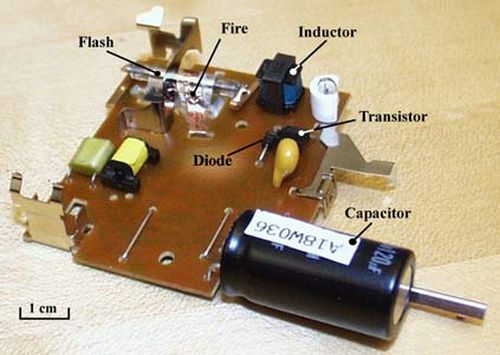
The discharge tube is a lot like a neon light or fluorescent lamp. It consists of a tube filled with xenon gas, with electrodes on either end and a metal trigger plate at the middle of the tube.
The basic idea is to conduct electrical current — to move free electrons — through the gas in the tube, from one electrode to the other. As the free electrons move, they energize xenon atoms, causing the atoms to emit visible light photons (see How Light Works for details on how atoms generate photons).
You can’t do this with the gas in its normal state, because it has very few free electrons — that is, nearly all the electrons are bonded to atoms, so there are almost no charged particles in the gas. To make the gas conductive, you have to introduce free electrons into the mix.
This is the metal trigger plate’s job. If you briefly apply a high positive voltage (electromotive force) to this plate, it will exert a strong attraction on the negatively charged electrons in the atoms. If this attraction is strong enough, it will pull the electrons free from the atoms. The process of removing an atom’s electrons is called ionization.
The free electrons have a negative charge, so once they are free, they will move toward the positively charged terminal and away from the negatively charged terminal. As the electrons move, they collide with other atoms, causing these atoms to lose electrons as well, further ionizing the gas. The speeding electrons collide with xenon atoms, which become energized and generate light (see How Fluorescent Lamps Work for more information).
To accomplish this, you need relatively high voltage (electrical “pressure”). It takes a couple hundred volts to move electrons between the two electrodes, and you need a few thousand volts to introduce enough free electrons to make the gas conductive.
For more detail: How Camera Flashes Work
- What are the three major parts of a basic camera flash system?
A small battery, a gas discharge tube, and a circuit made up of electrical components. - How does the metal trigger plate work?
It applies a high positive voltage to pull electrons free from atoms through a process called ionization. - Why can't the gas conduct electricity in its normal state?
Because nearly all electrons are bonded to atoms, leaving almost no charged particles to move. - What happens when free electrons collide with xenon atoms?
The xenon atoms become energized and generate visible light photons. - How much voltage is needed to introduce free electrons into the gas?
You need a few thousand volts to make the gas conductive. - What voltage is required to move electrons between the two electrodes?
It takes a couple hundred volts to move electrons between the electrodes. - Does the battery force electrons to flow through the circuit?
Yes, the battery forces electrons to flow from one terminal to the other when hooked up to a circuit.
