
Summary of How HD Radio Works
HD Radio digitizes signals to deliver near-CD quality audio and multicasting capabilities on existing frequencies. It eliminates static by removing interference and allows stations to broadcast multiple channels (HD2) simultaneously. While the system uses lossy compression, it offers superior sound over analog FM and AM. Stations continue broadcasting analog signals alongside digital ones to ensure compatibility with older radios. Implementation involves upgrading equipment at a cost of $30,000 to $200,000 plus annual licensing fees.
Parts used in HD Radio System:
- Digital signal transmitter
- Analog FM/AM carrier wave
- Text data signal
- PAC (Perceptual Audio Coding) algorithm
- HDC (High-Definition Coding) algorithm
- HD Radio receiver
- Station upgrade equipment
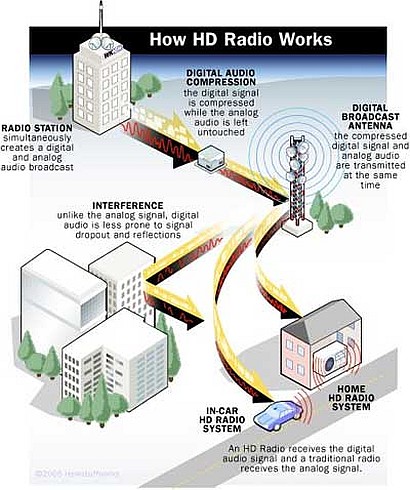
HD Radio sends more information over the same radio frequency by digitizing the signal. A digital signal can then be compressed by a computer, much like an MP3 is a compressed version of the much larger WAV file that is on a CD. Digitizing allows FM stations to broadcast with near-CD quality sound, and HD Radio AM stations will sound just as good as FM stations do now. An HD Radio receiver can also zero in directly on the digital transmission, eliminating interference and signal “reflections” off of buildings. The result is clear sound without any static, pop or hiss.
Another application of HD Radio is the ability to multicast multiple channels on the same signal. Multicasting also refers to a form of Internet routing architecture, so the multiple channel transmissions allowed by HD Radio might be more accurately described as multiplexing (iBiquity chose the term “multicasting”).
The extra bandwidth of an HD Radio signal leaves room for completely separate channels operating on the same frequency. Here’s how it works: Suppose your favorite radio station is 102.5 FM. When you tune in, you pick up the regular broadcast — classic rock. Your HD Radio receiver indicates that the station is multicasting. You turn a dial to select the alternate channel, where they play nothing but blues. Or your favorite talk radio station might have separate, simultaneous broadcasts featuring news and weather, sports talk and political commentary.
Current HD technology allows the addition of one extra music channel and three extra talk channels before the sound quality begins to suffer. The extra stations are referred to as HD2 stations. If an HD Radio receiver loses the digital signal, it seamlessly fades back to analog FM until the digital signal returns.
An HD Radio receiver can display text data that is sent alongside the audio signal. This could take the form of artist and song information about the music being played or sports, weather or stock updates.
No radio stations are planning to go all-HD. They’ll continue to broadcast regular analog signals along with the HD signals, so old radios will be able to pick up AM and FM stations with no problems in the foreseeable future.
HD Radio Signal
The radio waves that carry analog AM and FM signals are limited in the amount of information they can convey, both because of the nature of the waves themselves and the spacing of stations on the frequency band. FM stations are separated by 200 kHz, while AM stations have just 10 kHz between them. Alternate channel spacing of FM stations gives them 400 kHz to work with. The signals broadcast by radio stations are actually spread out on either side of the frequency into Upper and Lower Sidebands (USB and LSB).
The larger spacing between FM stations gives them enough room to broadcast higher quality audio in stereo, but not enough for true CD-quality audio. An FM signal could carry enough information for a higher-quality signal, but it would take up so much bandwidth that there would be room for far fewer stations on the dial.
HD Radio solves this problem by compressing the digital signal so more information can be sent along the same amount of radio bandwidth. Initially, iBiquity used a compression algorhythm called PAC (Perceptual Audio Coding). However, audio compressed with this method led to complaints about poor sound quality, so in 2003, iBiquity changed to HDC (High-Definition Coding), a different compression method that allowed for higher sound quality.
Although HD Radio is touted as providing CD-quality sound on the FM airwaves, the compression of the digital signal is a “lossy” method. That means that it discards some of the information in the signal, resulting in a reduction in overall fidelity to the original sound. Much of the discarded information is not perceptible to human ears, and the final product may sound very close to CD-quality, but technically it is not the same sound as on the CD.
The digital signal is sent out piggybacked onto the analog signal on the same carrier wave (the wave sent out by the transmitter that gives a radio station its frequency on the dial). A third signal can also be added — this carries text data. It is an in-band on-channel (IBOC) system because the signal is piggybacked onto the analog signal and doesn’t use up extra bandwidth. If the system was an in-band adjacent-channel (IBAC) system, the bandwidth would be increased by using space on nearby channels (and causing interference if another station was trying to broadcast there).
Implementation of HD Radio on the station side requires significant modification and upgrading, with cost estimates ranging from $30,000 to $200,000 [Sources: Crutchfield Advisor and Wired]. Because HD Radio is a proprietary system owned by iBiquity, stations also have to pay an annual licensing fee of $5,000.
For more Details: How HD Radio Works
-
How does HD Radio improve sound quality?
Digitizing the signal allows for compression that results in near-CD quality sound on FM and improved quality on AM. -
Can HD Radio broadcast multiple channels on one frequency?
Yes, the technology allows for multicasting or multiplexing, enabling extra music and talk channels known as HD2 stations. -
What happens if an HD Radio loses the digital signal?
The receiver seamlessly fades back to the analog FM signal until the digital transmission returns. -
Does HD Radio use extra bandwidth compared to analog?
No, it is an in-band on-channel system that sends the digital signal piggybacked onto the analog carrier without using extra bandwidth. -
Is the sound quality on HD Radio exactly like a CD?
Technically no, because the compression method is lossy and discards some information, though it sounds very close to CD quality. -
Will old analog radios be able to receive HD Radio stations?
Yes, stations will continue broadcasting regular analog signals so old radios can pick up AM and FM stations without issues. -
What information can be displayed on an HD Radio receiver?
Receivers can display text data such as artist names, song titles, sports scores, weather updates, and stock market information. -
How much does it cost for a station to implement HD Radio?
Implementation costs range from $30,000 to $200,000, plus an annual licensing fee of $5,000.
