
Summary of LCD Display On Glass Interface Using AT2313
This article introduces the LCD on Glass technology, featuring compact dimensions (55x27 mm), various monochrome and RGB backlight options, and three display series. The project demonstrates connecting this display to an AVR AT2313 microcontroller using a custom PCB with 20-pin sockets and a 5x2-pin connector. Software is written in assembler using Studio4, initializing the ST7036 controller in 4-bit mode to manage character output and contrast settings.
Parts used in the LCD Display On Glass Interface Using AT2313:
- Liquid Crystal Display on Glass module
- LED backlight unit
- AVR AT2313 microcontroller
- Custom designed PCB
- Two rows of 20-pin socket connectors
- Current limiting resistor for background LEDs
- 5x2-pin connector
- STK500 board or AT2313 project board
- 10-pole flat cable
Description
Liquid Crystal Display on Glass is the newest in LCD technology. The display’s are very compact, it measures 55×27 mm and the height is only 2mm without LED backlight and 5.8mm with LED backlight. The display’s can have different LED background light instead of only the green and blue of the normal LCD modules.There are 5 monochrome colors available: white, green/yellow, blue, red, amber and there is even a full color RGB background possible. The contrast of the display can be set with a command. This is done using software. The display’s series consists of 3 types:
- 3*16 with 3.6 mm character height.
- 2*16 with 5.6 mm character height.
- 1*8 with 12 mm character height.
The display and the corresponding back light are clipped together and inserted into a PCB and soldered.
The display has a build-in character set of 248 European and Japanese characters, in addition you can also define 8 characters. The integrated controller, the ST7036, has build in commands to control the display.
In this project the display is connected to an AVR AT2313 microcontroller.
Hardware
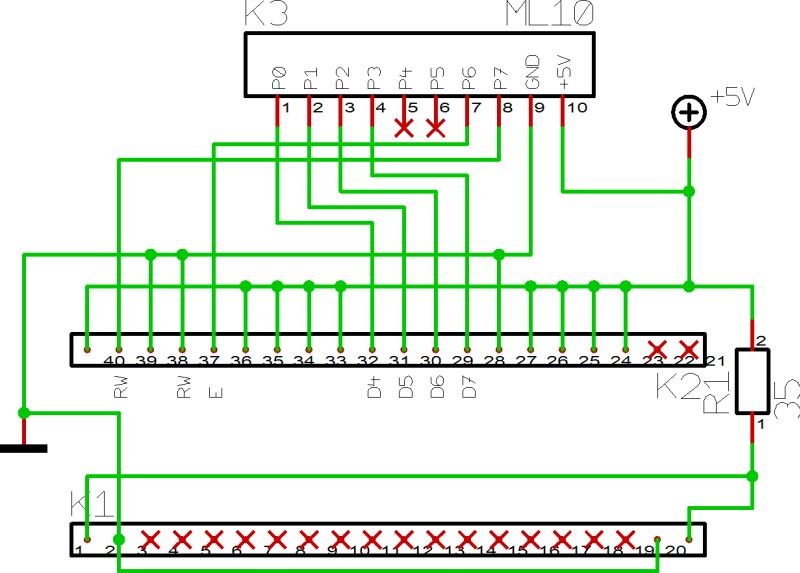
For the ease of use i have designed a small PCB. The board has two rows of 20-pins socket connectors, in which the display can be inserted, it has also a resistor to limit the current through the background LEDs. For connection with the microcontroller the board has a 5×2-pin connector, so the board can easily connected to the STK500 board or to the AT2313 project board with a 10-pole flat cable. In this project the 4-mode is used so ther are only 4 datalines and 2 control lines.
Software
The software is made in assembler program code. It is made with the Studio4 program wich you can download for free from the Atmel website. Before you can send characters to the display, it has to be initialized. First you have to switch the display to the 4-bit mode.
For more details, click: LCD Display On Glass Interface Using AT2313
- What are the physical dimensions of the Liquid Crystal Display on Glass?
The display measures 55x27 mm with a height of 2mm without LED backlight and 5.8mm with it. - How many monochrome colors are available for the background light?
There are five monochrome colors available: white, green/yellow, blue, red, and amber. - Which microcontroller is used in this project?
The display is connected to an AVR AT2313 microcontroller. - What software environment is used to write the program code?
The software is made in assembler program code using the Studio4 program from the Atmel website. - How is the contrast of the display adjusted?
The contrast can be set with a command using software. - What type of connection mode is used between the display and microcontroller?
The project uses the 4-mode which utilizes only 4 datalines and 2 control lines. - How does the custom PCB facilitate connection to the microcontroller?
The board features a 5x2-pin connector that allows easy connection to the STK500 board or AT2313 project board via a 10-pole flat cable. - Does the display have a built-in character set?
Yes, it has a built-in character set of 248 European and Japanese characters plus the ability to define 8 additional characters.
