
Summary of LED Matrix Display using TD62783 microcontroller
Last Sunday I ran a workshop assembling an 8×8 red/green LED matrix interface on stripboard. The circuit interfaces a microcontroller to a dual-color common-anode 8×8 LED module using time-multiplexing: a TD62783APG 8-channel high-side source driver enables row sourcing (one row at a time), a 74HC238 3-to-8 decoder selects which row, and two 74HC595 shift registers provide low-side column sinking. High-side outputs must source ~240 mA; low-side sinks ~15 mA per column. Persistence of vision creates the appearance of a fully lit display.
Parts used in the 8×8 Red/Green LED Matrix Display project:
- 8×8 Dual Colour Common Anode LED Module
- TD62783APG 8-Channel High-Voltage Source Driver (Toshiba Semiconductor)
- 74HC238 3-to-8 Decoder (NXP)
- Two 74HC595 8-bit Shift Registers (NXP)
- Microcontroller
- Stripboard (veroboard)
- Wiring and connectors
- Resistors for current limiting (as used in the design)
Last Sunday I gave a workshop in TOG as part of it’s Engineers Week 2011 activities. We spent the day assembling a 8×8 Red/Green LED Matrix Display circuit which I designed in strip board.
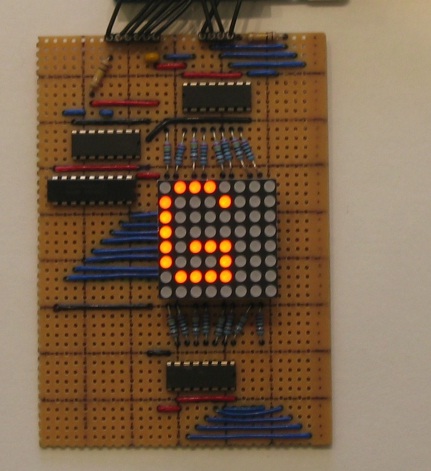
The circuit forms an interface between a micro controller and a 8 by 8 Dual Colour Common Anode LED Module. This type of module has two LEDs per pixel. Each row has 8 pixels, with 8 rows. The anodes of each LED in a row are connected, with 16 columns formed by connecting together the cathode of an LED from each row.
A high side switch is needed to turn on/off a row and must be able to source approximately 240 milliamperes (16 multiplied by 15 milliamperes). A low side switch is needed to turn on/off a column. But only one LED is on per column so it only needs to sink 15 milliamperes.
For the high side switching I used a TD62783APG 8 Channel High-Voltage Source Driver from Toshiba Semiconductor. It’s very important that only one output from the TD62783 is on at any one time so I used a 74HC238 3-to-8 Decoder from NXP to control the row selection. For the low side switching we used two 74HC595 8-bit Shift Registers from NXP.

Only one row of LEDs is on at a time. The display uses persistence of vision to give the illusion that all the LEDs are active at one time.
For more detail: LED Matrix Display using TD62783 microcontroller
- What type of LED module is used?
A dual-colour common anode 8×8 LED module is used. - Which component handles high-side row switching?
The TD62783APG 8-channel high-voltage source driver handles high-side row switching. - How are rows selected so only one is active at a time?
A 74HC238 3-to-8 decoder is used to ensure only one TD62783 output (one row) is on at a time. - Which components provide low-side column switching?
Two 74HC595 8-bit shift registers provide low-side column sinking. - Why does the high-side switch need to source about 240 mA?
Because one row contains 16 LEDs at about 15 mA each, totaling approximately 240 mA. - How much current does each low-side column need to sink?
Each low-side column needs to sink about 15 mA since only one LED is on per column at a time. - How does the display appear fully lit if only one row is on at once?
The circuit uses persistence of vision by rapidly multiplexing rows so it appears all LEDs are lit simultaneously. - On what medium was the circuit assembled during the workshop?
The circuit was assembled on stripboard.
