
Summary of LOW COST HIGH ACCURACY STM32 FFT LCR METER
This university project describes a high-accuracy, mixed-signal LCR meter built for personal lab use. It features a robust analog front end paired with a DSP processor to calculate impedance and discriminate phase between voltage and current waveforms. The device supports test frequencies of 1, 10, and 100 KHz, displays L, C, R, Z values, and includes an auto-mode classification. It achieves a measurement range from 0.1 Ohm to 10 MOhm using a reconfigurable analog signal path and costs approximately £55.
Parts used in the STM32 FFT LCR Meter:
- Analog front end
- DSP processor
- Digital synthesizer circuitry
- Resistive current shunt
- Difference amplifier U1
- Gain stages
- Solid-state CMOS switches (discussed as limitations)
- Relay (discussed as an alternative)
- Jelly bean 128×64 LCD display
I have always wanted to build a fairly capable LCR meter that could cope with real world use in my own personal lab. This would mean reasonably good accuracy across a wide range of L, C and R. Fortunately, I got the time to do just that this year in the 3rd year Instrumentation module at my University. Although this justified spending time on such a project, I was motivated to do a good job so the end result would be usable as an actual piece of test equipment.
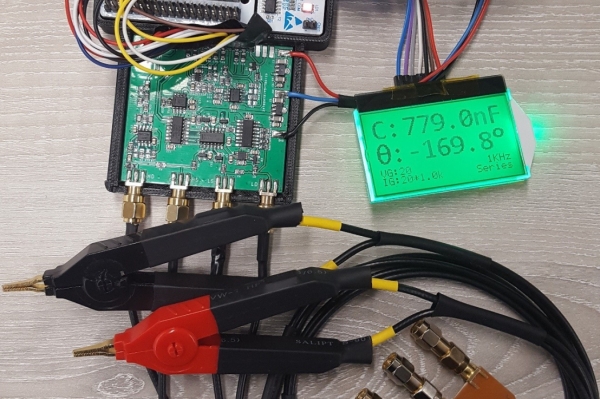
The approach I took was a mixed signal one where a capable analog front end would be paired up with a beefy DSP processor to compute the Impedance. Most importantly, in this scheme, the DSP is responsible for discriminating the phase between the sampled voltage and current waveforms; this approach is preferred because it leads to good accuracy and calibration stability.
The specifications and features were basically designed to mimic a commercial LCR meter. The test frequencies can be chosen from 1, 10 and 100 KHz and are all digitally synthesised. The software supports displaying L, C, R, Z and also an auto mode that classifies the DUT based on its impedance phase. The impedance measurement range with simple calibration has currently been tested from 0.1 Ohm to 10 MOhm with very good accuracy; this range is achieved by a highly reconfigurable analog signal path that allows about 100 voltage and current ranges, most of which are not used to allow easier calibration.
The LCD is a jelly bean 128×64 type and has been divided into a primary display consisting of the measured quantity and a secondary display showing the current measuring range and the impedance representation currently being displayed. The overall cost came to about £55.
Measurement Theory:
Passive Shunt:
The first method is the traditional and broadband technique commonly referred to as the “I-V method”. In this a resistive current shunt is placed in series with the DUT and the voltage across the shunt and the DUT are read off, allowing a calculation of Z.
However, this method has severe practical limitations described briefly below.
Limited I-V gain which is coupled to burden voltage: To keep the burden voltage of the shunt small, the shunt itself is typically, a few mOhms. As a result, I-V gain i.e. the differential voltage across the shunt is very small and on top of a much larger common mode signal. This places very strict performance requirements on the difference amplifier U1 and any subsequent gain stages. The only way to practically increase this signal is to increase the value of RSHUNT, which in turn increases the burden voltage. The source V1 then needs to be increased to keep VZDUT, often a strictly specified test parameter, constant
Difficult to employ solid state range switching: One way to overcome the above problem and to accommodate a wider measurement range is to switch in different shunts for different ranges. However, solid-state CMOS switches can have resistances in the range of 20-150ohms and as they would be placed in series with the shunt, would significantly increase the burden voltage requirement of the setup. The relay would also take up substantial board area and have more complicated drive circuitry.
Read more: LOW COST HIGH ACCURACY STM32 FFT LCR METER
- What approach was used to build the LCR meter?
A mixed signal approach pairing a capable analog front end with a beefy DSP processor. - How does the DSP contribute to accuracy?
The DSP discriminates the phase between sampled voltage and current waveforms for good accuracy and calibration stability. - Which test frequencies are supported by the device?
The device supports digitally synthesized frequencies of 1, 10, and 100 KHz. - What is the measured impedance range of the meter?
The range tested with simple calibration is from 0.1 Ohm to 10 MOhm. - Does the software support automatic component classification?
Yes, it includes an auto mode that classifies the DUT based on its impedance phase. - What type of display is used in the project?
A jelly bean 128×64 LCD is used with a primary and secondary display area. - What is the total cost of building this LCR meter?
The overall cost came to about £55. - Why is the passive shunt method limited in gain?
To keep burden voltage small, the shunt value is low, resulting in very small differential voltage signals. - What issue arises when using solid-state switches for range switching?
CMOS switches have resistances of 20-150ohms which significantly increase the burden voltage requirement.
