
Summary of MEET THE NANOPI R2S FROM FRIENDLYELEC
The NanoPi R2S is an upgraded open-source IoT gateway from FriendlyElec, replacing the R1S with a Rockchip RK3328 processor and 1GB DDR4 RAM. It features dual Gigabit Ethernet ports for WAN/LAN connectivity and supports 4G LTE via USB dongles. Notably, it lacks onboard Wi-Fi, recommending RTL8821CU USB adapters instead. The board also includes a 10-pin I/O header and runs on Ubuntu Core, U-boot, or OpenWrt.
Parts used in the NanoPi R2S:
- Rockchip RK3328 quad-core Cortex-A53 processor
- 1GB DDR4 RAM system memory
- Dual Gigabit Ethernet ports (WAN and LAN)
- Huawei 8372H-155 USB dongle support for 4G LTE
- RTL8821CU USB dongle for Wi-Fi connectivity
- MicroSD slot and SPI flash footprint
- USB Type-A host port and Micro USB power port
- 10-pin I/O header
- Debug Serial Port with 3Pin 2.54mm pitch pin header
- Open-source firmware supporting Ubuntu Core, U-boot, and OpenWrt
In a bid to achieve full rate dual Gigabit, the FriendlyElec team is currently working on its latest open-source IoT application artifact which is an upgraded version of the NanoPi R1S SBC & Gateway, called the NanoPi R2S.
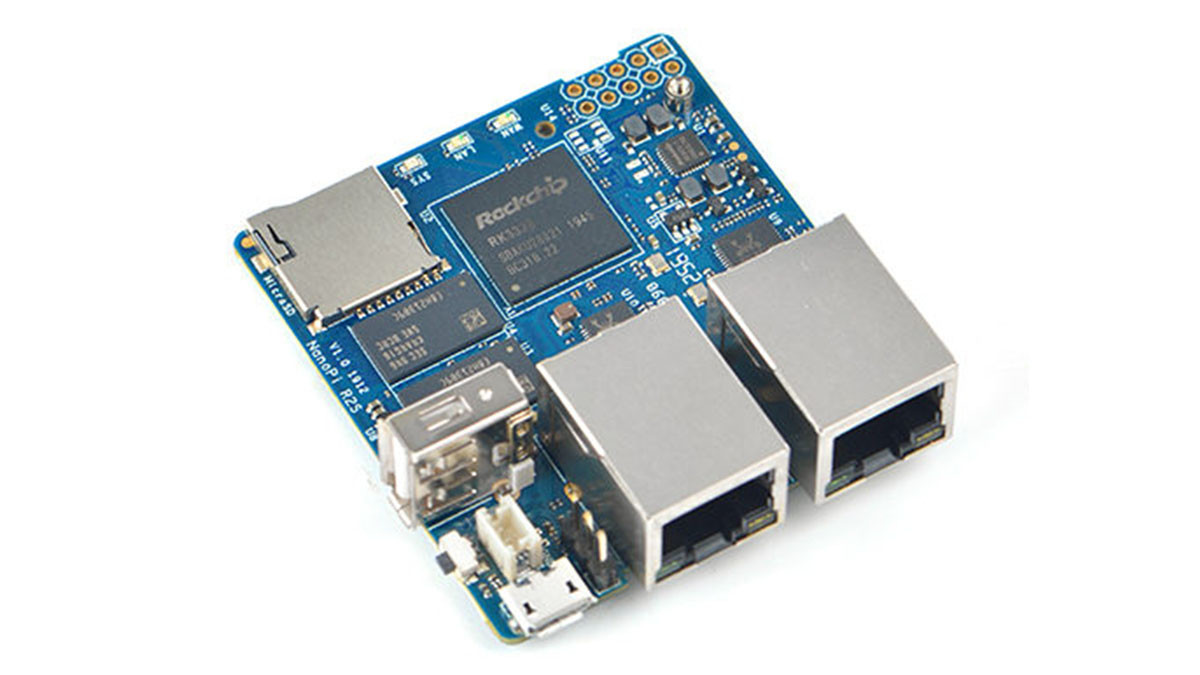
In contrast to the NanoPi R1S which came with 512MB RAM, an Allwinner H3 / H5 processor and a USB 2.0 to Ethernet Controller to mention a few, the new NanoPI R2S is based on the Rockchip RK3328 processor and is expected to come with more system memory including a 1GB DDR4 RAM, along with support for the 4G LTE via Huawei 8372H-155 USB dongle and two Gigabit Ethernet ports (with one deployed for WAN and the other for LAN) each capable of attaining close to 1Gbps.
While most of the features feel like an upgrade. The NanoPi R2S will not be spotting an On-board wiFi due to unclear reasons and it certainly makes things feel like a downgrade on that end. However, instead of the On-board WiFi, friendlyELEC recommends the use of the RTL8821CU USB dongles which will be supported out-of-the-box by the default firmware.
Asides dropping the WiFi and possible memory increases, most of the other features of the new board seem quite similar to the earlier one, although there is a 10-pin I / O in the R2S which cannot be found in the NanoPi R1S board.
Some of the highlight features and specifications of the new R2S include:
- Rockchip RK3328 quad-core Cortex-A53 @ 1.5 GHz
- 1 Gigabit Ethernet (WAN) @ 941 Mbps, 1 Gigabit Ethernet (LAN) @ 941 Mbps
- MicroSD slot and SPI flash footprint for storage
- 1GB DDR4 RAM system memory
- 1 x Ethernet port using the GMAC from the chip, 1 x Ethernet port relying on a USB 3.0 to Ethernet controller
- 1 micro USB port (power + slave)
- 1 USB Type-A host port
- Debug Serial Port: 3.3V TTL level and 3Pin 2.54mm pitch pin header
- 5V DC / 2A power supply via Micro USB por
- tTemperature range of 0℃ to 80℃
- Supports Ubuntu – Core, U-boot, OpenWrt as software/operating systems
- completely open-source for secondary development of personal NAS and enterprise IoT
Read more: MEET THE NANOPI R2S FROM FRIENDLYELEC
- What processor does the NanoPi R2S use?
The board uses a Rockchip RK3328 quad-core Cortex-A53 processor running at 1.5 GHz. - How much system memory does the NanoPi R2S have?
The device comes with 1GB of DDR4 RAM. - Does the NanoPi R2S have onboard WiFi?
No, the NanoPi R2S does not feature onboard WiFi due to unclear reasons. - Can I add WiFi to the NanoPi R2S?
FriendlyElec recommends using RTL8821CU USB dongles which are supported out-of-the-box by the default firmware. - How many Gigabit Ethernet ports are available on the board?
The board has two Gigabit Ethernet ports, one deployed for WAN and the other for LAN, each capable of close to 1Gbps. - Is 4G LTE support available on the NanoPi R2S?
Yes, the board supports 4G LTE via the Huawei 8372H-155 USB dongle. - What operating systems does the NanoPi R2S support?
The board supports Ubuntu Core, U-boot, and OpenWrt as software options. - What unique feature does the R2S have compared to the R1S?
The NanoPi R2S includes a 10-pin I/O header that cannot be found in the earlier NanoPi R1S board.
