
Summary of Minimum Mass Wireless LCD Display using ATtiny2313 microcontroller
This battery-operated LCD display project uses Minimum Mass Wireless Coupler technology to receive data without physical connections. By adapting code from a serial interface project, the system integrates a ferrite loop antenna and passive components to wirelessly display output from devices like a scanning voltmeter. The firmware allows the ATtiny2313 microcontroller to process signals from either the wireless coupler or a UART source simultaneously.
Parts used in the Minimum Mass Wireless LCD Display:
- 2 line X 16 character LCD display (Truly MTC-C162DPLY-2N)
- ATtiny2313 microcontroller
- Ferrite loop antenna
- Two resistors
- One capacitor
- Battery power source
A 2 line X 16 character LCD display that is battery operated and works without an external connection. The basic MinThe basic Minimum Mass Wireless Coupler technology is described and links to other projects on this site that use the Minimum Mass Wireless Coupler are located on the web page, Minimum Mass Wireless Coupler.
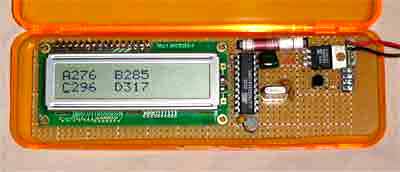
Its an adaptation of the 2X 16 LCD project, by adding a fettite loop antenna,
two resistors, and a capacitor. Here the display shows the output of the
10 bit scanning voltmeter with Minimum Mass Wireless Coupler. Both the
ferrite loop antenna and the scanning voltmeterare described elsewhere on this site.
Downloads
Download the AVRStudio assembly source for the program: rftruly040802A.asm.
Download the AVRStudio assembly source for the include file: vlfcw2313.inc.
Download the AVRStudio assembly source for the include file: vlfcw2313.inc.

This project is an adaptation of A serial interface for the Truly MTC-C162DPLY-2N. Similar to the Minimum Mass Wireless Coupled Frequency Meter project, the firmware was made by adapting that from a finished project. In this case, the part of the code that makes the calls to check for and retrieve data from the UART was modified to also makes calls to check for and retrieve data from the Minimum Mass Wirelss Coupler. In this way, the dispaly can accept and display input from either source, or both at the same time if there was a reason to do that. The benefit is that the display can be used with various other devices. Such as the scanning voltmeter without the need to make a physical connection. Merely place the display near the gizmo sending the signal and read the result.
For more detail: Minimum Mass Wireless LCD Display using ATtiny2313 microcontroller
For more detail: Minimum Mass Wireless LCD Display using ATtiny2313 microcontroller
- How does this display work without an external connection?
It uses a ferrite loop antenna and Minimum Mass Wireless Coupler technology to receive signals wirelessly. - Can the display accept input from multiple sources at once?
Yes, the modified firmware allows it to accept and display input from both the wireless coupler and a UART source simultaneously. - What microcontroller is used in this project?
The project utilizes an ATtiny2313 microcontroller. - Is this device battery operated?
Yes, the display is designed to be battery operated. - Can I use this display with a scanning voltmeter?
Yes, the display can show the output of a scanning voltmeter by simply placing it near the device sending the signal. - What changes were made to the original firmware?
The code was adapted to check for and retrieve data from the Minimum Mass Wireless Coupler in addition to the UART calls. - Where can I find the assembly source files?
Downloadable AVRStudio assembly source files named rftruly040802A.asm and vlfcw2313.inc are available.
