
Summary of Modular User Interface System using ATMega88 microcontroller
The IOSTRING is a modular physical user interface system built around the Atmel AVR AtMega88 microcontroller. It features three basic board modules capable of handling various inputs like switches, encoders, and potentiometers, as well as outputs such as LEDs and LCDs. These modules can be daisy-chained to create complex panels while requiring only a single serial port from the host for control.
Parts used in the Modular User Interface System:
- Atmel AVR AtMega88 MCU
- Switches
- Pushbuttons
- Rotary selector switches
- Rotary shaft encoders
- Potentiometers
- LED's
- LCD displays
- Alphanumeric LED display
- Dual footprints on boards
The IOSTRING is a modular physical user interface system which consists of a series of three basic board modules designed around the Atmel AVR AtMega88 MCU. Each module type can handle switches, pushbuttons, rotary selector switches, rotary shaft encoders, potentiometers, LED’s, LCD displays, and an alphanumeric LED display. Dual footprints are provided on each board to accommodate a large variety of combinations and device types.
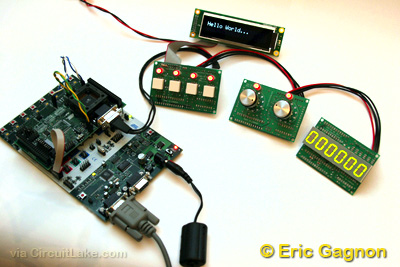
Designers simply assemble IOSTRING modules together in a daisy-chain configuration to form an arbitrarily complex user interface panel. The best part of it is that the host only needs a single serial port to interface to all the IOSTRING modules.
For more detail: Modular User Interface System using ATMega88 microcontroller
- What is the IOSTRING system?
It is a modular physical user interface system consisting of three basic board modules. - Which microcontroller does it use?
The system is designed around the Atmel AVR AtMega88 MCU. - How are the modules connected?
Designers assemble the modules together in a daisy-chain configuration. - Does the host need multiple ports?
No, the host only needs a single serial port to interface with all modules. - Can it handle rotary shaft encoders?
Yes, each module type can handle rotary shaft encoders among other devices. - What output devices are supported?
It supports LED's, LCD displays, and an alphanumeric LED display. - Are there options for different device combinations?
Yes, dual footprints are provided on each board to accommodate a large variety of combinations.
