
Summary of NUT4NT, Open-Source 4-Channel GNSS Receiver Development Board
NUT4NT is a development board from NTLab featuring the NT1065 four-channel, all-frequency GNSS front-end chip with USB 3.0 output. It allows continuous raw sample capture to a PC for offline or real-time processing, enabling centimeter-level precision positioning and antenna-array interference mitigation. Offered in two- and four-input configurations, NUT4NT makes professional multi-frequency, software-defined GNSS evaluation accessible to small teams and startups, and supports precision drone positioning as a lighter, cheaper alternative to traditional RTK setups.
Parts used in the NUT4NT:
- NT1065 four-channel, all-frequency front-end chip
- USB 3.0 interface
- Two-input configuration hardware
- Four-input configuration hardware
- Dual-frequency GNSS antenna (for precision drone use)
- PCB and associated passive components
- Power supply circuitry
- Connectors for antenna inputs
- Firmware/FPGA or microcontroller for interfacing (implied)
Today, multi-frequency multi-signal satellite navigation equipment is designed by professionals working in large companies. It is also manufactured by large specialized companies. But tomorrow everything will change. NTLab — a fabless semiconductor company – has started to manufacture a four-channel, all-frequency front-end chip: the NT1065. It brings professional navigation to the masses. We are introducing NUT4NT – a development board with NT1065 with a USB 3.0 interface for rapid evaluation of the signals being sampled. The full, continuous sample stream can be captured to a PC for recording and/or processing. Now professional equipment products can be developed and produced even by small or startup companies. For more information about the NT1065, please refer to its specification sheet.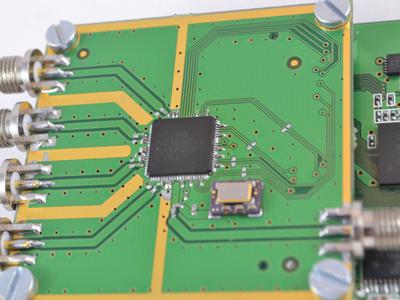
Welcome to a new age of multi-frequency, software-defined GNSS receivers
The core of NUT4NT is the NT1065 chip, which NUT4NT implements in a two-input and four-input system. The main use case of the NT1065 chip is centimeter level precision positioning. This is possible even without the RTK algorithm, which requires a high quality antenna with low phase center variation and sufficient time to converge. The dual input NUT4NT is ideal for this use, providing rapid evaluation of receiving system. Developers can set all the modes of NT1065, capture samples and process it offline or online, in real time.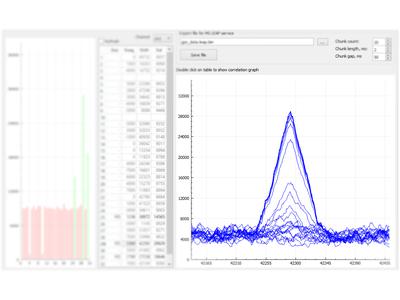 The second use case of the NT1065 is as an array antenna processing system for jammer or interference mitigation. Using the NUT4NT with four inputs, fast evaluation of complex antenna array processing systems in the software is simplified.
Precision drone positioning
Drone developers mostly require precision positioning. Today, they use RTK systems with a base on the ground and a rover in the air. This is both expensive and heavy, with the equipment sometimes weighing more than the drone. A NUT4NT with the dual-frequency antenna provides a lighter, cheaper solution, allowing a new generation of drone developers to evaluate autonomous precision positioning quickly, easily, and affordably.
For more detail: NUT4NT, Open-Source 4-Channel GNSS Receiver Development Board
- What is the core chip used in NUT4NT?
The core chip is the NT1065 four-channel, all-frequency front-end chip. - Can NUT4NT capture continuous raw GNSS samples?
Yes, it provides a full, continuous sample stream that can be captured to a PC. - Does NUT4NT support real-time and offline processing?
Yes, developers can capture samples and process them offline or online in real time. - Is there a multi-input option for antenna array processing?
Yes, NUT4NT is implemented in two-input and four-input systems for array antenna processing. - What precision use case is NUT4NT intended for?
It is intended for centimeter-level precision positioning and rapid evaluation of receiving systems. - Can NUT4NT help with jammer or interference mitigation?
Yes, the four-input configuration simplifies evaluation of complex antenna array processing systems for interference mitigation. - How does NUT4NT benefit drone developers?
It offers a lighter, cheaper alternative to traditional RTK setups, enabling rapid evaluation of autonomous precision positioning with a dual-frequency antenna. - Who manufactures the NT1065 chip?
The NT1065 is manufactured by NTLab, a fabless semiconductor company.
