
Summary of PARTICLE ACCELERATOR FITS ON A CHIP
Stanford researchers have developed a prototype "on-chip integrated laser-driven particle accelerator" using silicon. This device accelerates electrons via infrared laser pulses within a nanoscale vacuum channel, achieving 94% light speed potential when scaled. Unlike massive 2-mile facilities like SLAC, this chip-based approach aims to miniaturize accelerator technology for broader accessibility in chemistry and materials science.
Parts used in the On-chip integrated laser-driven particle accelerator:
- Silicon chip
- Nanoscale channel
- Vacuum cavity
- Infrared laser
- Electrons
- Channel walls
Researchers at Stanford University have demonstrated the acceleration of electrons through what they describe as an “On-chip integrated laser-driven particle accelerator”, detailed in a recent paper published in the Science journal. by Tom Abate
On a hillside above Stanford University, the SLAC National Accelerator Laboratory operates a scientific instrument nearly 2 miles long. In this giant accelerator, a stream of electrons flows through a vacuum pipe, as bursts of microwave radiation nudge the particles ever-faster forward until their velocity approaches the speed of light, creating a powerful beam that scientists from around the world use to probe the atomic and molecular structures of inorganic and biological materials.
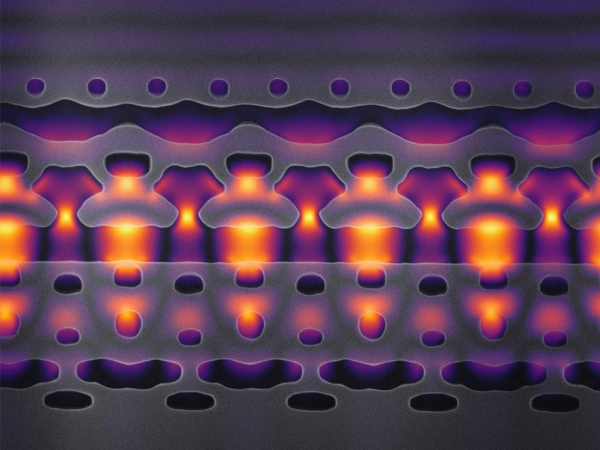
This image, magnified 25,000 times, shows a section of an accelerator-on-a-chip. The gray structures focus infrared laser light (shown in yellow and purple) on electrons flowing through the center channel. By packing 1,000 channels onto an inch-sized chip, Stanford researchers hope to accelerate electrons to 94 percent of the speed of light. (Image credit: Courtesy Neil Sapra)
Now, for the first time, scientists at Stanford and SLAC have created a silicon chip that can accelerate electrons – albeit at a fraction of the velocity of that massive instrument – using an infrared laser to deliver, in less than a hair’s width, the sort of energy boost that takes microwaves many feet.
Writing in the Jan. 3 issue of Science, a team led by electrical engineer Jelena Vuckovic explained how they carved a nanoscale channel out of silicon, sealed it in a vacuum and sent electrons through this cavity while pulses of infrared light – to which silicon is as transparent as glass is to visible light – were transmitted by the channel walls to speed the electrons along.
The accelerator-on-a-chip demonstrated in Science is just a prototype, but Vuckovic said its design and fabrication techniques can be scaled up to deliver particle beams accelerated enough to perform cutting-edge experiments in chemistry, materials science and biological discovery that don’t require the power of a massive accelerator.
“The largest accelerators are like powerful telescopes. There are only a few in the world and scientists must come to places like SLAC to use them,” Vuckovic said. “We want to miniaturize accelerator technology in a way that makes it a more accessible research tool.”
Read more: PARTICLE ACCELERATOR FITS ON A CHIP
- How do Stanford researchers accelerate electrons on a chip?
They carve a nanoscale channel out of silicon, seal it in a vacuum, and transmit pulses of infrared light through the channel walls to speed the electrons along. - Can an infrared laser deliver energy boosts in less than a hair’s width?
Yes, the silicon chip uses an infrared laser to deliver energy boosts that typically require microwaves traveling many feet in massive instruments. - What is the maximum velocity the chip can potentially achieve?
By packing 1,000 channels onto an inch-sized chip, researchers hope to accelerate electrons to 94 percent of the speed of light. - Is the demonstrated accelerator-on-a-chip a final product?
No, the device described in the Science paper is just a prototype. - How does silicon interact with infrared light in this project?
Silicon is as transparent to infrared light as glass is to visible light, allowing the light to be transmitted by the channel walls. - What scientific fields could benefit from this miniaturized technology?
The design can be scaled up to perform experiments in chemistry, materials science, and biological discovery. - Why do scientists want to miniaturize accelerator technology?
Large accelerators are rare global resources; miniaturization aims to make this technology a more accessible research tool. - Who led the team that published these findings?
The team was led by electrical engineer Jelena Vuckovic.
