
Summary of REMOTE MAIL NOTIFIER (AND GPS TRACKER)
The author built a wireless remote mail notifier and GPS tracker for a flat mailbox lacking power or WiFi. Using an A9G GPRS/GPS module, the system sends alerts when the flap opens via an ATtiny402 managing power with a P-MOSFET. Powered by a 10440 lithium battery, it avoids cable runs while offering tracking and bug features.
Parts used in the Remote Mail Notifier:
- A9G GPRS/GPS module
- ATtiny402 microcontroller
- P-MOSFET
- 10440 rechargeable lithium battery
At the moment I’m living in a block of flats and my mailbox is in a central lobby area. I’m often receiving small surprise packets from China and never know when the postman has been, usually between 8 and 12, sometimes even twice a day! I also don’t have any road facing windows that I can look out of for the bright red Royal Mail van.
So, I wanted to make something that can notify me of when the postman comes by and pops something into my mailbox. The previous place I lived at had the mailboxes at the far end of a gated car park, not great when it’s cold and wet!
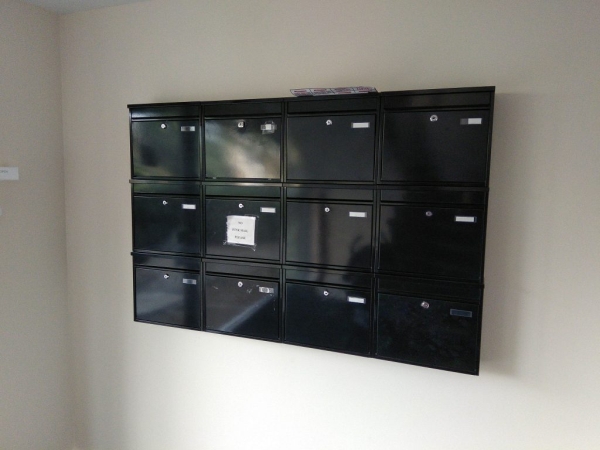
I can’t have any cables going from the mailbox to my flat of course, so a wireless solution is needed. The first choice would have been to use WiFi, but the mailboxes are too far to get a signal to my back to my flat. I could probably use some kind of 433MHz radio module with a receiver in my flat, but I had recently come across A9G GPRS/GPS modules from A.I. Thinker that can have custom firmware loaded onto them. They only cost around £4 each, and it would also mean I don’t have to deal with annoying AT command parsing like with the popular SIM800.
In the end I decided to go with the A9G and add secondary functions of being a listening bug and GPS tracker since it also has a built-in GPS receiver!
Having only an A9G is no good in this project as its shutdown mode still draws a massive 240uA, and the battery would only last a few months between charges. An ATtiny402 was added to deal with power management of the A9G by controlling a P-MOSFET to completely remove power from the module when sleeping. The ATtiny402 also deals with detecting when the mailbox flap has been opened, when the GPS tracking mode button is pressed, when battery charging has completed (for sending a charge complete notification) and making sure the battery voltage is high enough before turning on the A9G. It communicates with the A9G via 1-wire UART, telling it the reason that it was woken up for and a few other things.
The power source is a rechargeable 10440 lithium battery (equivalent size to AAA) with a rated capacity of 380mAh, though the actual measured capacity is 317mAh. The supply voltage range for the A9G is 3.5V – 4.2V and 1.8V – 5V for the ATtiny402, so the lithium-ion voltage range of 3V – 4.2V is perfect. Don’t trust what they write on these batteries, there are no built-in protection circuits!
Read more: REMOTE MAIL NOTIFIER (AND GPS TRACKER)
- Why was WiFi not chosen for this project?
The mailboxes are too far away to get a signal back to the flat. - How does the system manage power consumption?
An ATtiny402 controls a P-MOSFET to completely remove power from the A9G module when sleeping. - What is the rated capacity of the battery used?
The rechargeable 10440 lithium battery has a rated capacity of 380mAh. - Does the 10440 battery have built-in protection circuits?
No, there are no built-in protection circuits in these batteries. - How does the ATtiny402 communicate with the A9G?
It communicates via 1-wire UART to tell the A9G the reason it was woken up. - What additional functions does the A9G provide in this build?
It serves as a listening bug and GPS tracker due to its built-in GPS receiver.
