
Summary of Power and Dependent Sources
The article explains how to calculate the power absorbed by a Voltage-Controlled Voltage Source (VCVS). It determines the controlling voltage across a 2-ohm resistor as 2V, resulting in a controlled source voltage of 4V. With a current of 1.5A flowing through the source, the total power absorbed is calculated to be 6W using the passive convention.
Parts used in the VCVS Power Calculation:
- Voltage-Controlled Voltage Source (VCVS)
- Open circuit
- Controlled-voltage source
- 2 ohm resistor
- 4 ohm resistor
- 6V source
Determine the power absorbed by the VCVS in the figure. Solution: The VCVS consists of an open circuit and a controlled-voltage source. There is no current in the open circuit,
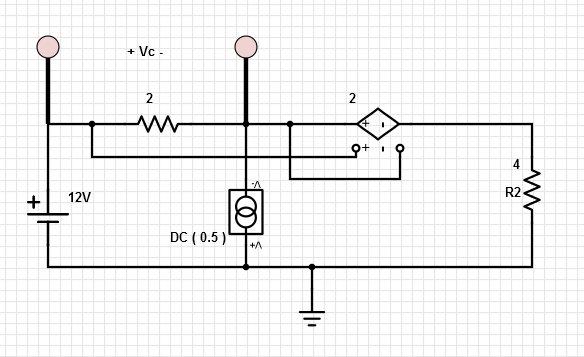
so no power is absorbed by the open circuit. The voltage vc across the open circuit is the controlling signal of the VCVS. The voltage Vc (across 2 ohm resisitor) measures vc to be vc = 2V. The voltage of the controlled voltage source is vd = 2 vc = 4V. The current in the controlled voltage source is 6V/4 ohm= 1.5A. The element current id and voltage vd adhere to the passive convention. Therefore, p = id*vd = (1.5)(4) = 6W is the power absorbed by the VCVS.
For more detail: Power and Dependent Sources
-
How is the controlling signal vc determined?
The voltage vc across the open circuit is measured as 2V across the 2 ohm resistor. -
What is the voltage of the controlled voltage source?
The voltage vd equals 2 times vc, which results in 4V. -
Why is there no power absorbed by the open circuit?
There is no current flowing in the open circuit component. -
How is the current in the controlled voltage source calculated?
The current is calculated by dividing 6V by 4 ohms, resulting in 1.5A. -
Does the element current and voltage adhere to the passive convention?
Yes, the element current id and voltage vd follow the passive convention. -
What is the final power absorbed by the VCVS?
The power absorbed is 6W calculated by multiplying 1.5A by 4V.
