
Summary of RF 2 channel remote control 418MHz using AVR microcontroller
This article describes a low-power 418MHz RF remote control system using an AT90S2323 microcontroller. The design prioritizes battery conservation, achieving standby currents under 1uA via sleep modes, and ensures data integrity through ID bytes and checksums. The transmitter operates at 2400 bps with a range of 10–15m, while the receiver features hardware UART decoding. No coil tuning is required as the RF modules are pre-set for the 418MHz frequency.
Parts used in the 418MHz RF Remote Control:
- AT90S2323 microcontroller
- TLP-418A RF transmitter module
- 3v power supply (battery)
Introduction
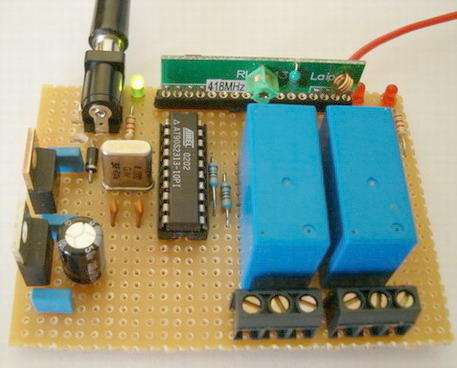
How many times you needed some remote control to handle some electric device ? Many times. There are lot of remote controls like infrared, RF, SMS (like my other circuit) and more. The basic small-range remote controls are 2, Infrared and RF (Radio Frequency). One of the weaks of Infrared is that the signal can not pass the walls. So, if you want to control your garage door, the only way is to use some RF remote control. The circuit (transmitter and receiver) uses few components and ordinary (I love few component circuits) . It’s easy to be built because you don’t have to tune-up any coil or variable capacitor. The RF modules are fix to work in 418MHz area.
I have designed this remote control considering :
a.) the verification of the received data because many other devices are working in this frequency (418MHz)
b.) and the power-saving of the transmitter. A transmitter must have long battery life. It’s not the best choice for you to change the battery every 3 days 😉 . I don’t care about the receiver`s power supply, because receiver must be working all the time.
Features
|
Transmitter
|
Receiver
|
Transmitter description
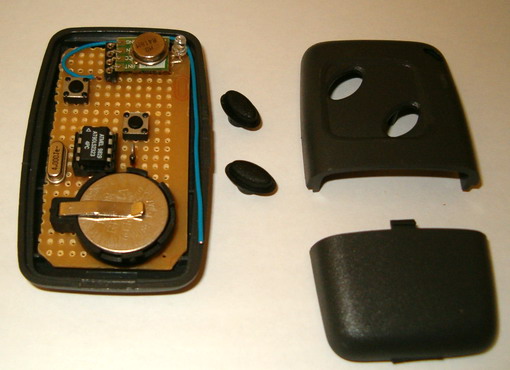
The transmitter is constituted by AT90S2323 microcontroller and TLP-418A RF transmitter module that works at 418MHz. I have designed the transmitter for more battery conservation and safe transmission of the data.
- The battery conservation was made by using the power-down mode of AVR. In this case the AVR goes to sleep with less than 1uA (microampere) current and wait for external interrupt on pin PB1 to awake from sleep mode and continue operating.
For more detail: RF 2 channel remote control 418MHz using AVR microcontroller
- Why is RF chosen over Infrared for this project?
RF is selected because Infrared signals cannot pass through walls, making RF necessary for applications like garage door control. - How does the transmitter achieve such low power consumption?
The AVR microcontroller uses a power-down mode where it sleeps with less than 1uA current until an external interrupt on pin PB1 wakes it. - What frequency do the RF modules operate at?
The RF modules are fixed to work in the 418MHz area. - How is data integrity ensured during transmission?
The system calculates a checksum of the sent data and includes two initial bytes for device recognition to avoid fake commands. - What is the communication speed of the system?
The transmitter and receiver communicate at 2400 bps. - Does the receiver require manual tuning of components?
No, the circuit requires no tuning of coils or variable capacitors because the RF modules are factory-fixed. - What is the expected distance range of the transmitter?
The transmitter provides a distance range of 10 to 15 meters. - How many bytes are used for the communication length?
The communication consists of 4 bytes, which equals 32 bits.
