
Summary of SAY “HELLO” THE NEW FEATHER-COMPACTIBLE ORANGECRAB BOARD
The article introduces the OrangeCrab, a Feather-compatible FPGA board by Greg Davill designed for makers. It features a Lattice Semi ECP5 FPGA with 118 I/O pins, 8Gbit DDR3 memory, and runs a soft RISC-V core using an open-source toolchain. The board includes a LiPo battery connector, QSPI Flash, micro USB, and an SD card socket, aiming to simplify FPGA entry through CircuitPython support.
Parts used in the OrangeCrab:
- Lattice Semi ECP5 FPGA
- DDR3 memory (up to 8Gbit)
- QSPI Flash memory (128Mbit)
- LiPo battery connector
- Micro USB connector
- Micro SD card socket
- RISC-V Core
Owing to the trend that is driving the success of the Feather form factor for boards is the change in the methodology and languages in which boards are now being programmed. It is quite certain that the maker market is in its transition state and it is hard to tell what the next interesting thing disrupting the board ecosystem is, but with the availability of open-source toolchains for FPGA chips, the age of FPGA has come to stay with a number of FPGAboards starting to appear. So, if you are thinking of getting started with using an FPGA board, this could be a good entry point.
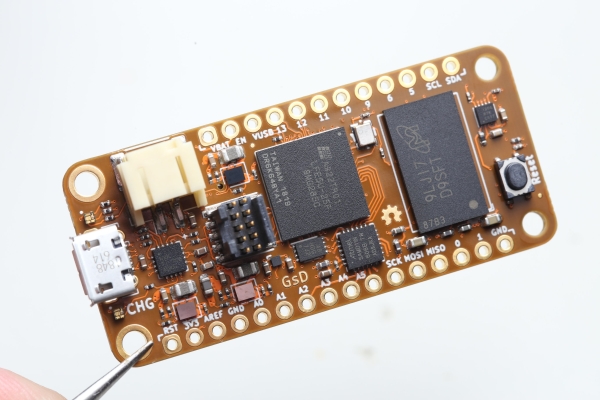
Among the new range of FPGA boards beginning to penetrate the maker market is the new OrangeCrab board from Greg Davill. The feather-compatible board modeled and developed by Davill is capable of running a soft RISC-V Core and has a fully open-source toolchain and according to the tweet by Davil, “
…the USB lines re hooked directly to the ECP5. So it should be possible to port [the CircuitPython] implementation done on Fomu over to this board”.
It is based on a Lattice Semi ECP5 FPGA, with 118 available I/O pins and up to about 8Gbit of DDR3 memory that takes more than 50 pins on the boards but still leaves enough for the board to be pin-compatible with the feather.
The board supports a LiPo battery connector, 128Mbit of QSPI Flash memory, a micro USB connector that allows for a direct UBS connection to the FPGA at full speed as well as a micro SD card socket.
Read more: SAY “HELLO” THE NEW FEATHER-COMPACTIBLE ORANGECRAB BOARD
-
What is the OrangeCrab board?
The OrangeCrab is a new Feather-compatible FPGA board from Greg Davill capable of running a soft RISC-V Core. -
Does the OrangeCrab support CircuitPython?
The developer stated it should be possible to port the CircuitPython implementation done on Fomu over to this board. -
What type of FPGA chip does the board use?
The board is based on a Lattice Semi ECP5 FPGA. -
How many I/O pins are available on the OrangeCrab?
The board has 118 available I/O pins. -
Can the OrangeCrab connect to a battery?
Yes, the board supports a LiPo battery connector. -
What memory types are included on the board?
The board includes up to about 8Gbit of DDR3 memory and 128Mbit of QSPI Flash memory. -
Is the toolchain for the OrangeCrab open source?
Yes, the board comes with a fully open-source toolchain.
