
Summary of Sensor Technologies for Accelerometers
This article explores industrial accelerometers, distinguishing between AC-response devices for dynamic events and DC-response devices capable of measuring static acceleration like gravity. It details piezoelectric sensing mechanisms, highlighting two types: charge mode accelerometers linked to external amplifiers for high durability and temperature ranges, and voltage mode accelerometers with integrated circuits that limit operating temperatures but offer simplified wiring.
Parts used in Industrial Accelerometer Systems:
- Piezoelectric elements
- Accelerometer mass
- Charge amplifier
- Voltage output circuit
- Two or three wire interface
There are many different types of accelerometers for industrial applications, ranging from the latest micro-machined capacitive devices to traditional rugged piezo electric crystals. The boom in portable devices and the advantages of knowing the position and orientation of the equipment, as well as the increased use of accelerometers in vehicle air bags, has led to an explosion in the different types of devices in recent years. All of this is to the advantage of the engineer who can use the wide range of devices for different applications, from monitoring to position measurement.
There are two basic classes of accelerometer: those with an AC response and those with DC response.
An AC-response accelerometer cannot be used to measure static acceleration such as gravity or constant centrifugal acceleration, only dynamic events, while a DC response device can handle measurements down to zero hertz.
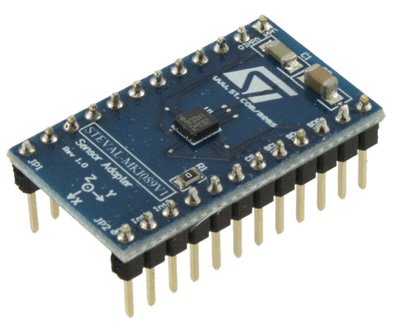
The majority of accelerometers measure the acceleration, but this also provides data on the velocity and position of the equipment by integrating the acceleration curve, and here the AC response devices can struggle as small changes or errors in the measurement can be amplified over time.
The most common AC-response accelerometers use piezoelectric elements as their sensing mechanism. Under acceleration, the mass of the accelerometer causes the piezoelectric element to displace charge, providing an electrical output proportional to the acceleration. The piezoelectric element looks like a source capacitor with a finite internal resistance, typically in the order of 10×9 ohms.
There are two types of piezoelectric accelerometers available: those using charge outputs or those using voltage outputs. The charge mode accelerometer, one of the most durable sensors, is linked to a charge amplifier. This gives a wide dynamic range of over 120 dB and a wide temperature range and so is often seen in applications such as monitoring turbine engines.
The other type of AC accelerometer integrates the charge amplifier directly to produce the voltage output on a two or three wire interface. Because the voltage mode device includes an electronic circuit, this limits the operating temperature of the device to the maximum operating temperature of the electronics, usually +125°C. These devices also have their full scale range pre-determined by the internal amplifier at the factory.
For more detail: Sensor Technologies for Accelerometers
- What are the two basic classes of accelerometers?
They are those with an AC response and those with a DC response. - Can an AC-response accelerometer measure static acceleration?
No, it cannot measure static acceleration such as gravity or constant centrifugal acceleration. - How do most accelerometers provide data on velocity and position?
They provide this data by integrating the acceleration curve. - Why can AC response devices struggle with position measurement?
Small changes or errors in the measurement can be amplified over time during integration. - What is the sensing mechanism for the most common AC-response accelerometers?
The majority use piezoelectric elements as their sensing mechanism. - What gives a charge mode accelerometer a wide dynamic range?
Being linked to a charge amplifier provides a wide dynamic range of over 120 dB. - What limits the operating temperature of voltage mode devices?
The maximum operating temperature of the internal electronics, usually +125°C. - How is the full scale range determined for voltage mode devices?
The full scale range is pre-determined by the internal amplifier at the factory.
