
Summary of SYNTHETIC SENSORS, All-In-One Smart Home Sensor
This article introduces "Synthetic Sensors," a low-cost, single-device solution developed by Carnegie Mellon Ph.D. student Gierad Laput to smart-enable entire rooms without instrumenting individual appliances. Using machine learning and wall socket power, the sensor monitors ambient data like sound patterns to recognize events. It virtualizes raw data into actionable feeds while addressing privacy concerns and enabling developers to create automated IoT triggers for various household tasks.
Parts used in the Synthetic Sensors Project:
- Synthetic Sensor device
- Wall socket power source
- Machine learning algorithms
- Second order sensors
- IoT applications
In the era of Internet of Things, we wanted most of our home appliances to become smart. But currently, smart devices may cost much more than their offline counterparts and they often do not communicate with each other. Trying to overcome these limitations, A Ph.D student invented a way to turn entire rooms into smart with a single low-cost device called “Synthetic Sensors“.
Gierad Laput, is a Ph.D. student of computer-human interaction at Carnegie Mellon University. His research program explores novel sensing technologies for mobile and wearable computing, smart environments, and the Internet of Things.
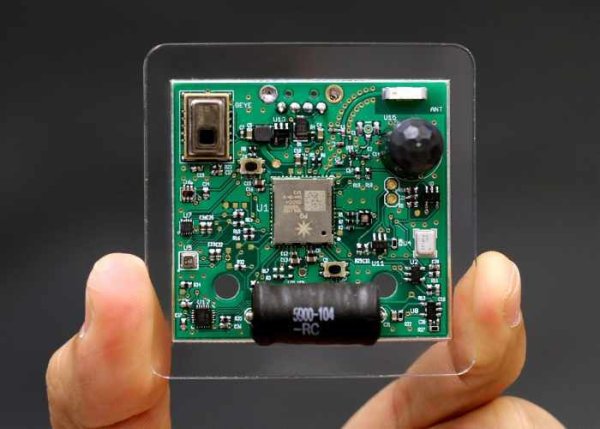
Synthetic Sensor is a general purpose sensor that is powered directly from a wall socket and tracks ambient environmental data to monitor an entire room. It removes the need to attach additional hardware to each of home appliances.
We explore the notion of general-purpose sensing, wherein a single, highly capable sensor can indirectly monitor a large context, without direct instrumentation of objects. Further, through what we call Synthetic Sensors, we can virtualize raw sensor data into actionable feeds, whilst simultaneously mitigating immediate privacy issues. We use a series of structured, formative studies to inform the development of new sensor hardware and accompanying information architecture. We deployed our system across many months and environments, the results of which show the versatility, accuracy and potential of this approach.
The device uses machine learning to recognize the events that happen in the room, like recognizing a particular sound pattern as taking a paper towel, but it cannot monitor when the roll may need to be changed. However, by using a “second order” sensors, the devices can capture counts and send notifications of the need to replenish. This capability can be scaled to an unlimited degree giving consumers highly specific and applicable feedback.
Developers can use the recognized events as triggers for other IoT applications. For example, one could use “left faucet on” to activate a room’s left paper towel dispenser and automatically schedule a restock when its supply runs low.
Read more: SYNTHETIC SENSORS, All-In-One Smart Home Sensor
- What is the main purpose of Synthetic Sensors?
To turn entire rooms into smart spaces using a single low-cost device that tracks ambient environmental data. - How does the device monitor room activity?
It uses machine learning to recognize specific events, such as sound patterns associated with taking a paper towel. - Can the device detect when a supply needs replenishing?
Yes, by using second order sensors to capture counts and send notifications for restocking. - Does this system require attaching hardware to each appliance?
No, it removes the need to attach additional hardware to each home appliance. - Who invented the Synthetic Sensor technology?
Gierad Laput, a Ph.D. student at Carnegie Mellon University. - How do developers utilize the recognized events?
Developers can use recognized events as triggers for other IoT applications like automatic scheduling. - What privacy concern does this approach mitigate?
The system virtualizes raw sensor data into actionable feeds to mitigate immediate privacy issues. - Is the capability of this device scalable?
Yes, the capability can be scaled to an unlimited degree to provide highly specific feedback.
