
Summary of Teardown of an Array 3711A 300W DC Electronic Load
The article details a teardown of the Array 3711A, a 300W DC electronic load capable of 30A and 300V. It features forced-air cooling with four fans and supports constant current, power, and resistance modes via RS232. The compact design mounts power boards directly on heatsinks, requiring partial disassembly for component access. Key internal components include OP07 OpAmps, three relays, six paralleled IRF3205 MOSFETs, and wire-wound power resistors.
Parts used in the Array 3711A:
- Four cooling fans
- Heatsinks
- OP07 ultra-low offset voltage OpAmps
- Three relays
- Six paralleled IRF3205 MOSFETs
- Wire-wound power resistors
- Microcontroller board
- RS232 interface
- Front panel digital board
- Analog board
I have made many electronic loads in the past. For instance this simple harddrive cooler housed small dummy load, this more sophisticated constant current/constant programmable load and this heavy-duty electronic load that is capable of sinking over 1kW under peak load. In this blog post though, I am going to take a look inside an Array 3711A DC electronic load I recently purchased on eBay. You can find a video of this teardown towards the end of the post.
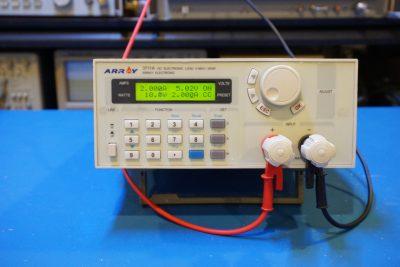
The Arrary 3711A can sink 300W with a maximum load current of 30A and maximum load voltage of 300V. It can be used in constant current, constant power or constant resistance mode and can be controlled remotely via an RS232 interface.
The entire unit is actually quite compact given the amount of power it is capable of dissipating. This can be largely attributed to the efficient forced-air cooling system it uses. There are four fans all together. Two are sitting at the bottom of the chassis that sucks in air. The air then flows through the heatsinks and the hot air gets blown out from the back via another two fans.
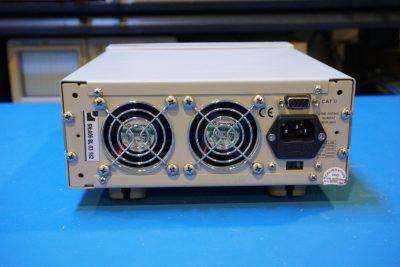
To achieve this compact design, some sacrifices need to be made. This becomes apparent after opening up the top cover. As you can see in the picture below, the power module boards are mounted directly on the heatsinks and the microcontroller board is tucked away behind the front panel. And to access any components located on either the front panel digital board or the analog board located at the bottom of the case you have no choice but to partially dissemble the unit.
And this is exactly what I did. Taking out the front panel is not quite trivial as it turned out. The front panel binding posts are screwed onto the connectors that are soldered onto the bottom board. Getting to these nuts are not easy given the tight clearance. With quite a bit of effort, I was able to eventually take out the bottom main board for a closer look.
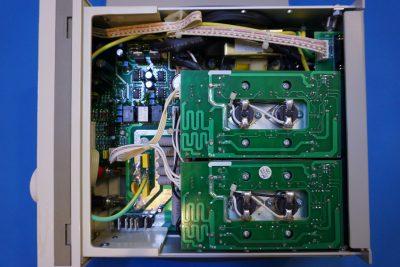
In the picture to the left below, you can see most of the components on the board. The main OpAmps used in the 3711A are OP07 ultra-low offset voltage OpAmps. There are three relays in the unit, two appears to be controlling the input voltage and current sensing and one controls the six paralleled IRF3205which switch the load on and off. Quite a few of the wire-wound power resistors can also be seen.
Read more: Teardown of an Array 3711A 300W DC Electronic Load
-
What is the maximum power rating of the Array 3711A?
The unit can sink 300W with a maximum load current of 30A and a maximum load voltage of 300V. -
How does the unit achieve efficient cooling?
It uses a forced-air cooling system with four fans that suck air in from the bottom and blow hot air out the back. -
Which operational modes are supported by this device?
The device operates in constant current, constant power, or constant resistance modes. -
Can the Array 3711A be controlled remotely?
Yes, it can be controlled remotely via an RS232 interface. -
Why is accessing internal components difficult?
Power module boards are mounted directly on heatsinks and the microcontroller is tucked behind the front panel, requiring partial disassembly. -
What type of operational amplifiers are used in the main circuit?
The main OpAmps used are OP07 ultra-low offset voltage OpAmps. -
How many relays are present in the unit and what do they control?
There are three relays; two control input voltage and current sensing, while one controls the six paralleled IRF3205 switches. -
What specific MOSFETs are used to switch the load?
The unit utilizes six paralleled IRF3205 MOSFETs to switch the load on and off.
