
Summary of THE CORTEX® M4F: ENABLING NEXT-GENERATION REAL-TIME PROCESSING IN I.MX8QM SMARC SYSTEM ON MODULE
iWave Systems released a SMARC System on Module based on the NXP i.MX 8QuadMax, combining heterogeneous 64-bit ARM processors (Dual Cortex-A72, Quad Cortex-A53, Dual Cortex-M4F). The SOM targets real-time, multimedia, and multi-OS applications, with the Cortex-M4F providing low-latency, energy-efficient real-time processing and peripherals for timers, fast GPIO, interprocessor messaging, and low-power serial interfaces, enabling separation of compute-intensive tasks on A cores and deterministic control on M4F cores.
Parts used in the i.MX 8QuadMax SMARC SOM:
- NXP i.MX 8QuadMax applications processors
- Dual Cortex-A72 cores @ 1.8 GHz
- Quad Cortex-A53 cores @ 1.2 GHz
- Dual Cortex-M4F cores @ 266 MHz
- Nested Vectored Interrupt Controller
- Memory Protection Unit (MPU)
- Floating Point Unit (FPU)
- LPIT (Low-power Periodic Interrupt Timer)
- TPM (Timer PWM Module)
- RGPIO (Rapid General-Purpose Input/Output)
- MU (Messaging Unit)
- INT MUX (Interrupt Mux)
- SEMA42 (hardware semaphore)
- LPI2C (Low-Power I2C)
- LPUART (Low-Power UART)
iWave systems recently launched a new SMARC System on Module (SOM) based on the powerful NXP® i.MX 8QuadMax applications processors. This high performance SOM features an intelligent blend of MPUs+MCU power in a single device and integrates heterogeneous multicore 64 bit ARM® processors (Dual Cortex® A72@ 1.8 GHz + Quad Cortex® A53 @ 1.2 GHz and Dual Cortex® -M4F @ 266 MHz), targeted for applications that demand advanced real-time processing, multi-media performance as well as in applications that requires simultaneous multi-OS operations.
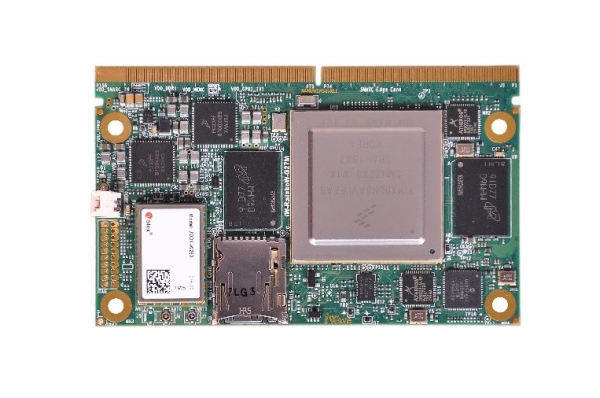
For more details refer to the link: i.MX8 QuadMax NXP SMARC SOM
The Cortex® M4F microcontroller plays an integral part in realizing various real-time operations of the SOM module. It is a powerful energy-efficient microcontroller core with floating-point arithmetic functionality that offers a low-latency execution environment with real-time and low-power processing capability running bare-metal code or a real-time operating system like FreeRTOS.
The Cortex® ‑M4F microcontroller incorporates the following key features:
- A processor core.
- A Nested Vectored Interrupt Controllerfor low-latency interrupt processing.
- Multiple high-performance bus interfaces.
- Memory Protection Unit(MPU) & Floating Point Unit (FPU).
- LPIT (Low-power Periodic Interrupt Timer) for periodic timer services
- TPM (Timer PWM Module) for timer and PWM services
- RGPIO (Rapid General-Purpose Input/Output) for the fast pin I/O capability
- MU (Messaging Unit) for interprocessor communication
- INT MUX (Interrupt Mux) to select local interrupts routed outside of the subsystem
- SEMA42 (hardware semaphore) for HMP synchronization to shared resources
- LPI2C (Low-Power I2C) for serial communication
- LPUART (Low-Power UART) for serial communication and debug
Optimized performance and efficiency for real-time processing:
To optimize performance and increase system efficiency it is always effective to separate computation tasks between various Cortex® cores. The Cortex® A cores runs high-level OS
(Linux /Android) and can be used to drive applications that demand compute-intensive graphics (2D/3D), 4K video, high speed data processing etc., while real-time applications such as sensor monitoring, data acquisition, motor control, etc., requires high degree of determinism and DSP capability which can be handled very efficiently by the RTOS running on the Cortex® M4F cores. In addition, the SOM supports simultaneous operation of multiple OS platforms that enables the cores to drive totally independent applications, for e.g. When the Cortex® A cores handle a system for HMI or an instrument cluster, the Cortex® M4F can drive the circuitry for sensor control while utilizing RPC for interprocessor communications.
Read more: THE CORTEX® M4F: ENABLING NEXT-GENERATION REAL-TIME PROCESSING IN I.MX8QM SMARC SYSTEM ON MODULE
- What processors does the SMARC SOM use?
The SOM uses NXP i.MX 8QuadMax processors with Dual Cortex-A72, Quad Cortex-A53, and Dual Cortex-M4F cores. - Can the Cortex-M4F run real-time operating systems?
Yes, the Cortex-M4F can run bare-metal code or a real-time operating system like FreeRTOS. - What real-time features does the Cortex-M4F include?
It includes a processor core, Nested Vectored Interrupt Controller, MPU, FPU, LPIT, TPM, RGPIO, MU, INT MUX, SEMA42, LPI2C, and LPUART. - Does the SOM support simultaneous multiple OS operations?
Yes, the SOM supports simultaneous operation of multiple OS platforms enabling independent applications on different cores. - How should tasks be divided between cores for optimized performance?
Use Cortex-A cores for compute-intensive tasks like graphics and video, and Cortex-M4F for deterministic real-time tasks like sensor monitoring and motor control. - What is the role of the Messaging Unit (MU)?
The MU provides interprocessor communication between cores. - Is the Cortex-M4F energy efficient?
Yes, the Cortex-M4F is described as an energy-efficient microcontroller core with low-power processing capability. - Can the Cortex-A cores run Linux or Android?
Yes, the Cortex-A cores can run high-level OS such as Linux or Android.
