
Summary of TINY MICROSUPERCAPACITOR THAT COULD POWER FUTURE WEARABLES
Researchers at UNIST developed a micro-supercapacitor printed directly onto circuits using electrohydrodynamic jet printing. This ultra-dense device, roughly the size of a fingerprint, achieves high power output for IoT and wearable applications by overcoming previous manufacturing limits.
Parts used in the Micro-supercapacitor:
- Electrohydrodynamic jet printer
- Electrode
- Electrolyte
- Chip
- Solid-state MSC unit cells
A group of researchers from the Ulsan National Institute of Science and Technology (UNIST), South Korea, have designed a really tiny and ultra-dense Micro-supercapacitor that can be printed directly into circuits.
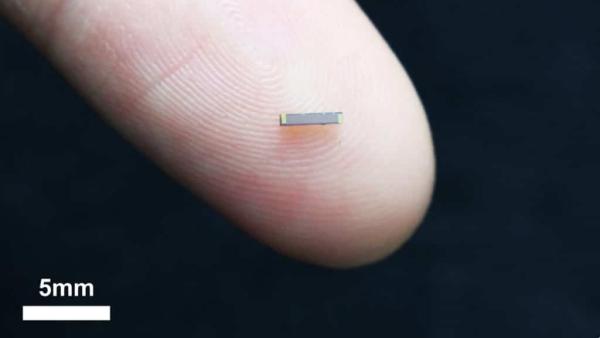
- “Microsupercapacitors (MSCs) have garnered considerable attention as a promising power source for microelectronics and miniaturized portable/wearable devices. However, their practical application has been hindered by the manufacturing complexity and dimensional limits.”
the team explains in the abstract of the paper.
The Micro-supercapacitor, as tiny as it is (roughly the width of a human fingerprint), is being positioned as the next big thing in the world of IoT — it could power both future wearables and embedded IoT devices.
The team from the School of Energy and Chemical Engineering was able to conduct a study, the first of its kind that exploits electrohydrodynamic jet printing in the micro-supercapacitors. They fabricated a new class of ultra-high areal number density solid-state MSCs directly on a chip via EHD jet printing. EHD jet printing is a high-resolution patterning technique that uses the electrode and electrolyte for printing purposes. It is similar to conventional inkjet printing but it can control printed liquid with an electric field.
And the results?
“We were able to produce up to 54.9 unit cells per square centimeter (cm2) via electro-hydrodynamic jet printing technique, and thus the output of 65.9 volts (V) was achieved in the same area,” the first author of the project, Kwonhyung Lee, explains.
Read more: TINY MICROSUPERCAPACITOR THAT COULD POWER FUTURE WEARABLES
- What is the primary application of this new micro-supercapacitor?
It is positioned as a power source for future wearables and embedded IoT devices. - How does the electrohydrodynamic jet printing technique work?
It uses an electric field to control printed liquid with an electrode and electrolyte, similar to inkjet printing but with higher resolution. - What was the achieved output voltage in the same area?
The team achieved an output of 65.9 volts in the tested area. - Can this device be integrated directly into circuits?
Yes, it can be printed directly into circuits and fabricated on a chip. - What problem does this technology solve compared to existing microsupercapacitors?
It overcomes the manufacturing complexity and dimensional limits that hindered practical application. - What is the density of unit cells produced per square centimeter?
The researchers produced up to 54.9 unit cells per square centimeter. - Which institution led this research project?
The study was conducted by researchers from the Ulsan National Institute of Science and Technology in South Korea. - Is this the first study to use electrohydrodynamic jet printing for these capacitors?
Yes, the team conducted the first study of its kind exploiting this technique in micro-supercapacitors.
