
Summary of ZERO VOLTAGE SWITCHING CHIPSET SHRINKS HIGH-POWER-DENSITY POWER SUPPLY UNITS TO 100W AND BEYOND
Dialog Semiconductor's innovative Zero Voltage Switching (ZVS) chipset reduces size and cost for high-power portable power supplies. This solution targets 100W+ PSUs, making them 30-50% smaller than conventional units. It integrates the iW9801 primary controller and iW709 secondary USB PD IC with a synchronous rectifier, eliminating extra compensation components. The system supports fast charge protocols like USB PD 3.0 with PPS, operates up to 200 kHz, and offers robust protection with low standby power under 20mW.
Parts used in the ZVS RapidCharge Solution:
- iW9801 primary-side controller
- iW709 secondary-side USB PD protocol IC
- Integrated synchronous rectifier controller
- Secondary-side digital compensation loop
- Transformer
- Passive components
The innovative digital Zero Voltage Switching (ZVS) chipset from Dialog Semiconductor enables designers to reduce component size and BOM cost for delivering small form-factor, lightweight power supplies, including travel adapters for smartphones, tablets, laptops, power tools, and other portable devices. Targeting high power density PSUs with Zero Voltage switching technology, these new devices enable 100 Watt and beyond High Power Density (HPD) Power Supply Units (PSUs) that are 30-50% smaller than conventional high power PSUs.
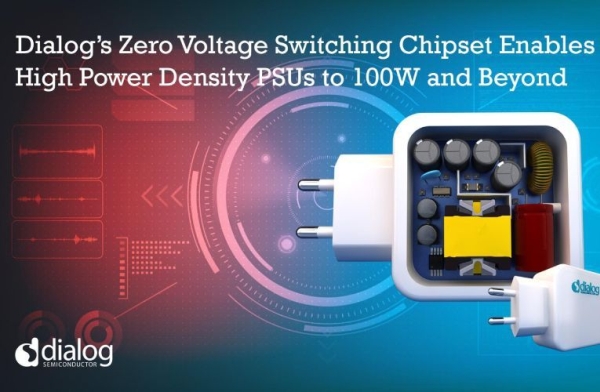
The easy-to-use ZVS RapidCharge solution comes integrated with the iW9801 primary-side controller and the iW709 secondary-side USB PD protocol IC. Additionally, there is an integrated synchronous rectifier controller in the secondary-side iW709 further reduces the overall component count. This secondary-side digital compensation loop ensures stability and eliminates the need for extra compensation components.
The ZVS chipset solution enables customers to simply design higher power density chargers that are lightweight, ultra-small, and quite cost-effective. It offers robust protection for over-voltage (OVP), over-current (OCP), user-configurable over-temperature, shoot-through, brown-in/brown-out VSENSE/ISENSE short, output short, and extra primary-side OCP and OVP. Besides, low standby power of less than 20mW makes it an eco-friendly solution.
The chipset supports most fast charge protocols, including USB PD 3.0 with Programmable Power Supply (PPS) and other third-party proprietary protocols. With the option to employ switching frequencies up to 200 kHz, designers can use a much smaller and lighter transformer and smaller passive components thereby reducing the charger size and weight.
Read more: ZERO VOLTAGE SWITCHING CHIPSET SHRINKS HIGH-POWER-DENSITY POWER SUPPLY UNITS TO 100W AND BEYOND
- How much smaller are these new power supply units compared to conventional ones?
The new devices enable power supply units that are 30-50% smaller than conventional high power PSUs. - What is the maximum switching frequency supported by this chipset?
The chipset supports employing switching frequencies up to 200 kHz. - Which fast charge protocols does the chipset support?
The chipset supports most fast charge protocols including USB PD 3.0 with Programmable Power Supply and other third-party proprietary protocols. - Does the iW709 chip require extra compensation components?
No, the secondary-side digital compensation loop ensures stability and eliminates the need for extra compensation components. - What is the standby power consumption of this eco-friendly solution?
The solution features a low standby power of less than 20mW. - Can this chipset be used for travel adapters for laptops?
Yes, the chipset enables designers to deliver small form-factor power supplies for travel adapters for smartphones, tablets, laptops, and other portable devices. - What specific protections are included in the chipset?
The chipset offers robust protection for over-voltage, over-current, user-configurable over-temperature, shoot-through, brown-in/brown-out VSENSE/ISENSE short, output short, and extra primary-side OCP and OVP. - How does using higher switching frequencies affect component size?
With the option to employ switching frequencies up to 200 kHz, designers can use a much smaller and lighter transformer and smaller passive components.
