
Summary of The Tuxgraphics AVR NTP clock using ATmega168
This article describes building an AVR-based NTP clock using an ATmega168 microcontroller, a tuxgraphics Ethernet board, and a 16x2 LCD display. The device synchronizes time via UDP packets from an NTP server at startup and hourly, maintaining accuracy locally with an onboard crystal. A built-in web server allows configuration, while the system handles complex 32-bit math for date conversion, necessitating the larger memory of the ATmega168 over the ATmega88.
Parts used in the AVR NTP Clock:
- tuxgraphics ethernet board
- LCD display (16x2 with blue backlight)
- AVR webserver SMD board
- ATmega168 microcontroller
- Acrylic glass sheet
- Ericsson Mobile phone charger (5V DC power supply)
- Onboard crystal
The Network Time Protocol (NTP) has revolutionized the world. Suddenly one could have anywhere in the world accurate time and date. NTP is a simple UDP based protocol and can be implemented in a Microcontroller.
Using the tuxgraphics ethernet board and a LCD display we build a nice clock which gets time and date via NTP. Just attach it to you DSL router!
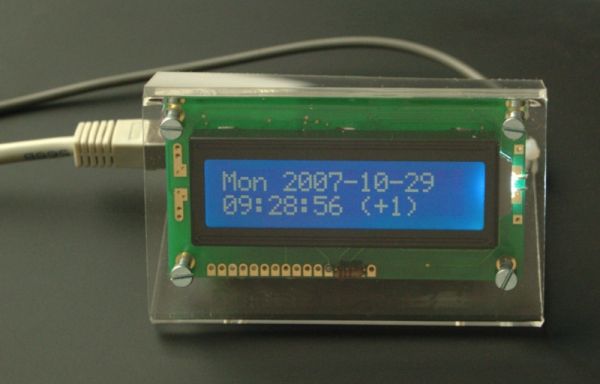
A NTP client
So far we have only implemented UDP and TCP servers. A clock needs however to be a client. This is something new. A server just answers to incoming IP packets it is therefore a bit easier to implement. However NTP is a short packet and it is therefore possible to add a NTP client to the existing network stack. We can therefore build a clock which has not only a LCD display but also a build-in webserver. This can then be used to configure the clock or see the current time.
The NTP protocol is described in RFC958. Essentially it is just a 64 bit time-stamp. 32 bits of this time-stamp are the seconds in UTC (=GMT Greenwich mean time) since since Jan. 1st 1900. The other 32 bits are fractions of a second. In other words NTP can be very very accurate. For our purposes it is however enough if we just evaluate the seconds.
The AVR NTP clock synchronizes at startup with a NTP server and uses then a timer interrupt to maintain time locally. Every hour it tries then to synchronize again. If your DSL router is however off during the night then it’s not a problem. The clock just continues. We use the on board crystal to maintain the clock locally. This will minimize the drift even if no Internet connection was possible for a couple of days.
How to build a clock
A clock is essentially just a counter. Since NTP is already a 32-bit “counter” we just take a 32bit variable and increment it. That is: the initial setting of the counter comes via NTP and then we just count up every second.
For this we just generate a timer interrupt every second. The 16bit timer/counter of the atmega168 supports this already on hardware level.
The basic clock is therefore just this:
// interrupt, step seconds counter
ISR(TIMER1_COMPA_vect){
        time++;
}
The hardware interrupt is generated every second and we step the counter “time”. Very easy.
If you had already a look at the code you might have noticed that the included README file says that one needs an atmega168 for this and a atmega88 not sufficient. Why should such a simple counter not fit into an atmega88 chip??.
The problem is the math to convert seconds since day-X into a human readable format. This requires quite heavy math for a microcontroller. AVR is a 8-bit processor therefore 32-bit math is expensive. Add the NTP client, the web-server and the LCD driver and you are above the 8Kb available in the atmega88. An atmega168 has however more than sufficient space. It fills not more than 2/3 of the atmega168. You can therefore easily add additional functions to this wall clock if you want.
The tuxgraphics AVR NTP clock
The 16×2 LCD display with blue backlight and the AVR webserver SMD board are mounted on an acrylic glass sheet. For the power supply I used an old Ericsson Mobile phone charger (not visible on the picture). It produces 5V DC and is very light as it is a switched power supply. It plugs directly into the wall socket and the 5V DC output is then connected via a 1.5m cable to the clock. I got the charger at ebay for 2 Euro.
For more detail: The Tuxgraphics AVR NTP clock using ATmega168
- How does the clock maintain time without internet?
The clock uses its onboard crystal and timer interrupts to maintain time locally when the internet connection is unavailable. - Can I use an ATmega88 instead of an ATmega168?
No, the ATmega88 lacks sufficient memory space for the required 32-bit math, NTP client, web server, and LCD driver code. - What protocol does this clock use for time synchronization?
The clock uses the Network Time Protocol (NTP), which is a simple UDP based protocol described in RFC958. - How often does the clock synchronize with the NTP server?
The clock synchronizes at startup and attempts to synchronize again every hour. - What is the purpose of the built-in web server?
The web server allows users to configure the clock or view the current time directly through a browser. - How is the time data structured in the NTP protocol?
NTP uses a 64-bit timestamp consisting of 32 bits for seconds since Jan 1st 1900 and 32 bits for fractions of a second. - What power source is recommended for this project?
An old Ericsson Mobile phone charger producing 5V DC is used as a light and efficient switched power supply. - Does the clock continue working if the DSL router is off?
Yes, the clock continues running on its internal timer and crystal even if the router is off during the night.
