
Summary of MAKERDIARY RELEASES PITAYA GO IOT DEVELOPMENT BOARD BASED ON NORDIC’S NRF52840 SOC
Makerdiary's Pitaya Go is a compact IoT development board integrating the Nordic nRF52840 SoC and Microchip ATWINC1500B Wi-Fi controller. This combination enables Bluetooth 5, Thread, Zigbee, and 802.11 b/g/n connectivity within a small 60.96mm x 25.4mm package. The board features 1MB Flash, 256KB RAM, an RGB LED, NFC-A tag support, and a reversible USB-C connector, making it ideal for diverse wireless applications requiring low power and high performance.
Parts used in the Pitaya Go IoT Development Board:
- Nordic Semiconductor nRF52840 SoC
- Microchip ATWINC1500B Wi-Fi Network Controller
- 64Mbit ultra-low-power QSPI Flash Memory
- Integrated Li-Po Battery Charger with Power Path Management
- NFC-A Tag PCB Antenna
- User-programmable RGB LED
- Dual Wi-Fi/Bluetooth 2.4G Chip Antennas
- Reversible USB-C Connector
- Li-Po Battery Connector
- Expandable dual 14-Pin Header Sockets
Makerdiary one of the most innovative startups in the IoT devices space which are known for a series of development boards like the nRF53832-MDK V2 IoT module, and the nRF52840 MDK USB dongle, among others, recently launched a new addition to their impressive line of Nordic’s nRF528xx-series of SoCs based IoT devices, called; Pitaya Go IoT Development Board.
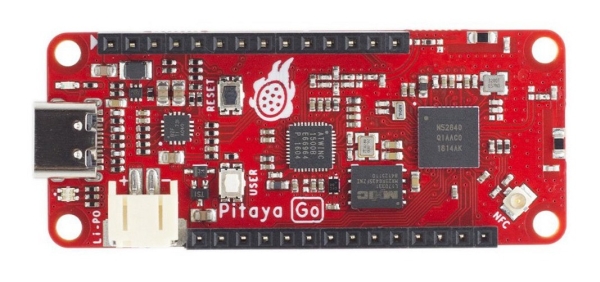
The Pitaya Go combines the Nordic’s nRF52840 SoC with an Arm Cortex-M4 (256Kb of RAM/1Mb of Flash) with FPU, and a Microchip’s ATWINC1500B Wi-Fi controller, in a 60.96mm x 25.4mm x 7.6mm package. This combination brings in a wealth of features which drives the array of connectivity options and high performance associated with the Pitaya Go.
Some of the features of the Pitaya Go include;
- Nordic Semiconductor nRF52840 SoC
- 64 MHz Arm® Cortex-M4 with FPU
- 1 MB Flash + 256 KB RAM
- Bluetooth 5, Bluetooth mesh, Thread, Zigbee, 802.15.4, ANT and 2.4 GHz proprietary
- Arm TrustZone® Cryptocell 310 Security Subsystem
- Integrated USB 2.0 Full-speed Controller
- QSPI/SPI/TWI/I²S/PDM/QDEC/ADC support
- Integrated NFC-A Tag
- Microchip ATWINC1500B Wi-Fi Network Controller
- Shipped with the latest firmware 19.6.1
- IEEE 802.11 b/g/n 20 MHz (1×1) Solution
- Extreme low power with Shutdown Control
- On-Chip Network Stack to Offload MCU
- Supports Soft-AP
- Security protocols supported: WPA/WPA2 Personal, TLS/SSL
- Enterprise Security with WPA/WPA2 (802.11x)
- Network services: DHCP, DNS, TCP/IP (IPv4), UDP, HTTP, HTTPS, MQTT, etc.
- 64Mbit ultra-low-power QSPI Flash Memory
- Integrated Li-Po Battery Charger with Power Path Management
- Additional NFC-A Tag PCB Antenna
- User-programmable RGB LED and Buttons
- Dual Wi-Fi/Bluetooth 2.4G Chip Antennas
- Reversible USB-C Connector
- Li-Po Battery Connector
- Easily expandable dual 14-Pin Header Sockets
- Measures 2.4″ x 1.0″ x 0.3″ (60.96mm x 25.4mm x 7.6mm)
Rounding out the Pitaya’s features are an integrated Li-Po battery charger (with power path management), additional NFC-A tag PCB antenna, programmable RGB LED and buttons, dual Wi-Fi/Bluetooth 2.4G chip antennas, USB-C port, Li-Po battery connector, and an expandable 14-pin header.
Read more: MAKERDIARY RELEASES PITAYA GO IOT DEVELOPMENT BOARD BASED ON NORDIC’S NRF52840 SOC
- What processor powers the Pitaya Go?
The board uses the Nordic Semiconductor nRF52840 SoC with a 64 MHz Arm Cortex-M4 core. - Does the Pitaya Go support Wi-Fi connectivity?
Yes, it includes the Microchip ATWINC1500B Wi-Fi controller supporting IEEE 802.11 b/g/n. - How much memory does the Pitaya Go have?
It features 1 MB of Flash and 256 KB of RAM alongside a separate 64Mbit QSPI Flash Memory. - Can the Pitaya Go be powered by a battery?
Yes, it has an integrated Li-Po battery charger with power path management and a dedicated battery connector. - What wireless protocols are supported besides Wi-Fi and Bluetooth?
The device supports Thread, Zigbee, 802.15.4, ANT, and proprietary 2.4 GHz protocols. - Is there NFC support on this board?
Yes, it includes an integrated NFC-A Tag and an additional NFC-A Tag PCB Antenna. - What type of USB connector is used on the Pitaya Go?
The board utilizes a reversible USB-C connector. - Can the Pitaya Go expand its interface via headers?
Yes, it comes with easily expandable dual 14-Pin Header Sockets.
