
Summary of CREATE +/-12V SPLIT RAIL FROM A 5V BIAS
Digital semiconductor trends lower system voltages, degrading analog sensor accuracy. This article describes a flyback circuit using a switch-mode regulator and transformer to generate a ±12V split-rail bias from a 5V single-rail supply, improving signal-to-noise ratio and measurement precision.
Parts used in the Split-Rail Bias Circuit:
- Texas Instruments LM5001 switch-mode regulator
- Center-tapped transformer T1
- Diode D3 with snubber components
- Diodes D2 and D4 (half-wave rectifiers)
With digital semiconductor technology driving system power supplies to lower voltages for higher performance and lower system power, sensitive analog sensor circuits face a growing problem. Much of the inherent noise created in the early stages of an analog sensor signal path is independent of the amplifier bias voltage, so using a higher bias voltage yields better accuracy and performance than a lower bias. With supply voltages dropping, then, designers must tolerate the loss of accuracy (SNR) due to the lower available voltage or derive a higher voltage bias from the available system supply.
In addition to the voltage, designers need to consider the ground. In many cases the sensor circuit must have bias voltages both above and below signal ground. That signal ground can be either a true system ground or a virtual ground created at the midpoint of a single-rail power supply. Using a true system ground requires “split-rail” biasing (±V), but yields improved performance as a result of reduced leakage currents and reduced variations in a virtual ground, both of which affect measurement accuracy.
To obtain the best performance from the analog front end, then, designers need a method of creating a higher voltage split-rail bias from a lower-voltage single-rail supply. One way to create this split-rail voltage is to use a switch-mode regulator IC in concert with a small transformer. This forms a flyback design that uses less than one square inch of board space.
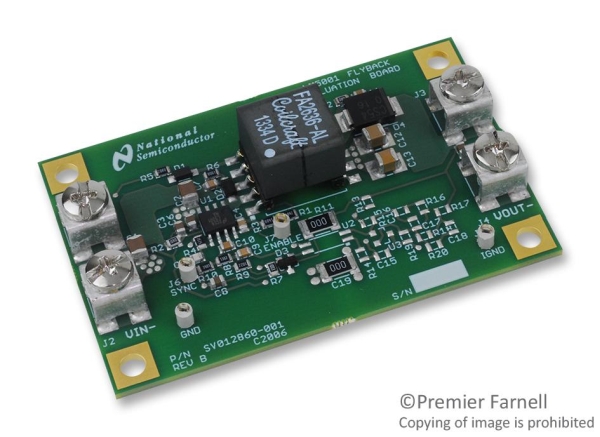
The circuit of Figure 1 boosts a nominal 5-V single-rail supply (4.5 to 5.5 V) to a low-noise, ±12-V bias and can be adapted to develop other voltages such as ±15 V. The design uses a Texas Instruments LM5001 (U1) switch-mode regulator that integrates a pulse-width modulation (PWM) generator, a switching transistor, a voltage reference, and an error amplifier that controls the PWM duty cycle based on a comparison between the reference and the feedback signal on pin 6.
The regulator switches current through the primary of center-tapped transformer T1, and the PWM duty cycle determines the output voltage at the secondary. Diode D3 and its attached components serve as a snubber to minimize transient noise and ringing on the transformer input when the regulator’s internal switch opens. Diodes D2 and D4 serve as half-wave rectifiers for the transformer’s output.
Read more: CREATE +/-12V SPLIT RAIL FROM A 5V BIAS
- Why do designers need higher bias voltages for analog sensors?
Higher bias voltages yield better accuracy and performance because inherent noise in early signal stages is often independent of amplifier bias voltage. - What problem arises when supply voltages drop?
Designers must tolerate a loss of accuracy measured as SNR or derive a higher voltage bias from the available lower system supply. - How does true system ground improve performance compared to virtual ground?
True system ground reduces leakage currents and variations that affect measurement accuracy, offering improved performance over a virtual ground. - What method creates a high-voltage split-rail bias from a low-voltage supply?
Using a switch-mode regulator IC in concert with a small transformer forms a flyback design that fits in less than one square inch. - What voltage range does the Figure 1 circuit boost?
The circuit boosts a nominal 5-V single-rail supply ranging from 4.5 to 5.5 V to a low-noise ±12-V bias. - Can this design be adapted for other voltages?
Yes, the design can be adapted to develop other voltages such as ±15 V. - What functions are integrated into the LM5001 regulator?
The regulator integrates a PWM generator, switching transistor, voltage reference, and error amplifier. - What is the purpose of diode D3 and its components?
They serve as a snubber to minimize transient noise and ringing on the transformer input when the internal switch opens.
