
Summary of INA190-Q1 – 40V, BI-DIRECTIONAL, ULTRA-PRECISE CURRENT SENSE AMPLIFIER
The INA190-Q1 is an automotive-grade, low-power current-sense amplifier designed for 12-V battery systems. It features a wide common-mode voltage range up to 40 V and bidirectional sensing. With ultra-low input bias currents and zero-drift architecture, it enables precise microamp-level measurements using either large or small sense resistors. Available in five gain options, this AEC-Q100 qualified device ensures high accuracy across extreme temperatures.
Parts used in the INA190-Q1 Project:
- INA190-Q1 Current-Shunt Monitor
- Current-Sense Resistor (Shunt)
- Automotive 12-V Battery
- Power Supply (VS: 1.7 V to 5.5 V)
- Temperature Grade 1 Component (–40°C to +125°C)
The INA190-Q1 is an automotive, low-power, voltage-output, current-shunt monitor (also called a current-sense amplifier). This device is commonly used for monitoring systems directly connected to an automotive 12-V battery. The INA190-Q1 can sense drops across shunts at common-mode voltages from –0.2 V to +40 V, independent of the supply voltage. In addition, the input pins have an absolute maximum voltage of 42 V.
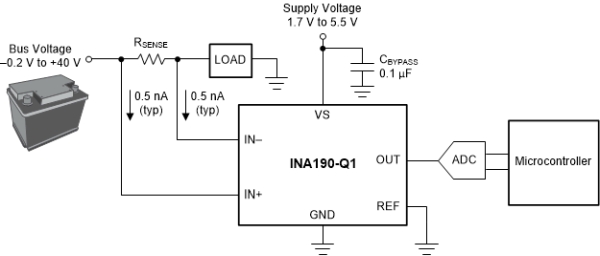
The low input bias current of the device permits the use of larger current-sense resistors, thus providing accurate current measurements in the microamp range. The low offset voltage of the zero-drift architecture extends the dynamic range of the current measurement. This feature allows for smaller sense resistors with lower power loss, while still providing accurate current measurements.
Features
- AEC-Q100 qualified for automotive applications:
- Temperature grade 1: –40°C to +125°C, TA
- Low input bias currents: 500 pA (typ)
(enables microamp current measurement) - Low power:
- Low supply voltage, VS: 1.7 V to 5.5 V
- Low quiescent current: 50 µA at 25°C (typ)
- Accuracy:
- Gain error: ±0.2% (A1 device)
- Gain drift: 5 ppm/°C (max)
- Offset voltage, VOS: ±15 µV (max)
- Offset drift: 0.13 µV/°C (max)
- Wide common-mode voltage: –0.2 V to +40 V with survivability up to 42 V
- Bidirectional current sensing capability
- Gain options:
- INA190A1-Q1: 25 V/V
- INA190A2-Q1: 50 V/V
- INA190A3-Q1: 100 V/V
- INA190A4-Q1: 200 V/V
- INA190A5-Q1: 500 V/V
Read more: INA190-Q1 – 40V, BI-DIRECTIONAL, ULTRA-PRECISE CURRENT SENSE AMPLIFIER
- What is the primary function of the INA190-Q1?
The INA190-Q1 is an automotive, low-power, voltage-output, current-shunt monitor used for monitoring systems connected to an automotive 12-V battery. - Can the device measure bidirectional current?
Yes, the device offers bidirectional current sensing capability. - What is the common-mode voltage range supported by the INA190-Q1?
The device can sense drops at common-mode voltages from –0.2 V to +40 V. - How does the low input bias current benefit the measurement?
The low input bias current permits the use of larger current-sense resistors, enabling accurate current measurements in the microamp range. - Does the zero-drift architecture affect power loss?
Yes, the low offset voltage allows for smaller sense resistors with lower power loss while maintaining accurate measurements. - What are the available gain options for the INA190-Q1?
Gain options include 25 V/V, 50 V/V, 100 V/V, 200 V/V, and 500 V/V depending on the specific sub-model. - Is the device suitable for extreme temperature environments?
Yes, it is AEC-Q100 qualified with Temperature grade 1 covering –40°C to +125°C. - What is the maximum absolute voltage allowed on the input pins?
The input pins have an absolute maximum voltage of 42 V.
