
Summary of Embedded System Design with the Atmel Avr Microcontroller – AVR E-Book
This textbook, "Atmel AVR: Advanced Programming and Interfacing," serves as a follow-up to a primer, focusing on advanced system-level design for Atmel AVR microcontrollers. It utilizes the ATmega164 as a representative model to teach interacting subsystems. The content covers architecture, assembly language, memory types, ports, and peripherals like PWM, ADC, USART, SPI, CAN, timers, interrupts, and various interfacing techniques for sensors and displays.
Parts used in the Atmel AVR: Advanced Programming and Interfacing project:
- Atmel AVR Microcontroller line
- Atmel ATmega164 microcontroller
- Pulse Width Modulation (PWM) channels
- Analog to Digital Converter (ADC)
- Serial Universal Synchronous/Asynchronous Receiver/Transmitter (USART)
- Serial Peripheral Interface (SPI)
- Controller Area Network (CAN)
- Timers (Timer 0, Timer 1, Timer 2)
- Interrupt System
- Battery power source
- Pull up resistors
- Keyboards
- Sensors including LM34 temperature sensor
- Liquid Crystal Character Display (LCD)
- Graphic Liquid Crystal Display (GLCD)
- DC Motor
- Servo motor
- AC devices
- Weather Station components
- Autonomous Maze Navigating Robot circuitry
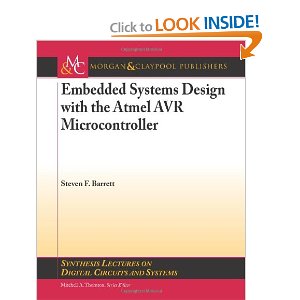
This textbook provides practicing scientists and engineers an advanced treatment of the Atmel AVR microcontroller. This book is intended as a follow-on to a previously published book, titled Atmel AVR Microcontroller Primer: Programming and Interfacing. Some of the content from this earlier text is retained for completeness. This book will emphasize advanced programming and interfacing skills. We focus on system level design consisting of several interacting microcontroller subsystems. The first chapter discusses the system design process. Our approach is to provide the skills to quickly get up to speed to operate the internationally popular Atmel AVR microcontroller line by developing systems level design skills. We use the Atmel ATmega164 as a representative sample of the AVR line. The knowledge you gain on this microcontroller can be easily translated to every other microcontroller in the AVR line. In succeeding chapters, we cover the main subsystems aboard the microcontroller, providing a short theory section followed by a description of the related microcontroller subsystem with accompanying software for the subsystem.
Contents
| 19 | |
| 20 | |
| 21 | |
| 22 | |
| 23 | |
| 24 | |
| 26 | |
| 27 | |
| 28 | |
| 30 | |
| 32 | |
| 34 | |
| 38 | |
| 41 | |
| 43 | |
| 45 | |
| 46 | |
| 47 | |
| 50 | |
| 53 | |
| 60 | |
| 63 | |
| 67 | |
| 69 | |
| 71 | |
| 72 | |
| 73 | |
| 74 | |
| 76 | |
| 77 | |
| 78 | |
| 79 | |
| 82 | |
| 83 | |
| 84 | |
| 85 | |
| 88 | |
| 89 | |
| 96 | |
| 98 | |
| 102 | |
| 104 | |
| 106 | |
| 107 | |
| 109 | |
| 110 | |
| 112 | |
| 114 | |
| 117 | |
| 118 | |
| 121 | |
| 136 | |
| 137 | |
| 139 | |
| 141 | |
|
622 PERIOD
|
142 |
| 145 | |
| 146 | |
| 147 | |
| 148 | |
| 149 | |
| 150 | |
| 152 | |
|
662 TIMER 0 REGISTERS
|
153 |
| 156 | |
|
68 TIMER 2
|
160 |
| 162 | |
| 165 | |
| 167 | |
| 169 | |
| 174 | |
| 182 | |
|
613 CHAPTER PROBLEMS
|
183 |
| 184 | |
|
Atmel AVR Operating Parameters and Interfacing
|
185 |
| 186 | |
| 189 | |
| 191 | |
| 193 | |
| 198 | |
| 200 | |
|
74 OUTPUT DEVICES
|
201 |
| 202 | |
|
744 TRISTATE LED INDICATOR
|
205 |
| 208 | |
| 211 | |
|
748 HIGH POWER DC DEVICES
|
220 |
| 222 | |
|
761 DC MOTOR OPERATING PARAMETERS
|
223 |
| 224 | |
| 233 | |
| 235 | |
| 237 | |
|
System Level Design
|
239 |
| 240 | |
| 241 | |
|
83 MOTOR SPEED CONTROL
|
255 |
| 258 | |
| 259 | |
| 267 | |
| 269 | |
|
855 UML ACTIVITY DIAGRAMS
|
270 |
| 273 | |
| 277 | |
| 297 | |
| 299 | |
Bibliographic information
| Title | Atmel AVR: Advanced Programming and Interfacing Volume 24 of Synthesis Lectures on Digital Circuits and Systems Series |
| Authors | Steven Barrett, M.D., Steven F. (Steven Frank) Barrett |
| Publisher | Morgan & Claypool Publishers, 2009 |
| ISBN | 1608451275, 9781608451272 |
| Length | 300 pages |
| Subjects |
› › › Computers / Microprocessors |
To download book & more info visit: Embedded System Design with the Atmel Avr Microcontroller – AVR E-Book
Purchase the book: Embedded System Design with the Atmel Avr Microcontroller – AVR E-Book
- What is the primary focus of this textbook?
The book emphasizes advanced programming and interfacing skills with a focus on system level design consisting of several interacting microcontroller subsystems. - Which microcontroller is used as a representative sample in the text?
The Atmel ATmega164 is used as a representative sample of the AVR line. - Can knowledge gained from the ATmega164 be applied to other microcontrollers?
Yes, the knowledge gained on the ATmega164 can be easily translated to every other microcontroller in the AVR line. - How does the book structure its chapters on subsystems?
Each chapter provides a short theory section followed by a description of the related microcontroller subsystem with accompanying software. - Does the book cover serial communication methods?
Yes, it covers Serial USART, SPI, and Controller Area Network (CAN). - What analog conversion technologies are discussed?
The text discusses Successive Approximation as an ADC conversion technology. - Are there specific examples of hardware interfaces included?
Yes, examples include a rain gage indicator, octal channel 8-bit DAC via SPI, and a one-bit ADC threshold detector. - What timing subsystems are detailed in the book?
The book details Timer 0, Timer 1, and Timer 2 systems along with Pulse Width Modulation and Input Capture modes. - Does the text address power management?
Yes, the book includes sections on battery operation and operating parameters. - What real-world projects are used to demonstrate system level design?
The book uses case studies such as a weather station, motor speed control, and an autonomous maze navigating robot.
