
Summary of Make-Yourself ATmega32 Starter’s Kit with LCD, I2C, SPI, RTC, ADC interfaces
This article details a DIY ATmega32 microcontroller starter kit featuring 32kB flash, EEPROM, SRAM, and various interfaces including LCD, RS232, ADC, SPI, TWI, and RTC. The project uses a custom etched PCB powered by a 12V adapter regulated to 5V via an IC 7805.
Parts used in the ATmega32 Starter Kit:
- ATmega32 microcontroller
- LCD with contrast adjustment
- RS232 port for PC connection
- Connector for 8 analog voltage inputs
- DS1307 Real Time Clock IC with battery backup
- Four general purpose keys
- Two interrupt generating keys
- LED indicator
- 12V DC adapter
- IC 7805 voltage regulator
- Ferric Chloride chemical for PCB etching
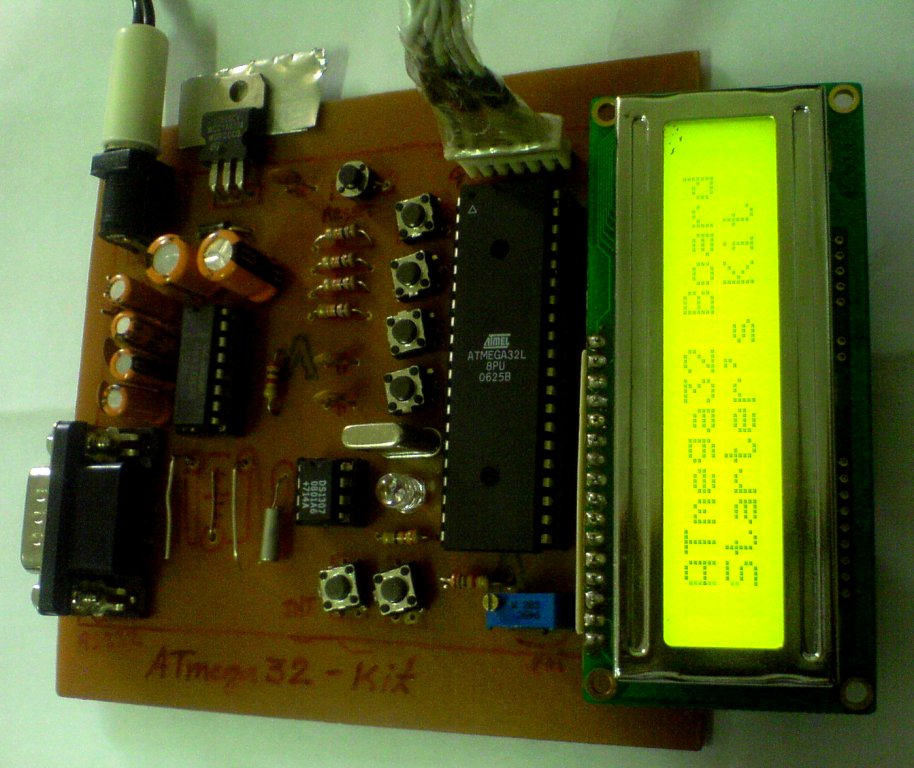
Here is my home-made kit of ATmega32 microcontroller interfacing. The ATmega32 controller is rich with features like onboard 32kB in-System programmable flash, 1 KB EEPROM, 2KB SRAM, 10bit ADC (8 channel), SPI bus inteface, TWI (compatible with I2C bus) interface, an USART, analog comparator, etc. That’s why I’ve selected it to load my kit with all those features.
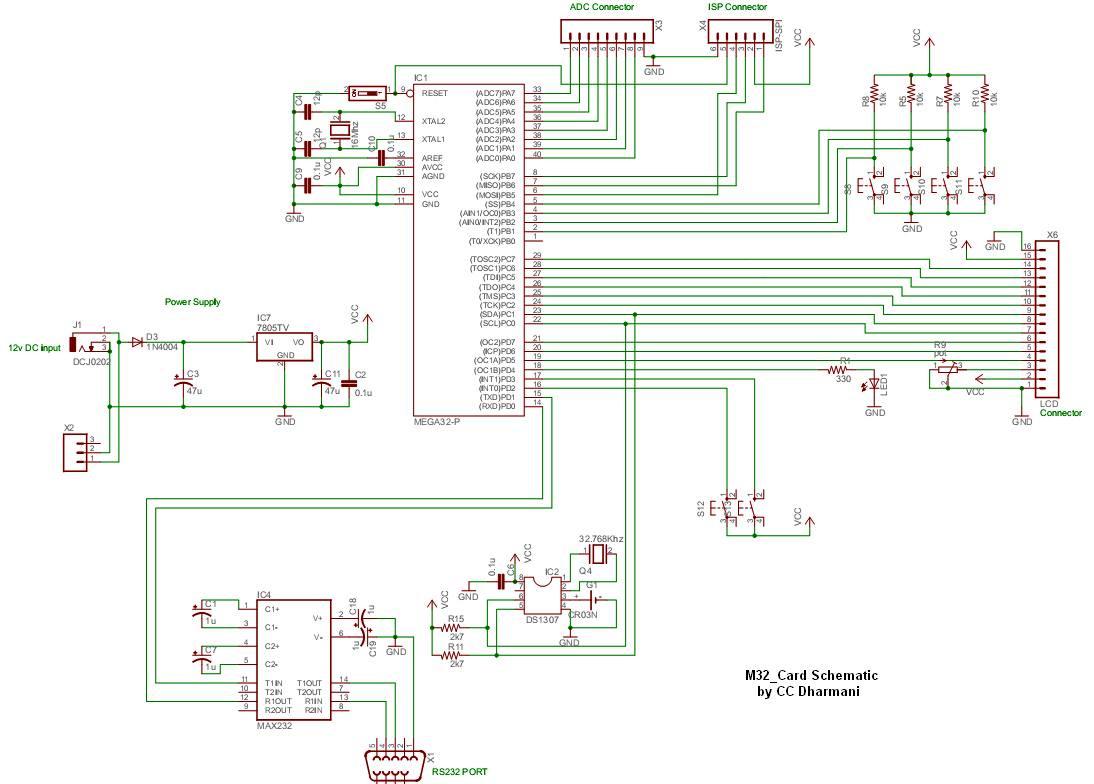
This M32 card is having an LCD inteface with contrast adjustment, an RS232 port for connecting with PC, a connector for 8 analog voltage inputs to measure by ADC, a Real Time Clock IC DS1307 from maxim with battery back-up, four general purpose keys, two keys for generating interrupts and an LED.
The circuit can be powered by an easily available 12v DC adapter. The voltage regulator IC 7805 used to convert the input into regulated 5v supply.
See below the kit in powered on condition and the schematic (click to enlarge the images)
The PCB is completely home-made, using the etching technique with the Ferric Chloride chemical. If you want to know how to make a PCB yourself from your layout, visit following webpage, it’s really helpful:
http://electrons.psychogenic.com/modules/arms/art/10/pcb_howto.php
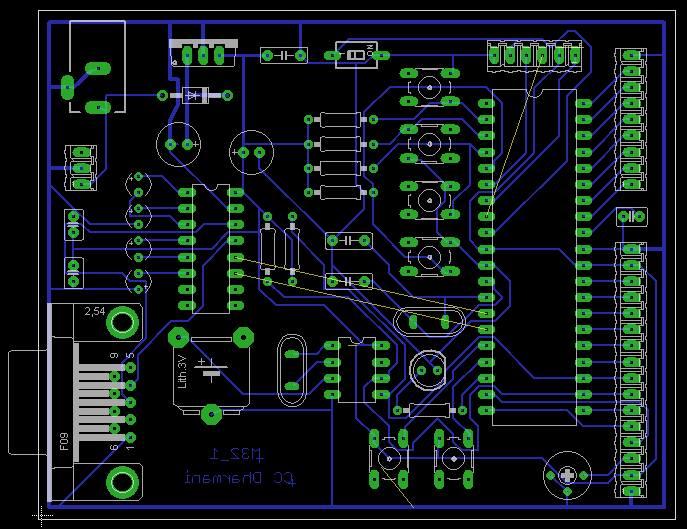
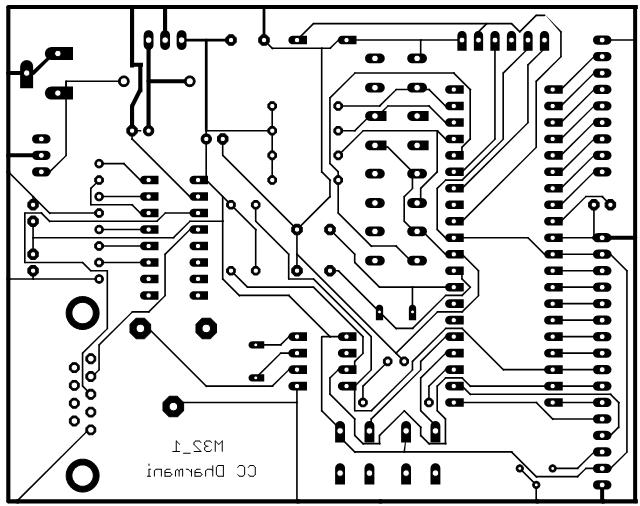
The schematic and layout of the M32_card shown here are prepared using EAGLE. It’s a single layer board for making the home-preparation easy. Check out the bottom layer and the layouts in the pics below:
For more details click : Make-Yourself ATmega32 Starter’s Kit with LCD, I2C, SPI, RTC, ADC interfaces
- What features does the ATmega32 controller have?
The controller includes 32kB in-System programmable flash, 1 KB EEPROM, 2KB SRAM, 10bit ADC with 8 channels, SPI bus interface, TWI compatible with I2C bus interface, USART, and an analog comparator. - How is the circuit powered?
The circuit is powered by an easily available 12v DC adapter which feeds into a voltage regulator IC 7805 to convert the input into a regulated 5v supply. - What software was used to prepare the schematic and layout?
The schematic and layout of the M32_card were prepared using EAGLE software. - How was the PCB manufactured?
The PCB is completely home-made using the etching technique with Ferric Chloride chemical. - Can the board be made as a single layer?
Yes, it is designed as a single layer board to make home-preparation easy. - What components are included for user interaction?
The kit includes four general purpose keys, two keys for generating interrupts, and an LED. - Does the kit support real-time clock functionality?
Yes, it includes a Real Time Clock IC DS1307 from Maxim with battery back-up.
