
Summary of A MINIATURE MICROFLUIDICS HEAT SINK FOR HIGH-PERFORMANCE CHIP COOLING
imec presented a silicon-based microchannel heat sink at Embedded World 2019 to solve high heat flux issues in power electronics. This compact device achieves low thermal resistance (0.28K/W to 0.34K/W) using less than 2W of pump power. By utilizing small, parallel silicon microstructures with high aspect ratios, the system dissipates over 600W/cm² while maintaining temperatures below 100°C. The technology leverages cost-effective silicon fabrication and optimized copper/tin-gold interfaces for seamless integration into semiconductor infrastructure.
Parts used in the imec Microchannel Heat Sink:
- Silicon (Si) microchannel structures
- High performance chip
- Copper/Tin-Gold (Cu/Sn-Au) interface
- Liquid cooling fluid
- Pump system
At the Embedded World Conference 2019, imec, a world-leading research and innovation hub in nanoelectronics and digital technologies, presents a silicon-based compact microchannel heat sink that enables high heat flux dissipation.
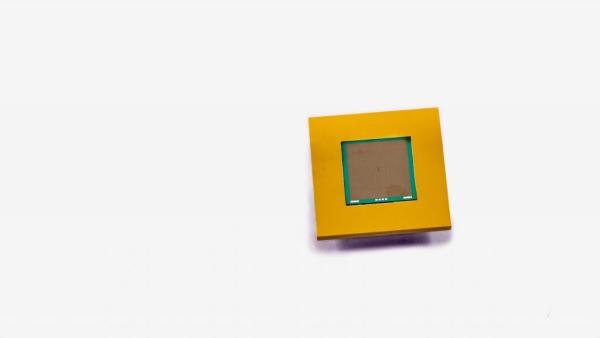
The imec heat sink assembled to a high performance chip for cooling the latter one achieves a low total thermal resistance of 0,34K/W to 0.28K/W at less than 2 W pump power. The advantages of using silicon (Si) technology for fabricating microchannels are reflected in the high quality and low cost of the final devices. Imec’s chip cooler may be the answer for the heat challenge that the new generation of power electronics and systems in a Package are faced with.
The downscaling of integrated chips and their packaging is a major trend in the electronics industry. However, with the resulting ever-increasing power density come detrimental heat effects that impact the reliability and performances of the devices. Liquid is more effective in removing that heat compared to air, because of its higher thermal conductivity and specific heat capacity. Silicon as a material is a relatively good heat conductor. The use of small, parallel, high-aspect-ratio silicon microchannel structures of 32µm wide and more than 260µm deep in imec’s chip cooler further increases the convective heat transfer surface area and the heat transfer coefficient, enabling high heat flux removal. This makes it possible to dissipate power of more than 600W/cm2 while keeping the component temperature below 100°C.
The key attribute of silicon is that it can realize high-aspect-ratio microstructures at low cost by leveraging massively parallel production processes and is directly integrable in the semiconductor infrastructure. In the current version, the Si-based microchannel heat sinks are fabricated separately and then interfaced to the back side of a heat-dissipating chip. Using an optimized Cu/Sn-Au interface, imec achieves a very low thermal contact resistance between both parts. Finally, since the fluidic performance and thermal behavior can be predicted with high degree of accuracy, imec’s microcooler can also be tailored according to external system constraints such as space and liquid supply.
Read more: A MINIATURE MICROFLUIDICS HEAT SINK FOR HIGH-PERFORMANCE CHIP COOLING
- What is the primary function of the imec heat sink?
To enable high heat flux dissipation for new generation power electronics. - How much thermal resistance does the device achieve?
It achieves a total thermal resistance between 0.28K/W and 0.34K/W. - What are the dimensions of the silicon microchannels?
The channels are 32µm wide and more than 260µm deep. - Can the system dissipate high power levels?
Yes, it can dissipate power of more than 600W/cm². - What temperature limit does the component maintain?
The component temperature is kept below 100°C during operation. - Why is silicon preferred for this application?
Silicon allows for high-aspect-ratio microstructures at low cost via massively parallel production. - How is the heat sink connected to the chip?
It is interfaced to the back side of the chip using an optimized Cu/Sn-Au interface. - Does the design allow for customization?
Yes, the microcooler can be tailored according to external system constraints like space and liquid supply.
