
Summary of DIY STC MCU Combined Wireless Small Camera With OV7670, NRF24L01 Wireless Transceiver Module, 2.8”TFT LCD (Provide Code)
This article details a DIY wireless video transmission project using an OV7670 camera, STC12LE5A32AD MCU, and NRF24L01 module. The system captures images at 320x240 resolution, transmitting them to a TFT display on a mobile device. The author reports successful monochrome transmission but encounters a color shift issue where green appears red in RGB565 format despite normal debugging.
Parts used in the Wireless Video Transmission Project:
- OV7670 camera
- NRF24L01 wireless transceiver module
- STC12LE5A32AD 1T 51 MCU
- 24M crystal oscillator
- 33M crystal oscillator
- 2.8 inch TFT LCD
- Old lithium battery from cell phone
Because I am familiar with BMP image display under the FAT32 file system and the application of NRF 24L01 wireless transceiver module.What’ more, I own a OV7670 camera in my hand, so I decide to make a project which I dream about since my childhood. The project is the wireless video transmission and display on wireless mobile device.
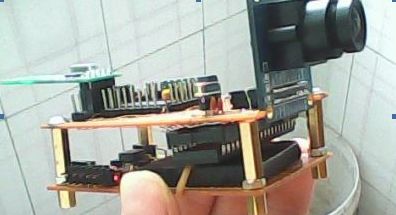
I use one week to debug the OV7670 and I estimate roughly that the time of transmitting a 320*240 16-bit color picture is about 2 seconds and if only the monochrome picture, it can transmit 4 to 5 160*120 picture in one second.And the coherence is just so so ,but is OK just to play .The image acquisition terminal uses 24M crystal oscillator and the acceptation display terminal uses 33M. The MCU is STC12LE5A32AD 1T 51
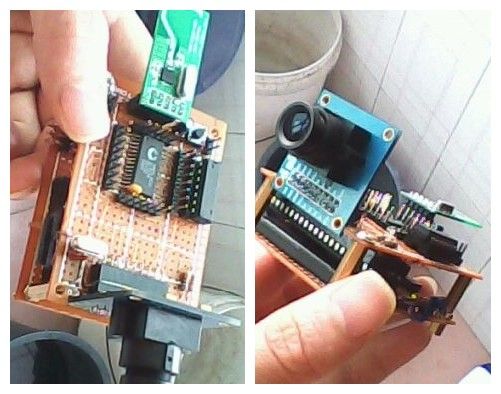
Step 1: Acquisition Module
This acquisition module is powered by the independent old lithium battery of the cell phone.
Step 2: TFT Receiver Display Module
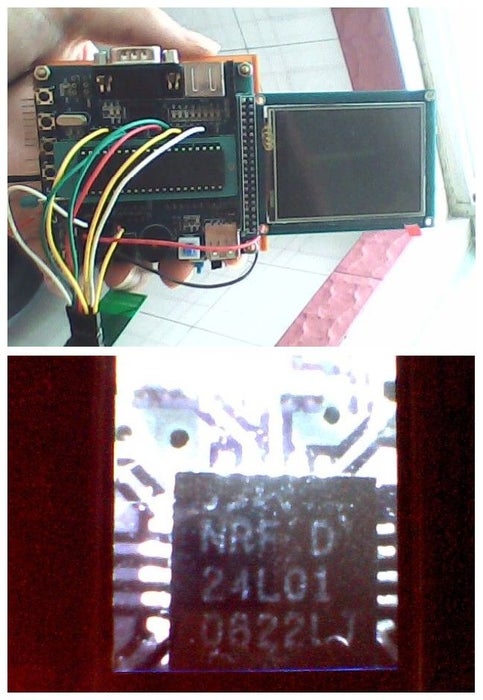
It is the TFT receiver display module. This is also powered by the old lithium battery of the cell phone.
Step 3: A Problem Appears and Need Your Help
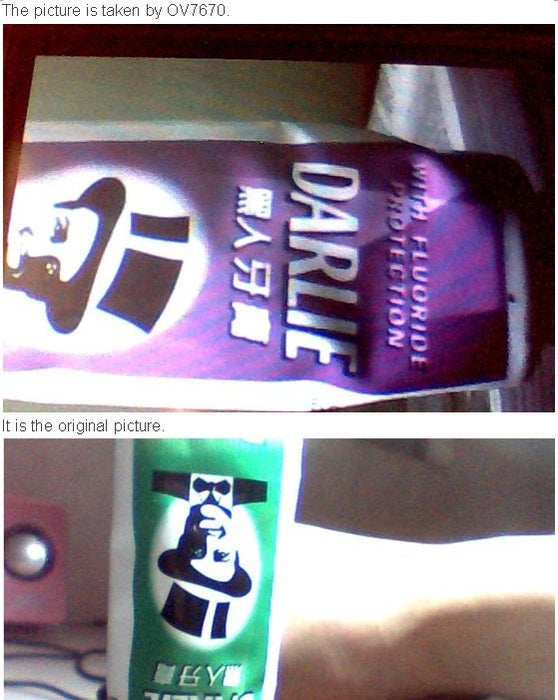
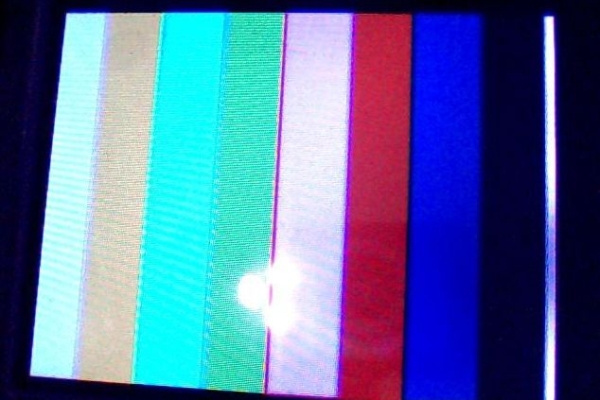
While the problem appears, why the picture taken by the OV7670 the green color will turn to the red and other color is basically no color ? Everything is normal when I debug.The output format is RGB565 and I try to change the register configurations which possibly have influence on.But the results are the same.
In my opinion, it should not be the problem of TFT display or disturb. And it may be the problem of the configuration of OV7670.But I don’t know which register configuration is wrong. I really hope someone could help me out about this problem.
At first I think it is the reason that I haven’t properly adjust the hue, that is to say it may be the hue register configuration of OV7670 is wrongly adjusted, but the key point is that there is no hue register configuration in OV7670. I am confused about it, it will be appreciated who can help me out.
Step 4: Code for Reference
Following is the code. There are many useful subroutine, including the drive of OV, NRF24L01, TFT and SCCB Bus. The program is a little messy, and the people who master them and no need to see.
You could download the code from here:http://www.icstation.com/newsletter/Forum/DIY/003/OV7670_AMScode.zip
Finally, really hope someone could help me to solve the problem!
- How long does it take to transmit a 320*240 16-bit color picture?
Roughly 2 seconds. - Can the system transmit monochrome pictures faster than color?
Yes, it can transmit 4 to 5 160*120 monochrome pictures in one second. - What causes the green color to turn red in the received image?
The article suggests it may be a problem with the configuration of the OV7670 registers, though the specific cause is unknown. - Does the OV7670 have a hue register configuration?
No, there is no hue register configuration in the OV7670. - What frequency crystal oscillators are used for the acquisition and display terminals?
The acquisition terminal uses a 24M crystal oscillator and the display terminal uses a 33M crystal oscillator. - What power source is used for the modules?
Both the acquisition and receiver modules are powered by independent old lithium batteries from cell phones. - Is the coherence of the transmitted video good?
The coherence is described as just so so, but it is OK to play. - What output format was attempted for the camera?
The output format used was RGB565.
