
Summary of ESP32MX-E, THE NEW CHIP ON THE BLOCK
The ESP32MX-E by Modtronix Engineering is an advanced IoT board featuring the ESP-WROOM-32 module with Wi-Fi, Bluetooth, and Ethernet. It includes a dual-core 32-bit processor, a secondary STM32F030F4 microcontroller, and versatile power options via USB-C or barrel jack. Designed for industrial use, it offers two temperature variants and supports Micro SD cards.
Parts used in the ESP32MX-E:
- ESP-WROOM-32 module
- USB-C connector
- 2.1 mm barrel connector
- Ethernet jack
- Micro SD card slot
- User addressable LED
- User button
- Dual-core 32-bit Tensilica Xtensa LX6 micro-processor
- STMicroelectronics STM32F030F4 micro-controller
- I²C I/O secondary processor expander
- Expansion headers (2x7 pins and 2x10 pins)
There are a host of boards based around the ESP32, and also its follow up, the ESP8266. It’s noteworthy to witness how they have evolved from the simple breakout boards they were when the chip was released back in 2015 to something a lot more major. The latest of these boards is the esp32MX-E from Modtronix Engineering, which will be raising soon on Crowd Supply.
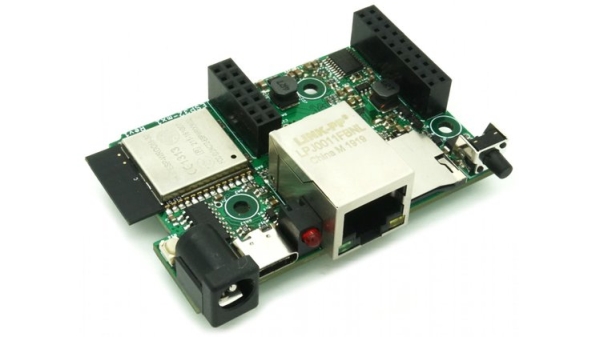
Measuring at 64.4 × 42 mm (2.54 × 1.65 inch), the board is designed based on an off the shelf ESP-WROOM-32 module. One interesting feature is its independent methods of powering the board; a USB-C connector, a 2.1 mm barrel connector, or via broken-out +V and GND pins, the board can be powered with a 4.5 to 16 V supply. The on-board USB connector also enables a serial console, and allows you to program the board. The board offers both Wi-Fi, and Bluetooth, enabled by the ESP32, and also an Ethernet jack. The board also features a Micro SD card slot, along with a user addressable LED and button. The ESP32 board is built around a dual-core 32-bit Tensilica’s Xtensa LX6 micro-processor which operates at either 160 or 240 MHz, equipped with 4MB of SPI Flash, and 520KB of SRAM.
The board also has a user-programmable STMicroelectronics STM32F030F4 micro-controller. The micro-controller is a 32-bit Arm Cortex-M0 core operating at 48 MHz, with 256 KB of Flash and 32 KB of SRAM. The I²C I/O secondary processor expander handles the pins on the two expansion headers; the first has 2×7 pins, and the other has 2×10 pins with programmable pull-up and pull-down resistors on most inputs. We should note that not all of the pins are available when the SD card slot is in use.
The board will be released in two versions, but with different operating range. While both will have the same configurations, one will have an operating range of 0° C to 85° C, while the second, an ‘industrial’ version, will operate at temperatures down to -40° C. The board is aimed squarely towards the Internet of Things (IoT) and industry, and will be housed in anonymous black or grey boxes with numbers written in sharpie on the outside for easy identification from other boxes.
Read more: ESP32MX-E, THE NEW CHIP ON THE BLOCK
- How can the ESP32MX-E be powered?
The board supports power via a USB-C connector, a 2.1 mm barrel connector, or broken-out +V and GND pins using a 4.5 to 16 V supply. - What wireless connectivity does the board offer?
The board features both Wi-Fi and Bluetooth enabled by the ESP32, along with an Ethernet jack. - Does the board have a secondary microcontroller?
Yes, it includes a user-programmable STMicroelectronics STM32F030F4 micro-controller with a 32-bit Arm Cortex-M0 core. - What are the operating temperature ranges available?
One version operates from 0° C to 85° C, while the industrial version operates down to -40° C. - Can all expansion pins be used when the SD card is active?
No, not all pins are available when the SD card slot is in use. - What type of processor powers the main ESP32 functionality?
It uses a dual-core 32-bit Tensilica Xtensa LX6 micro-processor operating at 160 or 240 MHz. - How many pins do the expansion headers provide?
The first header has 2x7 pins and the second has 2x10 pins with programmable pull-up and pull-down resistors.
