
Summary of FTDI CHIP HIGH-SPEED USB BRIDGE ICS WITH TYPE-C CONTROLLERS
This article describes FTDI's high-speed USB bridge ICs featuring integrated Type-C and Power Delivery (PD) 3.0 controllers. These devices support bidirectional power negotiation, offering two PD ports where one combines data and power, while the other is power-only. They enable multi-channel interfacing to reduce system BOM by eliminating external USB hubs, allowing independent channel configuration for UART, MPSSE, or FIFO modes with varying baud rates. The chips support multiple voltage profiles configurable via EEPROM and include features like adjustable timeouts, hardware handshaking, and a wide industrial temperature range across various QFN package options.
Parts used in the FTDI High-Speed USB Bridge ICs:
- USB Type-C Connector
- Power Delivery (PD) 3.0 Controller
- External EEPROM
- 32-bit RISC Controller
- 1.2V LDO Regulator
- MPSSE Engine
- Virtual Com Port (VCP) Drivers
- D2XX Drivers
FTDI Chip High-Speed USB Bridge ICs with Type-C/PD 3.0 Controllers fully support the latest USB Type-C and Power Delivery (PD) standards. This enables the support for power negotiation with the ability to sink or source current to USB host devices. These high-speed USB bridge devices feature up to two PD ports viz, PD1 port and PD2 port. The PD1 port shares the same Type-C connector with USB data and the PD2 port is the power port only without USB data. The high-speed USB bridge ICs support 5V, 9V, 12V, 15V, and 20V PDO profiles and these profiles are configurable through an external EEPROM at power-up/reset.
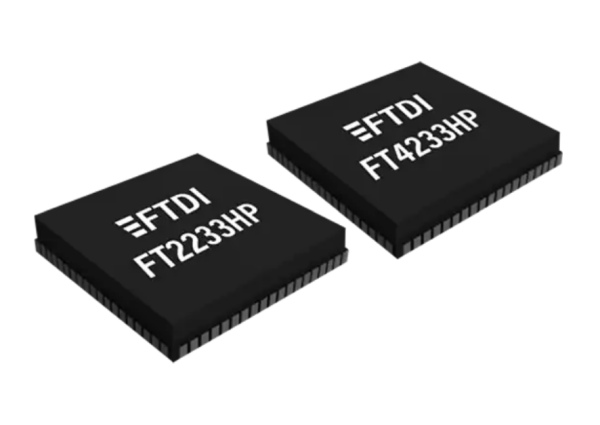
The high-speed USB bridges offer up to 40Mbytes/s data rates and multi-channel interfacing. The benefit of a multi-channel bridge is that the system BOM is reduced by removing the need for a USB hub chip. Additionally, each channel of the device appears to the host PC as a separate device. This enables each channel to be independently configured for different modes such as UART, MPSSE, or FIFO. Also, with different parameters such as 4 UARTS all operating with different baud rates.
Features
- Supports PD specification Rev 3.0
- 2 USB PD 3.0 port support:
- Port 1 mode configuration for Sink or Dual-role
- Port 2 works as Sink, supporting charge through to Port 1
- Support 5V 3A, 9V 3A, 12V 3A, 15V 3A, and 20V 3A PDOs as sink or source
- Type-C/PD physical layer protocol
- PD policy engine using 32-bit RISC controller with 8kB data RAM and 48kB code ROM
- PD mode configuration through external EEPROM
- Options to use external MCU controlling PD policy through I2C interface
- USB 2.0 high speed (480Mbits/second) and full-speed (12Mbits/second) compatible
- Adjustable receive buffer timeout
- Multi-Protocol Synchronous Serial Engine (MPSSE) to simplify the synchronous serial protocol (USB to JTAG, I2C (MASTER), SPI (MASTER), or bit-bang) design
- FTDI royalty-free Virtual Com Port (VCP) and Direct (D2XX) drivers eliminate the requirement for USB driver development in most cases
- Highly integrated design includes 1.2V LDO regulator for VCORE and integrated POR function
- Low operating and USB suspend current
- USB Bulk data transfer mode (512-byte packets in high-speed mode)
- Fully assisted hardware or X-On / X-Off software handshaking
- Extended -40°C to 85°C industrial operating temperature range
- Available in Pb-free QFN-56/QFN-46/QFN-76/QFN-68/LQDP-80 packages (RoHS compliant)
Source: FTDI CHIP HIGH-SPEED USB BRIDGE ICS WITH TYPE-C CONTROLLERS
- How many PD ports do these high-speed USB bridge devices feature?
These devices feature up to two PD ports designated as PD1 port and PD2 port. - What voltage profiles are supported by the high-speed USB bridge ICs?
The ICs support 5V, 9V, 12V, 15V, and 20V PDO profiles. - Can the system BOM be reduced using this multi-channel bridge?
Yes, the system BOM is reduced by removing the need for a separate USB hub chip. - How can the PD mode configuration be set on these devices?
PD mode configuration is possible through an external EEPROM at power-up/reset. - What serial protocols can the Multi-Protocol Synchronous Serial Engine simplify?
The MPSSE simplifies design for synchronous serial protocols including JTAG, I2C, SPI, or bit-bang. - Does the device support different baud rates for its channels?
Yes, each channel can be independently configured with different parameters such as 4 UARTs all operating with different baud rates. - Are Virtual Com Port drivers required for most cases?
No, FTDI royalty-free Virtual Com Port drivers eliminate the requirement for USB driver development in most cases. - What is the operating temperature range for these ICs?
The extended operating temperature range is -40°C to 85°C.
