
Summary of How Inside a Wind-up Alarm Clock
This article explores the internal mechanics of a wind-up alarm clock, highlighting its oscillating wheel mechanism that replaces a traditional pendulum. It details how the main spring and alarm spring drive separate gear trains and escapements to power timekeeping and the alarm function.
Parts used in Wind-up Alarm Clock:
- Winding knobs
- Clock back
- Stand
- Alarm bells
- Hands
- Face
- Mounting ring
- Oscillating wheel
- Main spring
- Alarm spring
- Gear train
- Escapement
- Concentric shafts
Wind-up alarm clocks have been around a long time, but they are still fun to explore. For more information on clocks in general, please see the article entitled How Pendulum Clocks Work. Here is the clock we will be exploring today:
Removing the winding knobs and the back of the clock reveals the inside of the clock:
By removing the stand, alarm bells, hands, face and mounting ring, you end up with the clock mechansim itself.
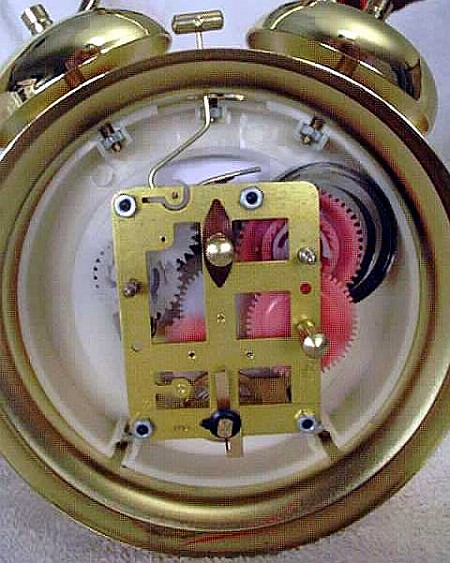
This clock (like most table clocks and wrist watches) uses an oscillating wheel in place of a pendulum. The wheel and its spring are at the bottom. In the picture above, the clock’s main spring is on the upper right. The spring on the left is for the alarm, which has its own gear train and escapement.
In the picture below you see the front of the mechanism. The hands go on the concentric shafts in the center.
Looking at the mechanism from the side shows how all of the different gears fit together.
The following picture shows you the oscillating wheel in the foreground, with gears delivering power to it.
For more Detail: Inside a Wind-up Alarm Clock
-
What replaces the pendulum in this clock?
This clock uses an oscillating wheel in place of a pendulum. -
Where is the main spring located?
The clock's main spring is on the upper right side of the mechanism. -
How does the alarm function work?
The alarm has its own spring, gear train, and escapement separate from the timekeeping parts. -
Where are the hands attached?
The hands go on the concentric shafts in the center of the mechanism. -
What components must be removed to see the mechanism?
You must remove the stand, alarm bells, hands, face, mounting ring, winding knobs, and the back of the clock. -
What is the purpose of the wheel at the bottom?
The wheel at the bottom is part of the oscillating system that drives the clock movement.
