
Summary of How to connect Arduino and RFID
This article demonstrates interfacing a Seeed Studio serial RFID sensor with an Arduino board. It outlines the necessary hardware components, wiring connections between the sensor and Arduino, and mentions software compatibility with IDE 021. The guide focuses on connecting three wires for power and serial communication to read 125kHz RFID tags.
Parts used in the Arduino RFID Interface:
- Arduino Board
- RFID Sensor from seeedstudios (serial version)
- Wires
- Protoboard
- RFID tags (125kHz) from seeedstudios
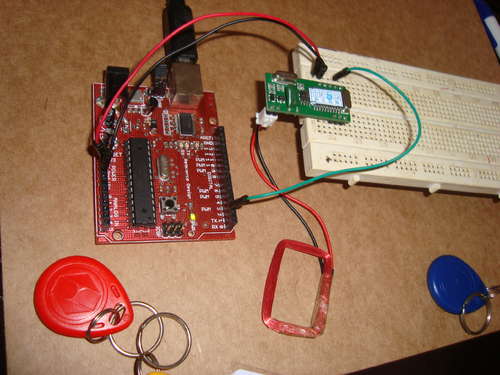 On this instructable I will try to show how to interface a RFID sensor with the Arduino. I am using the RFID sensor from seeedstudio the serial version of it. There are a few parts you will gonna need. I also bought some RFID keys.
UPDATE: Now it works with IDE 021
Step 1 What you gonna need?
– Arduino Board
– RFID Sensor from seeedstudios
– Wires
– Protoboard
– RFID tags (125kHz) from seeedstudios
Step 2 Plugging all together
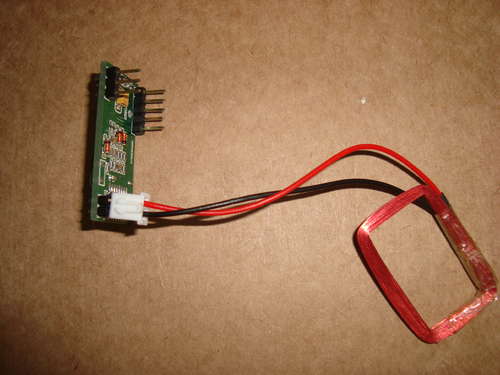 Connect the antenna on the appropriate pins like the first photo.
Plug the RFID sensor to the protoboard like the second photo above.
Only 3 wires are required to interface, 2 wires for supply and another for the serial line(communication)
The wires as connected as the third photo shows.
On RFID sensor: PIN 1 -> Tx
PIN 2 -> Rx (Not Used)
PIN 3 -> NC
PIN 4 -> GND
PIN 5 -> VCC (+5V)
Tx from RFID board goes to Digital PIN 2 on Arduino Board.
That is all you gonna need to wire.
Moving on to next step, the software.
For more Detail: How to connect Arduino and RFID
- How many wires are required to interface the RFID sensor?
Only 3 wires are required, including 2 for supply and another for the serial line. - Which pins on the RFID sensor connect to the Arduino?
The Tx pin connects to Digital PIN 2 on the Arduino Board. - What is the function of PIN 2 on the RFID sensor?
PIN 2 is labeled Rx and is not used. - Can this project work with IDE 021?
Yes, the project now works with IDE 021. - What frequency do the recommended RFID tags operate at?
The RFID tags are specified as 125kHz. - Which pin on the RFID sensor provides the +5V power supply?
PIN 5 is designated as VCC for the +5V supply.
