
Summary of LC Determination by Resonant Frequency Measurement using microcontroller
This article describes a low-cost inductance measurement circuit designed for home use, utilizing an AT90S2313 microcontroller and an LM393 oscillator. Unlike high-frequency RF meters, this device operates at lower frequencies (down to 100 kHz) to avoid pulse distortion in ferrite cores, making it suitable for measuring inductances from hundreds of microhenries to several millihenries. The system drives a two-line LCD via a serial interface powered by a switched +8V line.
Parts used in the Inductance Measurement Circuit:
- 5 volt regulator
- LM393 oscillator
- 0.047 uf capacitor
- AT90S2313 microcontroller
- Serial connector
- Two-line LCD module
A well known L/C measurement circuit is pressed into service to make a bare bones measurement circuit.
Download the AVRStudio assembly source: lgm031227I.asm.
Download the AVRStudio hex file: lgm031227.hex.
Left-to-right: The 5 volt regulator, the LM393 oscillator (a 0.047 uf capacitor is mounted on the LC circuit connector), the AT90S2313, and the serial connector to the LCD module.
Recently, I have needed to measure inductances in the hundreds of microhenries to several millihenry range. Though I have a pretty good LRC meter and an excellent bridge on my workbench in Mesa, Arizona. I wanted to make these measurements in my home in Thailand. Thus I decided to put something together.
The RF Inductance meter on this website is good for low value rf inductors, but because of the way it works – putting a sharp-edged square wave through the inductor -its not suitable for inductors made with high permeability ferrites (Because of pulse shape distortion that results from high frequency losses in the core.) This meter operates at lower frequencies, and by careful selection of the resonating capacitor. The oscillator can be made to run anywhere from 100 kHz on down. This makes it possible to test near standard frequencies like 1 kHz and 400 Hz, to compare results with precision bridges.
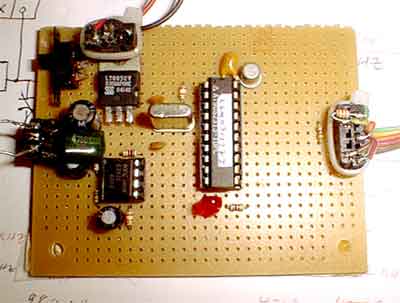
The AT90S2313 frequency meter drives a serial terminal with a 0 to 5 volt signal. The firmware was adapted from the RS-232 Freq. Meter/Pulse Generator project on this site, and then tailored to work with the a two-line LCD (See theserial interface for Truly LCD also on this site). The serial connector has switched +8 volts to power the LCD and its interface.
Circuit Description
This is basically just an oscillator based on a comparitor and a frequency meter. The oscillator oscillates at the resonant frequency of an LC parallel tuned circuit. A really nice version of this was created by Chris Krah using an AT90S1200, including floating point math, etc. to display the L and C readings directly. I’ll post a link to Chris’ version once it is published on the web (it was posted on the AVRFreaks board).
For more detail: LC Determination by Resonant Frequency Measurement using microcontroller
- What is the primary purpose of this circuit?
To measure inductances in the range of hundreds of microhenries to several millihenries. - Why was this circuit created instead of using existing bench equipment?
The author needed to perform measurements at home in Thailand rather than on their workbench in Mesa, Arizona. - How does this meter differ from RF inductance meters regarding core material?
This meter operates at lower frequencies to avoid pulse shape distortion caused by high frequency losses in high permeability ferrites. - What frequency range can the oscillator operate within?
The oscillator can be made to run anywhere from 100 kHz down to lower frequencies like 1 kHz or 400 Hz. - Which microcontroller drives the serial terminal for this project?
The AT90S2313 frequency meter drives a serial terminal with a 0 to 5 volt signal. - How is the LCD module powered in this design?
The serial connector has switched +8 volts to power the LCD and its interface. - What type of mathematical approach does the original Chris Krah version use?
Chris Krah's version includes floating point math to display L and C readings directly. - Can this device compare results with precision bridges?
Yes, by testing near standard frequencies like 1 kHz and 400 Hz, it allows for comparison with precision bridges.
