
Summary of Make Your Own Power Meter/Logger
This project details the construction of a portable power meter/logger using an Arduino Pro Mini, INA219 power monitor, OLED LCD, and Micro SD Card PCB. The device offers enhanced functionality compared to standard USB power meters by logging data and displaying real-time metrics on a screen. It includes a LiPo battery and TP4056 charging board for portability, controlled via a switch.
Parts used in the Portable Power Meter/Logger:
- LiPo Battery
- TP4056 Board
- Arduino Pro Mini
- INA219 Board
- OLED LCD
- SD Card PCB
- Switch
In this project I will show you how I combined an Arduino, an INA219 power monitor IC, an OLED LCD and a Micro SD Card PCB in order to create a power meter/logger that has more functions than the popular USB Power Meter. Let’s get started!
Step 1: Watch the Video!
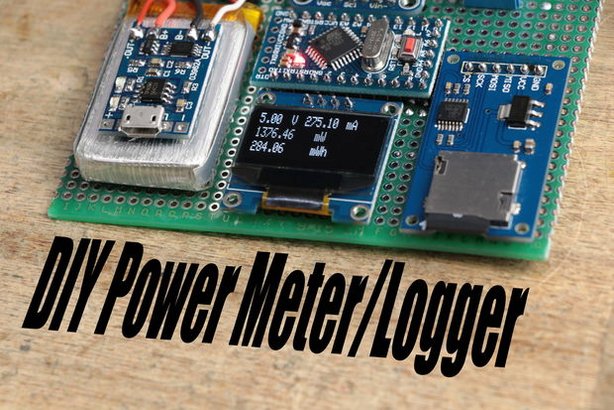
The video gives you a good overview on how to create your own power meter. In the next steps though I will present you some additional information to make this project even simpler.
Step 2: Order Your Parts!
Here you can find a parts list with example seller for the portable version of this project.
Amazon.com:
1x LiPo Battery: http://amzn.to/2gz4yvd
1x TP4056 Board: http://amzn.to/2gzdIb4
1x Arduino Pro Mini: http://amzn.to/2gvfXuQ
1x INA219 Board: http://amzn.to/2gvflW7
1x OLED LCD: http://amzn.to/2fobopO
1x SD Card PCB: http://amzn.to/2fodhmu
1x Switch: http://amzn.to/2gz9ZtW
Ebay:
1x TP4056 Board: http://rover.ebay.com/rover/1/711-53200-19255-0/1?…
1x Arduino Pro Mini: http://rover.ebay.com/rover/1/711-53200-19255-0/1?…
1x INA219 Board: http://rover.ebay.com/rover/1/711-53200-19255-0/1?…
1x OLED LCD: http://rover.ebay.com/rover/1/711-53200-19255-0/1?…
1x SD Card PCB: http://rover.ebay.com/rover/1/711-53200-19255-0/1?…
1x Switch: http://rover.ebay.com/rover/1/711-53200-19255-0/1?…
Amazon.de:
1x LiPo Battery: http://amzn.to/2gM2vXB
1x TP4056 Board: http://amzn.to/2eUvMNO
1x Arduino Pro Mini: http://amzn.to/2g6Ujjr
1x INA219 Board: http://amzn.to/2gM5M9v
1x OLED LCD: http://amzn.to/2g6Q3Rd
1x SD Card PCB: http://amzn.to/2gM9Zdf
Amazon.com:
1x LiPo Battery: http://amzn.to/2gz4yvd
1x TP4056 Board: http://amzn.to/2gzdIb4
1x Arduino Pro Mini: http://amzn.to/2gvfXuQ
1x INA219 Board: http://amzn.to/2gvflW7
1x OLED LCD: http://amzn.to/2fobopO
1x SD Card PCB: http://amzn.to/2fodhmu
1x Switch: http://amzn.to/2gz9ZtW
Ebay:
1x TP4056 Board: http://rover.ebay.com/rover/1/711-53200-19255-0/1?…
1x Arduino Pro Mini: http://rover.ebay.com/rover/1/711-53200-19255-0/1?…
1x INA219 Board: http://rover.ebay.com/rover/1/711-53200-19255-0/1?…
1x OLED LCD: http://rover.ebay.com/rover/1/711-53200-19255-0/1?…
1x SD Card PCB: http://rover.ebay.com/rover/1/711-53200-19255-0/1?…
1x Switch: http://rover.ebay.com/rover/1/711-53200-19255-0/1?…
Amazon.de:
1x LiPo Battery: http://amzn.to/2gM2vXB
1x TP4056 Board: http://amzn.to/2eUvMNO
1x Arduino Pro Mini: http://amzn.to/2g6Ujjr
1x INA219 Board: http://amzn.to/2gM5M9v
1x OLED LCD: http://amzn.to/2g6Q3Rd
1x SD Card PCB: http://amzn.to/2gM9Zdf
Step 3: Create the Circuit!
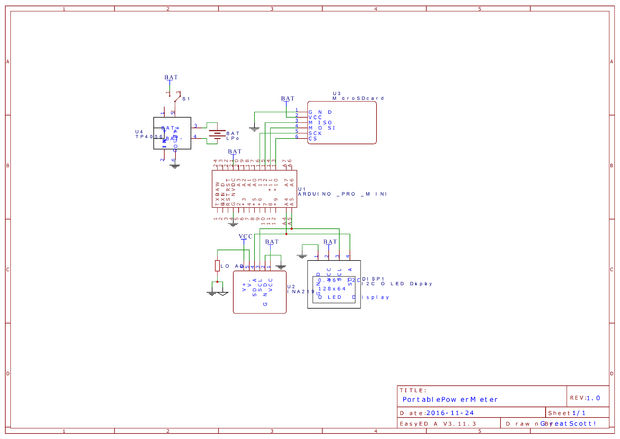
Here you can find the schematic for the Arduino Nano version and the portable version of this project. You can also find those schematic on the EasyEDA website:
https://easyeda.com/GreatScott/PowerMeter-b6051723…
https://easyeda.com/GreatScott/PortablePowerMeter-…
You can also use the pictures of my finished board as a reference for your own.
For more detail: Make Your Own Power Meter/Logger
https://easyeda.com/GreatScott/PowerMeter-b6051723…
https://easyeda.com/GreatScott/PortablePowerMeter-…
You can also use the pictures of my finished board as a reference for your own.
For more detail: Make Your Own Power Meter/Logger
-
What components are needed to build this power meter?
You need a LiPo Battery, TP4056 Board, Arduino Pro Mini, INA219 Board, OLED LCD, SD Card PCB, and a Switch. -
Can I find these parts on Amazon?
Yes, the article lists specific links for all required components on Amazon.com and Amazon.de. -
Does this project use an Arduino Nano or Pro Mini?
The parts list specifies an Arduino Pro Mini, though schematics are also available for an Arduino Nano version. -
How does this device compare to a popular USB Power Meter?
This project creates a power meter/logger with more functions than the popular USB Power Meter. -
Where can I find the circuit schematics?
Schematics for both the Nano and portable versions are available on the EasyEDA website. -
Is there a video guide available for this project?
Yes, Step 1 recommends watching a video that provides a good overview of how to create the power meter.
