
Summary of NCH6300HV HIGH VOLTAGE DC-DC POWER BOOSTER FOR NIXIE DISPLAYS
Nixie tubes are vintage glow-discharge displays using low-pressure gas to illuminate numerals 0-9 via high-voltage cathodes. Since mass production ceased, they require external high-voltage drivers (100-230V) powered by DC-DC step-up converters or flyback topologies. These drivers convert standard 5V input to the necessary voltage levels using components like MOSFETs, inductors, capacitors, and transformers.
Parts used in the Nixie Display Driver Project:
- Nixie tube
- DC-DC step-up converter
- Diode
- Power MOSFET
- Inductor
- Capacitor
- Transformer
- Flyback converter topology
Nixie tube is an electronic device for displaying numerals or other information using glow discharge. A potential difference is applied between two electrodes in a glass tube containing low-pressure gas. The flow of electric current through the gas makes plasma. This phenomenon is called glow discharge. First introduced in 1955, the Nixie displays are legendary. The retro nixie displays had a single anode, multiple cathodes that are electrodes shaped like numerals 0-9 stacked on top of one another. Applying the power to one cathode will make that numeral glow. The tube is filled with a low-pressure gas that creates an orange glow discharge. These legendary displays, however, are no longer mass-produced, and they need high-voltage drivers.
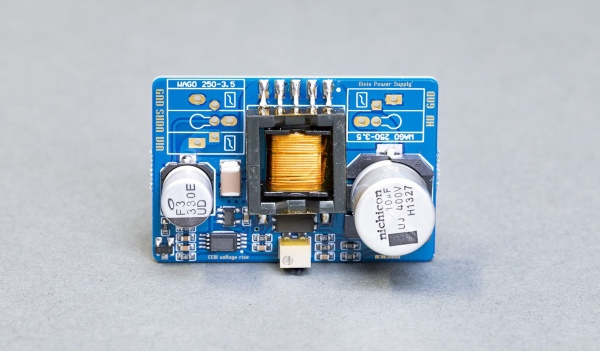
There are still some places on the Internet where one can get these retro nixie displays. The high-voltage display drivers are, however, hard to find. The high-voltage driver consists of a DC-DC step-up converter which will step up the voltage level from around 5V to 100-230V.
About Step-Up Converters
DC-DC step-up converters or boost converters generally consist of a diode, a power MOSFET, and two energy storage elements: an inductor and a capacitor.
When the switch is open initially, there is not much resistance, so high current flows through the inductor. The energy in the inductor is due to the magnetic fields. When the switch is closed, the impedance in the circuit increases and the current will be reduced. The magnetic field previously created will be reduced in energy to maintain the current towards the load. The polarity of the inductor will therefore be reversed and will create another voltage source in series with the input voltage supply. If the rate of switching is fast enough, the voltage will be higher than the input voltage, and this boosted voltage can be controlled by controlling the duty cycle of the switch.
Nixie display drivers also sometimes use flyback converter topology. It provides galvanic isolation between the input and the output with the help of a transformer.
Read more: NCH6300HV HIGH VOLTAGE DC-DC POWER BOOSTER FOR NIXIE DISPLAYS
- What is a Nixie tube?
A Nixie tube is an electronic device displaying numerals using glow discharge in low-pressure gas. - How does a Nixie display work?
Applying power to a specific cathode shaped like a numeral causes that digit to glow orange due to plasma formation. - Can I find mass-produced Nixie tubes today?
No, these legendary displays are no longer mass-produced. - What voltage do Nixie drivers need?
Drivers must step up voltage from around 5V to between 100V and 230V. - Does a step-up converter use a transformer?
Standard boost converters use inductors, but flyback converter topologies use transformers for galvanic isolation. - What components make up a DC-DC step-up converter?
They generally consist of a diode, a power MOSFET, an inductor, and a capacitor.
