
Summary of Nikon Camera Remote Control using ATtiny13 Microcontroller
This article describes a DIY IR remote control for Nikon cameras, compatible with the ML-L3 model. It uses an ATtiny13V microcontroller to generate signals for supported models like the D40 and Coolpix series. The circuit prioritizes reliability by keeping the device powered continuously, allowing the button to act as a simple trigger rather than a power switch. This design ensures complete signal transmission even if the user releases the button early and filters out contact bounce noise while maintaining extremely low standby power consumption.
Parts used in the Nikon Camera Remote Control:
- ATtiny13V microcontroller
- Button
- Transistor
- Resistor
- IR diode
- 3V battery
This is an IR remote control for Nikon cameras. It is compatible with the Nikon ML-L3 remote control. Supported cameras include: D40, D40X, D50, D60, D70, D70s, D80, Coolpix 8400 8800. This design is based on an idea from http://www.bigmike.it/ircontrol/.
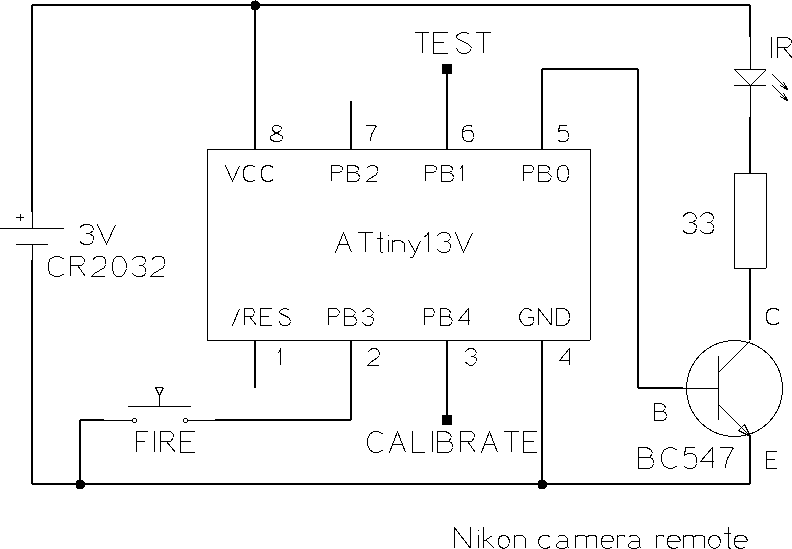
The circuit is extremely simple: an ATtiny13V, button, transistor, resistor, IR diode and 3V battery. You could even omit the transistor and resistor, and connect the IR diode directly to the ATtiny13V, but that will limit the LED current and therefor the range.
I chose to power the circuit permanently, and connect the button to an input, instead of controlling the power with the button. This ensures that the IR sequence is always completely sent, even when you release the button too early, and that contact bounce may be filtered. The standby power consumption is so low, about the same as the self-discharge rate of the lithium battery, that this does not really affect the battery life.
For more detail: Nikon Camera Remote Control using ATtiny13 Microcontroller
- Which Nikon cameras are compatible with this IR remote?
Supported cameras include the D40, D40X, D50, D60, D70, D70s, D80, and Coolpix 8400 8800. - What is the main component used in the circuit design?
The circuit is based on an ATtiny13V microcontroller. - Can the transistor and resistor be omitted from the build?
You can omit them to connect the IR diode directly, but this limits the LED current and range. - Why was the circuit designed to stay permanently powered?
Permanent power ensures the IR sequence is always completely sent even if the button is released too early. - Does keeping the circuit powered affect battery life?
No, the standby power consumption is so low it does not really affect battery life. - How does the design handle contact bounce?
The design allows contact bounce to be filtered because the button controls an input rather than the power.
